When I first heard about DUSK, I expected the usual crypto spectacle—shiny graphics, bold promises, and a frenzy of hype. What I found instead was something much more interesting: a network that quietly prioritizes privacy, security, and real-world usability over noise. That’s what makes @dusk_foundation and its #dusk network stand out in a space often dominated by flash and instant gratification.
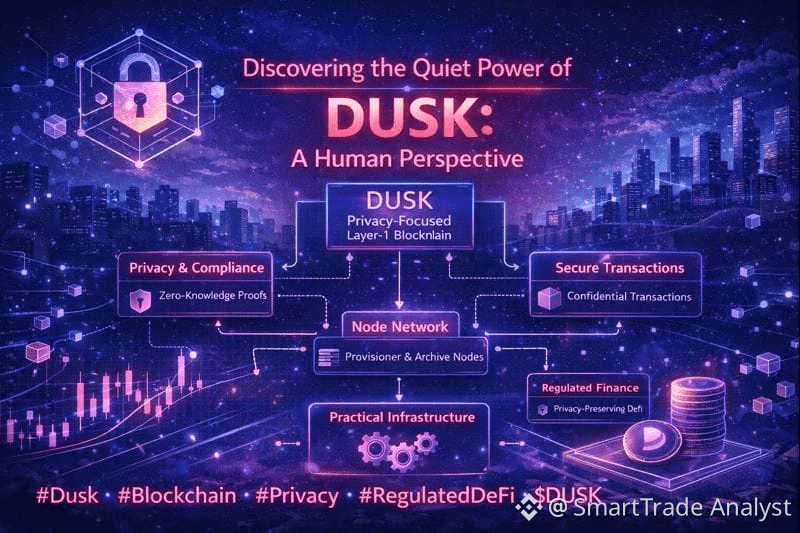
At its core, DUSK is a privacy-focused Layer-1 blockchain designed for regulated financial systems. Unlike many blockchains that emphasize public transparency, DUSK is built to respect confidentiality while still ensuring compliance and trust. Its architecture allows transactions, ownership, and verification to happen without exposing sensitive details, thanks to its innovative zero-knowledge technology. This balance between transparency and privacy makes $DUSK unique and highly practical.
One of the aspects I find most fascinating is the node system. DUSK supports multiple types of nodes, including provisioner nodes that participate in consensus and help validate transactions, and archive nodes that store detailed historical chain data for deeper insights. Running a node is not just technical; it’s part of the network’s lifeblood, ensuring that the blockchain remains decentralized, secure, and resilient.
Setting up a node, while technical, reveals the thoughtful design of DUSK. Operators can configure wallets, sync data efficiently, and maintain nodes with relative ease. The system is built to encourage participation while maintaining high standards of security and reliability. For anyone interested in contributing to blockchain infrastructure or experimenting with regulated financial networks, this is a fascinating playground.
What resonates most with me, beyond the technical marvels, is the philosophy behind DUSK. In a world obsessed with immediate results and hype cycles, it is a network that rewards patience, understanding, and deliberate action. It encourages participants to look beyond short-term excitement and focus on sustainable growth, real usability, and long-term trust.
Another point worth highlighting is the network’s focus on regulated DeFi. By allowing confidential transactions that still comply with necessary regulations, DUSK provides a bridge between traditional financial systems and the decentralized world. This positions $DUSK not just as a blockchain, but as a practical infrastructure for the future of finance, where privacy and compliance can coexist.
In the end, DUSK makes sense when you step back from the noise. It’s not about instant thrills, but about building systems that endure, protect sensitive data, and maintain trust. It’s a quiet revolution, where real innovation happens behind the scenes. By exploring its nodes, privacy protocols, and real-world applications, it becomes clear that DUSK is not just another crypto project—it’s a foundational tool for the next generation of financial technology.
For anyone curious about practical, privacy-first blockchain technology, DUSK offers a unique opportunity. It combines advanced cryptography, thoughtful network design, and regulated DeFi functionality, all wrapped in a calm and deliberate ecosystem. Watching $DUSK evolve, I’ve come to appreciate that sometimes the most powerful innovations are the ones that don’t scream for attention, but simply work—quietly and effectively.