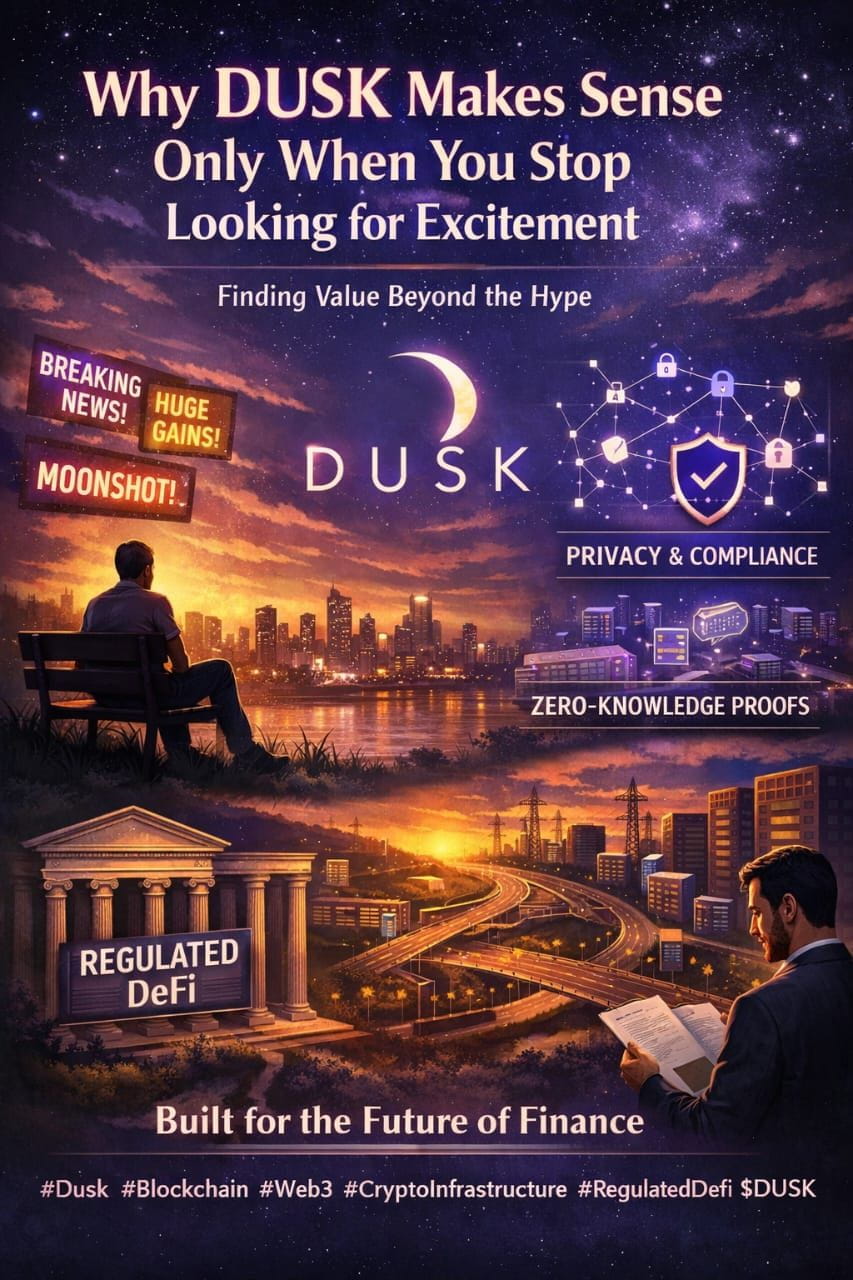
You know, the more I spend time in crypto, the more I realize how much we are trained to chase excitement. Every feed, every headline, screams “look at me!” and promises something dramatic. We scroll, we skim, and if something isn’t loud or flashy, we move on. That’s exactly how I felt the first time I came across @dusk_foundation. DUSK didn’t make me feel a rush. There was no flashy announcement, no viral hype. Honestly, I almost ignored it. And then I realized: I was judging it all wrong.
Once I slowed down and actually tried to understand what $DUSK is, things started to click. The #dusk network doesn’t try to grab attention, and that’s the point. It feels like a project for people willing to think a little deeper, people who understand that real finance is complicated, and that complexity doesn’t need to be simplified into clickbait. It isn’t about trending—it’s about building something that actually works for systems that matter.
At its heart, DUSK is a privacy-focused Layer-1 blockchain built for regulated financial activity. That means it’s designed for real-world use cases like digital securities and compliant decentralized finance. What makes it different is how it balances privacy with transparency. On most blockchains, everything is public, and “trust” is assumed to come from visibility. DUSK flips that. You can prove compliance, verify transactions, and follow rules—all without revealing your private financial information. For anyone who’s ever worried about sharing too much data, this immediately feels important.
One of the features I really admire is its use of zero-knowledge technology. At first, it sounds abstract and technical, but what it really means is simple: you can prove that something is true without showing all the details. Compliance can be verified, ownership confirmed, and rules enforced—without exposing internal information. For me, this makes DUSK feel thoughtful, almost human. It respects boundaries. It understands that privacy isn’t optional—it’s essential.
Another thing that struck me is how DUSK handles regulation. So many crypto projects treat regulations as annoying obstacles or try to ignore them entirely. DUSK does the opposite. It accepts that oversight exists and builds systems to work within it. That approach feels calm, deliberate, and surprisingly mature for the crypto world. It doesn’t shout about “breaking the rules”—it quietly makes sure the rules can be followed, and still lets innovation happen.
The more I think about DUSK, the more I see it as infrastructure rather than a product. Infrastructure rarely makes headlines, but it’s what everything else relies on. Roads don’t entertain you, electricity doesn’t excite you, and yet life becomes impossible without them. DUSK feels like that for regulated financial activity. It quietly supports systems that need trust, verification, and privacy—and that makes it far more powerful than the loud projects we usually notice.
What I love about DUSK is that it doesn’t pressure you. There’s no rush, no urgency to “get in now.” It rewards patience, curiosity, and careful thought. The longer you explore it, the more its philosophy makes sense. It’s about long-term usefulness, not quick wins. And in a world full of instant reactions and hype cycles, that calm presence is refreshing. You start to appreciate it not because it shouts, but because it works.
In the end, DUSK makes sense only when you stop chasing hype and start thinking about real-world impact. It’s not here to entertain or make you feel a high—it’s here to quietly build something that can last, something you can rely on. When you understand its privacy features, its regulated DeFi capabilities, and its Layer-1 infrastructure, it starts to feel less like another crypto project and more like a tool that the future of finance might actually depend on. And once you see it that way, the quiet makes perfect sense.