We live in an age of staggering abundance. A tap brings a universe of content, a global marketplace, a cacophony of voices and visions. Yet, within this endless digital expanse, a peculiar emptiness can take root. It is the feeling of scrolling, endlessly, through a landscape where everything is available but nothing seems to matter. We have conquered scarcity, only to find ourselves adrift in a sea of undifferentiated plenty, longing not for more options, but for meaningful ones. The great challenge of our connected world is no longer access; it is discovery. How do we find the signal in the noise? How do we stumble upon the community, the art, the tool, or the idea that truly resonates, that feels less like content and more like a discovery?
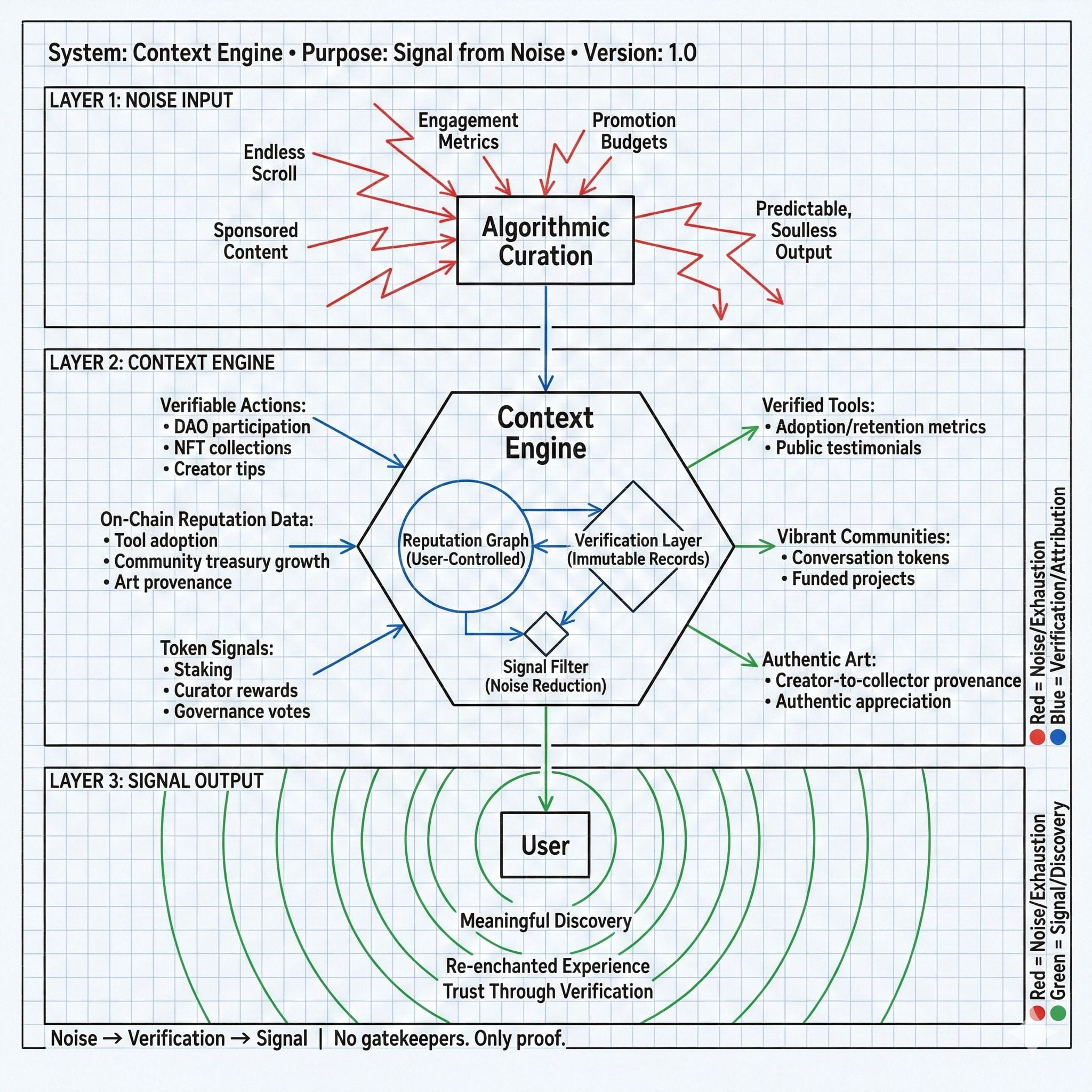
This fatigue is the silent tax of the algorithmic age. Our digital journeys are increasingly curated by opaque systems designed to capture attention, not to cultivate it. We are fed what keeps us watching, not what helps us grow. The serendipity of stumbling upon a small artist, the trust in a community-vouched tool, the genuine connection in an un-gamed forum—these experiences feel increasingly rare. Our digital worlds have become efficient but soulless, predictable but devoid of magic. We yearn for spaces where discovery feels human again, where value is signaled by passion and participation, not just by promotion budgets and engagement metrics.
What if the next foundational layer for the decentralized world wasn't just about moving value, but about revealing it? What if, beyond the ledger of transactions, we could build a living map of reputation, a dynamic tapestry of human interest and verified quality? This is the shift from a simple database to a context engine. It imagines a network that doesn't just process what you own, but understands what you seek and helps you find it in a landscape built on transparent participation.
Imagine exploring a digital realm not through a centralized, ad-driven portal, but through a lens of curated trust. You seek a new tool for digital collaboration. Instead of sifting through sponsored search results, you query a network where every tool's reputation is built from immutable, verifiable records of its use—how many teams adopted it, how long they retained it, the public testimonials they left on-chain. You are not shown what paid the most to be seen; you are shown what has proven itself to be valuable, its history etched in the unchangeable ledger. This is discovery backed by proof, not promotion.
Or picture finding a community. You don't stumble upon it via a random suggestion, but you can see its vitality mapped in real-time—the flow of meaningful conversation tokens, the growth of its shared treasury, the projects its members have collectively funded and completed. The community's footprint is its credential. You discover art not because an algorithm thinks you'll click, but because you can trace its journey from creator through a chain of collectors, seeing the authentic appreciation it garnered along the way. The "noise" of empty hype is filtered out by the silent, cumulative weight of real interaction.
This requires a network that is inherently attributive. Every action, from joining a DAO and contributing code, to collecting an NFT and tipping a creator, becomes a verifiable data point. These are not surveillance metrics, but voluntary, portable badges of participation. They form a rich, user-controlled graph of interest and reputation that travels with you across applications. The system's native token becomes the key to this economy of attention. It is used to signal value through staking on promising projects, to reward genuine curators who separate brilliance from bluster, and to govern the parameters of this discovery layer itself. It moves the power of what gets seen from centralized gatekeepers to a decentralized collective of engaged participants.
The emotional impact of this is a re-enchantment of the digital experience. It replaces the exhaustion of the endless scroll with the joy of the meaningful find. It swaps the feeling of being marketed to with the empowerment of being able to search through, armed with tools of verification. It fosters environments where quality rises to the top not because it is loud, but because it is demonstrably true, useful, or beautiful. This is how technology can cultivate culture rather than just commodify attention.
We are moving beyond building mere platforms for transaction. We are beginning to architect grounds for discovery. The goal is a digital commons where the pathways to value are illuminated not by the brightest ad, but by the accumulated light of a thousand honest interactions. It is a world where you can once again lose yourself in exploration and truly find something—a community, a creator, a tool—that changes your trajectory. This is the promise of a decentralized future that understands a profound human truth: that our greatest journeys begin not when we are given a destination, but when we are given a trustworthy compass and a map still being drawn by explorers like us.