
For a long time, Web3 defined itself by contrast. Faster than traditional systems. More open than centralized platforms. More transparent than legacy finance. That framing made sense in the early days, when proving that decentralized technology could even work was the primary challenge. But as the ecosystem matured, something became increasingly obvious. Being different is not the same as being useful.
This is where Vanar Chain enters the conversation in a way that feels less like disruption and more like correction.
Vanar does not begin with finance as its central narrative. It begins with experience. How people interact with digital environments. How creators build immersive worlds. How users engage with games, media, and interactive systems without wanting to think about infrastructure at all. In many ways, Vanar starts from the assumption that blockchain has already proven itself technically. The harder question now is whether it can integrate naturally into how digital life actually works.
I’m seeing Vanar as part of a broader shift in Web3 thinking. Instead of asking users to adapt to blockchain, it asks how blockchain can adapt to users. That change in perspective sounds subtle, but it reshapes everything that follows.
Gaming and immersive media are unforgiving environments. A delayed action breaks immersion. A failed transaction interrupts flow. High fees destroy engagement. Traditional blockchains, even well-designed ones, often struggle here because they were not built with these constraints in mind. Vanar treats these constraints not as edge cases, but as core requirements.
This focus on performance is not about chasing benchmarks or marketing metrics. It is about preserving experience. In gaming, players do not tolerate friction. In entertainment platforms, users expect immediacy. In AI-driven applications, responsiveness is not optional. Vanar’s infrastructure choices reflect an understanding that Web3 will not be adopted through ideology alone. It will be adopted when it feels invisible.
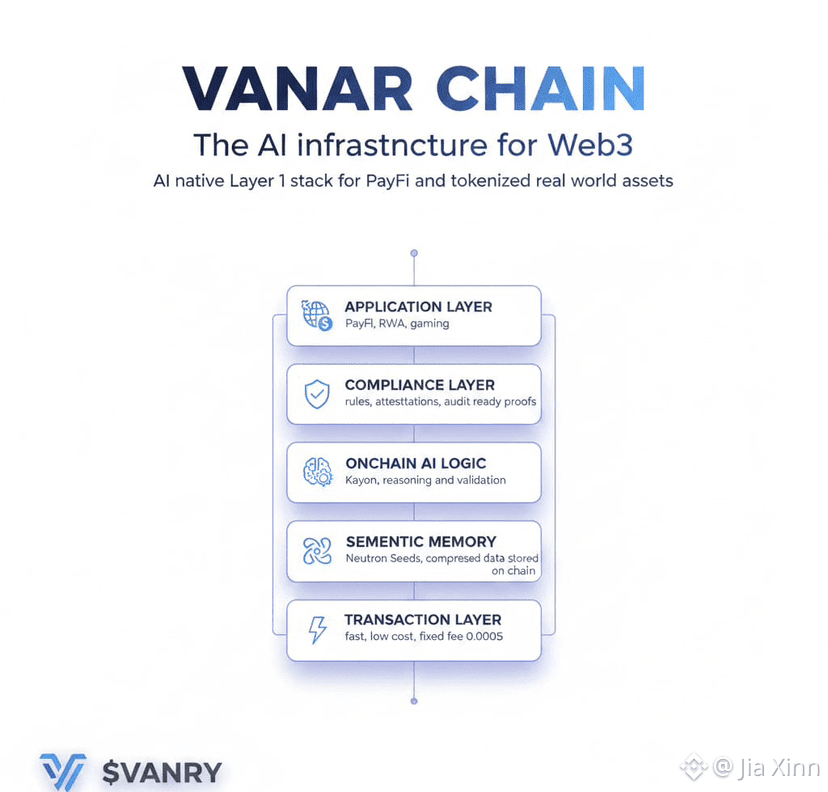
What stands out is that Vanar does not frame blockchain as the main attraction. It treats it as a background layer. Ownership, logic, and value transfer happen quietly while applications take center stage. This is the opposite of how many Web3 projects position themselves, where users are constantly reminded that they are interacting with a blockchain.
I’m noticing that this restraint is intentional. Vanar appears to recognize that mainstream users do not want to learn new mental models just to enjoy digital experiences. They want systems that behave predictably and disappear into the background. That philosophy influences not just performance goals, but also developer tooling and ecosystem design.
Creators are another important part of this story. Web3 often claims to empower creators, but the reality is that building decentralized applications remains complex and expensive. Many creators default to centralized platforms not because they prefer them, but because they are easier to use and scale. Vanar’s approach suggests an attempt to reduce that gap by providing infrastructure that supports creators without demanding deep blockchain expertise.
This becomes increasingly important as digital creativity evolves. AI-generated content, interactive storytelling, and virtual environments are becoming more common. These systems require infrastructure that can handle dynamic data, frequent state changes, and real-time interactions. Vanar’s design choices suggest awareness of this future, where blockchain is one component of a much larger creative stack.
Another aspect that feels important is Vanar’s attitude toward specialization. Web3 spent years building general-purpose chains that attempted to serve every use case at once. That approach worked during early experimentation, but it becomes inefficient as the ecosystem matures. Not every chain needs to do everything. Vanar appears to be carving out a role focused on experience-heavy applications where performance and usability matter more than generalized flexibility.
I’m seeing this specialization as a sign of maturity rather than limitation. Infrastructure becomes stronger when it is designed with clear use cases in mind. By focusing on gaming, media, and immersive environments, Vanar avoids spreading itself too thin. It builds depth instead of breadth.
There is also a long-term cultural dimension to this approach. Games and media are not just products. They are shared spaces where communities form, identities develop, and stories unfold over time. Infrastructure supporting these spaces needs to be stable, reliable, and forgiving. Systems that break unexpectedly or impose friction at critical moments erode trust quickly. Vanar’s emphasis on reliability reflects an understanding of this emotional layer.
I’m also noticing how Vanar positions itself relative to Web2 rather than against it. Many Web3 narratives frame legacy platforms as enemies to be replaced. Vanar’s approach feels more integrative. It asks how blockchain can enhance existing creative workflows rather than forcing total reinvention. This makes adoption more realistic for studios, developers, and creators who already operate at scale.
As Web3 moves closer to mainstream audiences, this integrative mindset becomes increasingly important. Adoption rarely happens through radical replacement. It happens through gradual improvement. Systems that slot naturally into existing workflows are far more likely to gain traction than those that demand ideological commitment.
Vanar’s focus on efficiency and scalability also has economic implications. High fees and unpredictable costs make it difficult to build sustainable user-facing applications. By prioritizing cost-effective execution, Vanar supports models where users can interact freely without constantly evaluating whether an action is worth the fee. This is essential for environments where engagement is continuous rather than transactional.
Looking ahead, the success of Vanar will not be measured by short-term hype or speculative interest. It will be measured by whether creators continue building on it, whether users remain engaged over time, and whether applications feel better, not worse, because blockchain is involved. These are slow metrics, but they are the ones that matter for long-term relevance.
I’m seeing Vanar as part of a quiet evolution in Web3. Away from proving that decentralization is possible, and toward proving that it can be practical, enjoyable, and sustainable. That evolution does not produce dramatic headlines, but it produces systems that people actually use.
As digital experiences become more immersive and interactive, the infrastructure supporting them must evolve as well. Vanar Chain represents an attempt to meet that challenge by aligning blockchain technology with how people actually interact with digital worlds.
Sometimes progress in technology does not look like acceleration. Sometimes it looks like refinement. Removing friction. Simplifying interaction. Letting systems fade into the background while experiences take the spotlight.
Vanar is being built with that understanding.
If Web3 is going to move beyond its experimental phase and become part of everyday digital life, it will need infrastructure that respects usability as much as ideology. Vanar Chain appears to be taking that path, quietly, deliberately, and with a clear sense of what matters next.
