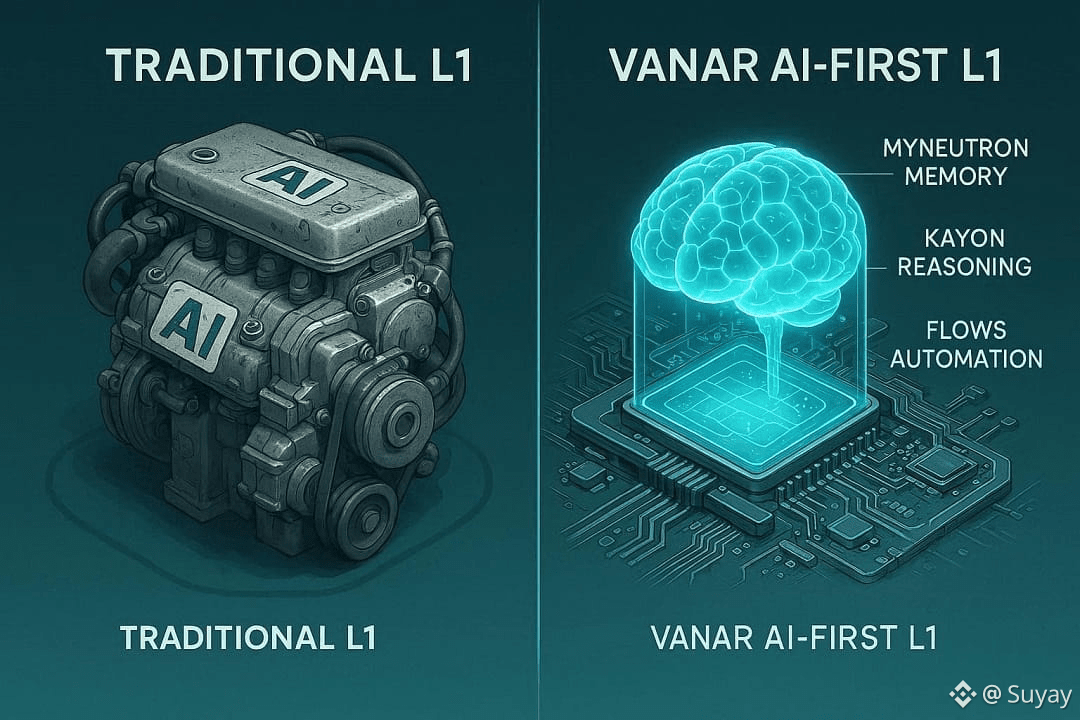
In the current blockchain gold rush, "AI" has become the most overused buzzword in the industry. Almost every legacy Layer 1 is now scrambling to announce an AI integration, a partnership with a compute provider, or a new marketing narrative. However, there is a fundamental difference between a blockchain that tries to retrofit AI into its existing structure and one that was built from the ground up to support it. This is the debate of AI-First vs. AI-Added, and for the future of decentralized intelligence, architecture is everything.
The Problem with "AI-Added" Retrofitting
Most blockchains were designed for a world of human-to-human or human-to-contract interactions. Their architecture focuses on things like transaction signing, wallet-based UX, and linear data storage. When these chains try to "add" AI, they usually do so through external layers. They use oracles to fetch data or sidechains to process logic.
The result? Fragmentation. An AI agent living on an "AI-Added" chain has to constantly jump through hoops—bridging assets, waiting for external data validation, and dealing with a user interface (wallets and private keys) that was never meant for an autonomous machine. It is like trying to install a modern electric engine into a 1950s car chassis; it might move, but it will never reach its true potential.
Vanar’s AI-First Philosophy: Beyond the Narrative
Vanar Chain represents a paradigm shift. Being "AI-First" means that intelligence is not a feature; it is the foundation. Vanar doesn't just "support" AI; it provides the native environment where AI can actually live and breathe. According to Vanar’s technical documentation, true AI readiness requires four pillars: memory, reasoning, automation, and settlement.
While legacy chains focus on TPS (Transactions Per Second), Vanar focuses on IPS (Intelligence Per Second). It recognizes that for an AI agent to be truly useful, it needs more than just a fast database; it needs persistent context and the ability to execute complex logic without human intervention.
The Trio of Innovation: myNeutron, Kayon, and Flows
To understand why Vanar’s architecture matters, we must look at the native products that prove its readiness. These aren't just concepts; they are the pillars of the Vanar ecosystem:
myNeutron (Persistent Memory): AI agents are often "stateless"—they forget what they did five minutes ago unless they are fed massive amounts of data. myNeutron provides semantic memory and persistent context at the infrastructure layer. This allows an AI agent on Vanar to "remember" past interactions and learn over time, creating a level of personalization and efficiency impossible on traditional L1s.
Kayon (Native Reasoning): Most blockchain logic is "if-this-then-that." It is rigid. Kayon brings reasoning and explainability natively on-chain. This means AI models can process complex variables and provide a rationale for their actions, ensuring that decentralized intelligence is not just powerful, but also transparent and verifiable.
Flows (Autonomous Automation): This is where intelligence turns into action. Flows allows for safe, automated execution. An AI agent can monitor market conditions, social trends, or on-chain data and execute trades or mint assets autonomously, all while staying within the security parameters of the Vanar protocol.
The Settlement Gap: Why AI Agents Hate Wallets
Perhaps the most significant architectural advantage of Vanar is how it handles settlement. Standard Web3 UX is built for humans—we love clicking "confirm" on a Metamask popup. AI agents do not. They require frictionless, global settlement rails that can handle thousands of micro-transactions per minute.
Vanar’s fixed-fee model ($0.0005 per transaction) and its integration with compliant payment rails ensure that AI agents can settle their own costs and trade value in real-time. By removing the "human-in-the-loop" requirement for transaction signing, Vanar becomes the first chain where an agent can be truly economically autonomous.
Conclusion: Investing in Readiness, Not Hype
The market is currently separating the "narrative" projects from the "readiness" projects. A project that adds AI to its roadmap to catch a trend is a narrative project. Vanar, with its live products and deep architectural integration, is a readiness project.
As we move into an era where AI agents will perform more on-chain transactions than humans, the underlying infrastructure must be ready. $VANRY is not just a token for a faster L1; it is the fuel for a chain that understands the language of machines. Architecture matters because, in the world of AI, you cannot fake native intelligence.