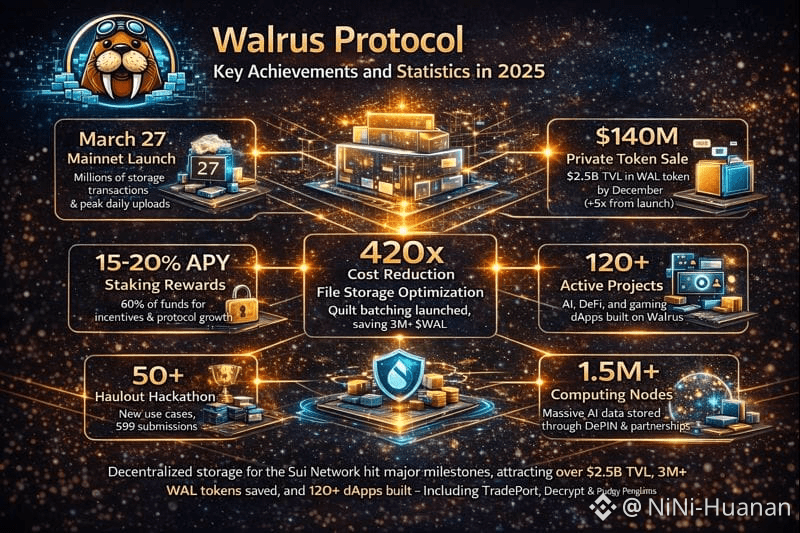
2025 was a pivotal year for the Walrus Protocol, a decentralized storage solution built on the Sui blockchain. Designed to handle large-scale data like AI datasets, videos, and NFTs with high efficiency and security, Walrus shifted from early testing to real-world adoption. This article breaks down the major milestones, backed by key stats, showing how Walrus became a cornerstone for Web3 data storage.
The year kicked off strong with the mainnet launch on March 27. This marked the transition from experimental phases to production use, allowing developers to store programmable blobs—large binary files—directly on a decentralized network. By the end of the year, Walrus had processed millions of storage transactions, with peak daily uploads exceeding thousands of blobs. The protocol's erasure coding technology ensured data reliability, achieving over 99.9% availability rates across its distributed nodes.
Funding was a big highlight. Walrus secured $140 million in a private token sale led by investors like Standard Crypto, a16z crypto, Electric Capital, and Franklin Templeton. This capital fueled ecosystem growth, with 60% of the funds allocated to protocol improvements and community incentives. The WAL token, launched alongside the mainnet, saw strong adoption: 4% of the total supply was airdropped to active users, and staking rewards averaged 15-20% APY in the first half of the year. By December, the token's total value locked hit $2.5 billion, reflecting a 5x growth from its initial listing.
Technological upgrades drove much of the progress. In July, Walrus introduced Quilt, a batch storage solution that grouped small files into single units, slashing overhead costs by up to 420x for 10KB blobs and 106x for 100KB ones. This saved users over 3 million WAL tokens in the first few months alone. Other enhancements included improved upload reliability and SDK refinements, making integration seamless for builders. As a result, more than 120 projects built on Walrus by year-end, spanning AI, DeFi, and gaming.
Partnerships expanded Walrus's reach. Deep integrations with Talus for AI agents, Itheum for data tokenization, and Pyth Network for decentralized pricing boosted functionality. Real-world apps like TradePort for NFT storage, Decrypt for censorship-resistant media, and Pudgy Penguins for heavy content migration showcased practical use. In the AI space, Walrus supported over 1.5 million computing nodes through DePIN, storing massive datasets for models and embeddings. Collaborations with Plume Network for real-world assets and Atoma for verifiable compute further solidified its role in emerging tech.
The Haulout Hackathon in late 2025 was a community triumph. It brought together Walrus, Seal for access control, and Nautilus for off-chain computation, resulting in 599 submissions across categories like data marketplaces and AI workflows. Winners included Storewave, a marketplace for unused storage space; TradeArena, an AI trading competition platform; and SuiVerify, a decentralized identity tool. These projects added over 50 new use cases, with hackathon participants contributing to a 30% spike in monthly active developers.
On the Sui ecosystem front, Walrus played a key role in broader growth. Sui processed 2.7 billion transactions in the first half of 2025, many involving Walrus-stored data. Institutional interest surged, with Grayscale launching the Walrus Trust, providing regulated exposure. Walrus also helped Sui's total value locked climb above $3.4 billion, including liquid staking, while stablecoin market caps on the network reached $1.15 billion.
Looking back, 2025 transformed Walrus from a promising protocol to a scalable powerhouse. With verifiable data ownership, low costs, and robust integrations, it handled billions in value and empowered hundreds of apps. As we head into 2026, these stats point to even bigger things ahead for decentralized storage.