
Cryptocurrency's promise of unrestricted money, free marketplaces, and unstoppable execution has long seemed straightforward. However, if you've spent years building, trading, or simply living online, you quickly discover that the majority of the globe still depends on shaky connections.
A chart you kept during a crazy week of liquidation. A research PDF that you distributed to a group. a dataset that you purchased. An NFT image that "exists on-chain," but one day inexplicably vanishes since the file was hosted in a regular location. This is the silent flaw in many Web3 systems: while the value layer is decentralized, the data layer is frequently not. Additionally, in markets, access breaks when data breaks. Trust is damaged when access is compromised.
The phrase "Walrus: One upload, infinite access" is therefore more difficult to understand than it first appears.
It doesn't sound like a convenience slogan. It seems to be a declaration about authority.
The actual issue that Walrus is highlighting
Decentralized storage is primarily about one harsh question when the marketing is removed:
Is it possible for a file to survive the organization that hosted it?
Because it is costly and ineffective, the majority of blockchain applications do not store large files directly on-chain. Thus, the "heavy" components—pictures, videos, documents, AI datasets, and community archives—are stored on conventional servers or in the cloud. A reference is stored in the chain. On the surface, it appears decentralized. However, the application becomes a skeleton as soon as the server is shut down. Tokens continue to move, but their surroundings disappear.
This isn't just a technical problem for traders and investors. It manifests itself in actual ways:
Stable access is essential for data pipelines and backtests.
The integrity of metadata is essential for tokenized assets.
Reliable datasets are essential for AI agents.
The availability of huge media is essential for consumer apps and gaming.
Document retrievability is essential for even basic due diligence.
Everybody has experienced the moment when something they depended on simply disappeared. The resource loads one day and displays a 404 error the following day. No one makes the announcement. No one pays you. It simply vanished. Walrus is working to eliminate that type of failure.
The true nature of Walrus (without the fog)
Walrus is a decentralized data availability and storage protocol for huge unstructured files (often referred to as "blobs") that don't belong in a typical blockchain transaction.
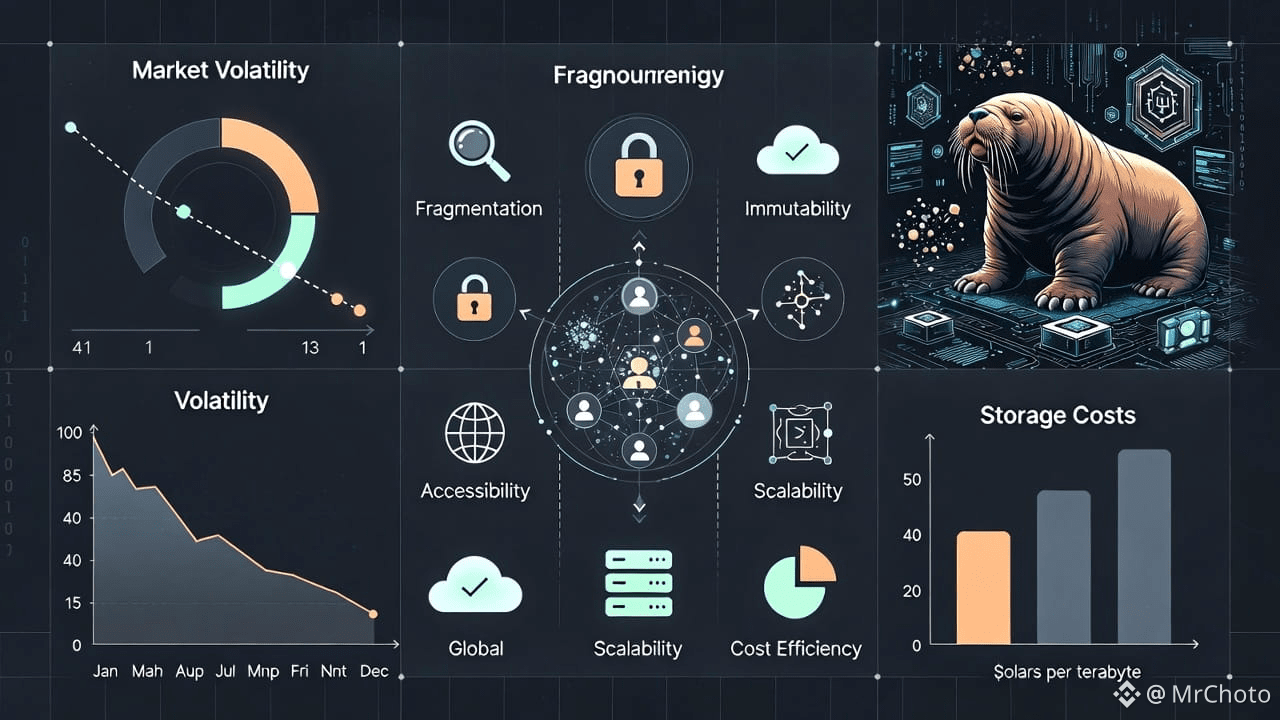
Walrus employs erasure coding, which is essentially a more intelligent kind of redundancy, rather than requiring each storage node to maintain a complete copy of a file (which quickly becomes costly).
The simple version is as follows:
One large file is uploaded.
Walrus splits it and encodes it into several pieces.
These pieces are dispersed throughout numerous separate storage nodes.
The entire file is not required by any one node.
Even if a large number of nodes fall offline, the system is still able to recreate the original file.
The core is that final point. Decentralization is more than just "many machines." It's survival in the face of failure. In trading, we evaluate a system at times of stress rather than on days of calm. Storage ought to be the same.
Walrus leverages the Sui blockchain as a control layer for economics and coordination, including storage obligations, incentives, and node lifecycle management. To put it simply, Sui assists Walrus in organizing who keeps what, for how long, and what occurs if they don't.
The realization of "one upload, infinite access"
Many individuals see this phrase as the cryptocurrency equivalent of Dropbox.
It goes deeper than that.
"One upload" aims to lower friction for both consumers and builders. Once you upload it, you can use it wherever. However, the emotional aspect is "infinite access," particularly for those who have experienced the agony of lost data.
Let's give it some substance.
Consider yourself a member of a serious trading community. You keep up a common library:
study of indicators
charts with annotations
strategic documents
models of risk
monthly recordings of market summaries
You are always one account issue away from losing history when using standard cloud storage. A shutdown, a compromised administrator, a policy change, a ban, a billing problem—anything. Communities have often experienced this, not just in the cryptocurrency space.
Your library is not dependent on permission from a single company when using a decentralized blob network. It turns into infrastructure.
That is the goal of "infinite access." It's not magically limitless. In a market sense, it is limitless and resilient to unfavorable circumstances.
WAL: Why is there even a token?
The token question is important from an investor perspective because storage networks collapse when incentives are lost.
Walrus employs WAL as the utility token linked to the protocol's economic payouts for network security, staking, and storage. Storage nodes invest WAL, are rewarded for their work, and run the possibility of being penalized for breaking agreements. Instead than focusing on feelings, this organizes the network around uptime and dependability.
From the perspective of "how this survives long-term," one aspect that I find appealing is that Walrus has discussed building its payment system so that storage costs can remain steady over time in fiat terms rather than fluctuating greatly due to changes in token prices. That may seem insignificant, but it's the kind of design element that determines whether something develops into actual infrastructure or remains a crypto experiment.
The distinct perspective that most people overlook: data turns into an asset class
If you've been keeping a close eye on the past two years, you've seen a change: data is becoming a more valuable asset than money.
Money moves quickly. Data endures.
AI is clearly the driving force behind models, agents, and automation pipelines that rely on datasets. However, this is also true in tokenized finance: each on-chain asset carries a shadow of metadata, papers, proofs, history, and compliance artifacts. The need for those artifacts to be durable will increase as regulated finance becomes more widespread.
Walrus offers more than just storage. Storage is being positioned as an ownable, programmable infrastructure.
Decentralized storage networks won't be "supporting tools" if that thesis is true. In the same manner as exchanges, stablecoins, and L1s become rails, they will be first-class rails.
The lesson for sincere investors
Walrus is not a pitch for a meme. It's a bet on infrastructure.
However, infrastructure bets are more successful when they are uninteresting and reliable than when they are noisy. Slogans are not the most important questions. They deal with reality:
Is it able to maintain file availability under pressure?
Can it continue to be economical at scale?
Is it able to draw in enough builders and nodes to be significant?
Is it possible for the incentive design to withstand bear markets?
Is it possible for it to become a standard storage layer rather than a specialized tool?
Volatility is the key when trading tokens. However, if you're investing in the concept, the long-term goal is a world in which cryptocurrency eventually stops acting as though decentralized money is sufficient and begins decentralizing data as well.
Because the memory of those markets—the files, the evidence, the databases, and the archives—must be serious if the next era of on-chain markets is to be serious.
And that's what "one upload, infinite access" truly promises: continuity rather than convenience. @Walrus 🦭/acc

