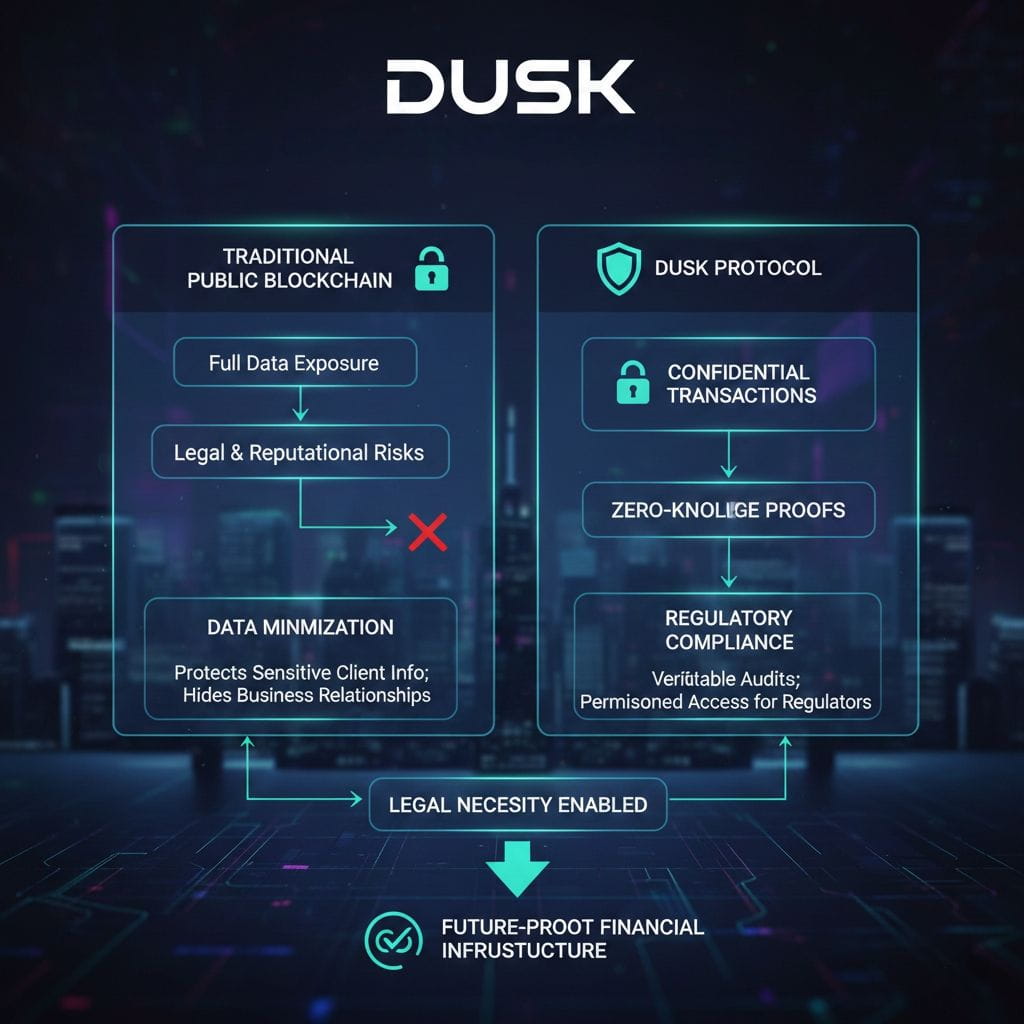
For years, transparency was treated as the safest option in blockchain design. If everything was public, the thinking went, trust would follow. But as blockchain technology moves closer to regulated financial markets, that assumption is being challenged. Today, full data exposure is no longer just a technical choice it is increasingly a legal risk.
Modern regulations emphasize data minimization. Institutions are expected to collect, process, and expose only what is strictly necessary. Public blockchains, where transaction details and account activity are visible to anyone, conflict with this principle. Even if no rules are broken, permanently exposing sensitive financial data can violate privacy obligations and create long-term legal liabilities.
Dusk was built with this reality in mind. Instead of choosing between privacy and compliance, it treats privacy as the mechanism that enables compliance. Transactions on Dusk can remain confidential while still being verifiable. Cryptographic proofs allow institutions to demonstrate that legal and regulatory requirements are met without revealing identities, balances, or transaction details to the public.
This approach reduces legal risk in practical ways. Sensitive client data is not broadcast on-chain. Business relationships are not exposed to competitors. Internal financial flows cannot be reconstructed by third parties years later. At the same time, auditors and regulators can still verify compliance when required, using permissioned access and mathematical proofs rather than raw data disclosure.
As laws continue to evolve around data protection and financial privacy, infrastructure must evolve with them. Dusk’s privacy-by-design model reflects this shift. By aligning blockchain verification with legal principles of confidentiality and proportional disclosure, Dusk makes privacy not a workaround but a legal necessity built directly into the system.