
Executive Summary
DeAgentAI has built a technically advanced decentralized AI agent coordination framework, but faces significant challenges in token economics sustainability and ecosystem adoption. The protocol addresses three core challenges for AI agents in distributed environments—consensus uncertainty, identity consistency, and state continuity—through its innovative Lobe-Executor-Committer three-layer architecture, demonstrating genuine technical originality. The $AIA


token currently has a market cap of $30.7M, FDV of $305M, and 24-hour trading volume of $93.78M, indicating extremely high market activity. However, the team and investors hold 39% of tokens with concentrated unlock risks, and ecosystem adoption remains in early stages, making this a high-risk, high-potential-reward investment. Institutional investors are advised to adopt a cautious wait-and-see approach until clearer adoption signals and token economics improvements emerge.
1. Project Overview
DeAgentAI is a decentralized AI agent infrastructure protocol designed to address three core challenges for AI agents in Web3 environments: consensus uncertainty, identity consistency, and state continuity. The project has built a framework called the "Autonomous Execution Network" that enables AI agents to operate reliably and persistently on-chain as sovereign entities with self-sovereign identities.
Core Positioning: Unlike traditional AI agent frameworks, DeAgentAI focuses on providing a decentralized decision coordination layer for AI agents rather than simple automation tools. Its core value proposition is ensuring the verifiability and consistency of AI decisions through blockchain technology.
Development Stage: The project is in the early stage of transitioning from testnet to mainnet, with initial applications deployed in the Sui, BSC, and Bitcoin ecosystems, though large-scale adoption has not yet been achieved.
2. Technical Architecture and Framework Design
Core Architecture Components
DeAgentAI's technical architecture is built around three core modules, mimicking different functional regions of the human brain:
Lobe (Decision Center):
Serves as the AI's "prefrontal cortex," responsible for high-level decision making
Reduces variability in probabilistic models through entropy minimization decision mechanisms
Integrates zkTLS/zkML proof generation to ensure authenticity of model calls
Provides verifiable computation guarantees for inference correctness
Memory & Tools System:
Hierarchical storage architecture enables decentralized knowledge accumulation
Short-term memory automatically includes recent N interactions for immediate conversational context
Long-term memory searches complete history through Retrieval-Augmented Generation (RAG) mechanisms
Built-in tools include distributed data queries, web access, and decision plugins
MPC Trusted Execution System:
Achieves trustless execution through Multi-Party Computation (MPC)
Committers form MPC groups to manage cryptographic keys for agent capabilities
Ensures sensitive operations require no single participant to hold complete authority or private keys
Provides enhanced security and decentralized control
Agent-to-Agent (A2A) Protocol
The A2A communication protocol supports complex collaboration, delegation, and emergent system behaviors:
Enables direct inter-agent interaction through underlying distributed systems
Supports patterns including information exchange, task delegation, coordinated actions, and negotiation
Ensures inter-agent communications are verifiable and consistently integrated into each participating agent's state history
Technical Differentiation
Compared to traditional AI agent frameworks, $AIA core differentiation lies in:
Decentralized Verification: Validates AI outputs through blockchain consensus mechanisms rather than relying on centralized authorities
State Persistence: Provides reliable on-chain memory systems ensuring decision continuity
Cross-chain Interoperability: Supports operation across multiple blockchain ecosystems including Sui, BSC, and Bitcoin
3. Token Economics and Economic Design
Token Fundamentals
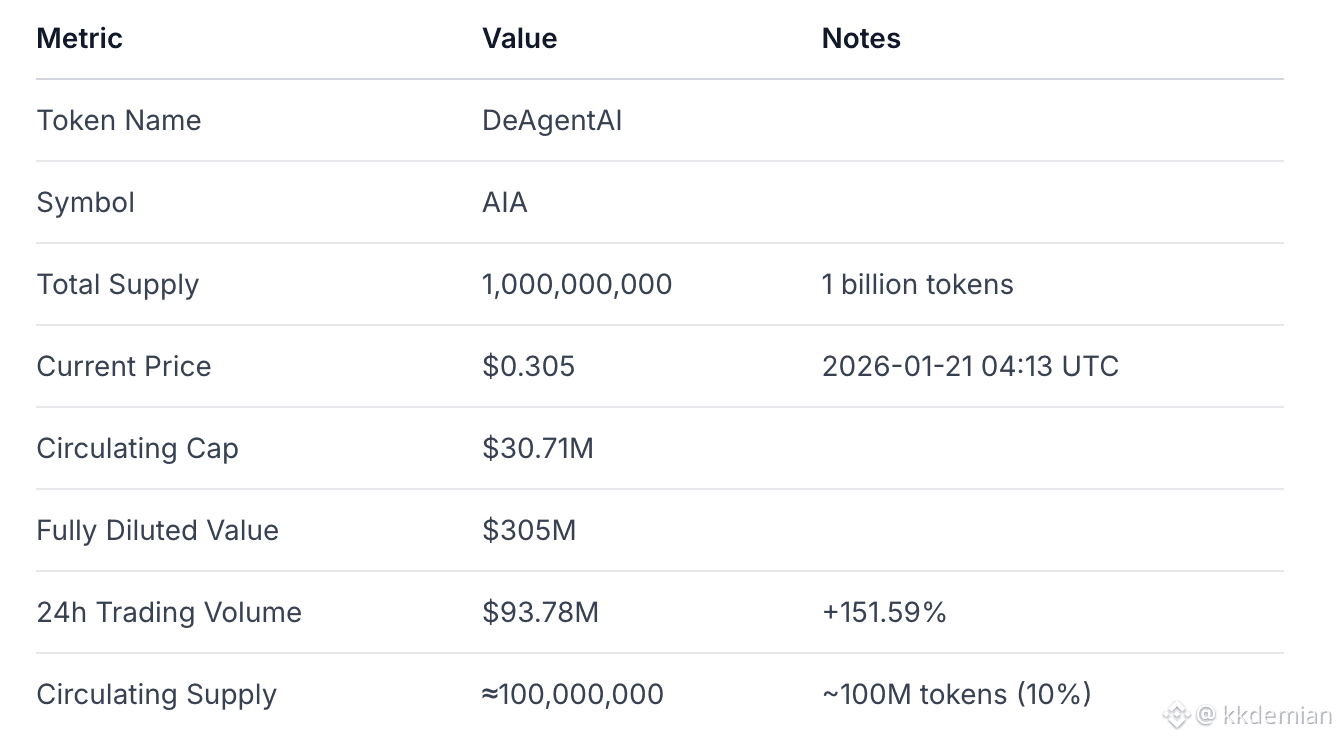
CoinGecko
Token Allocation and Economic Model
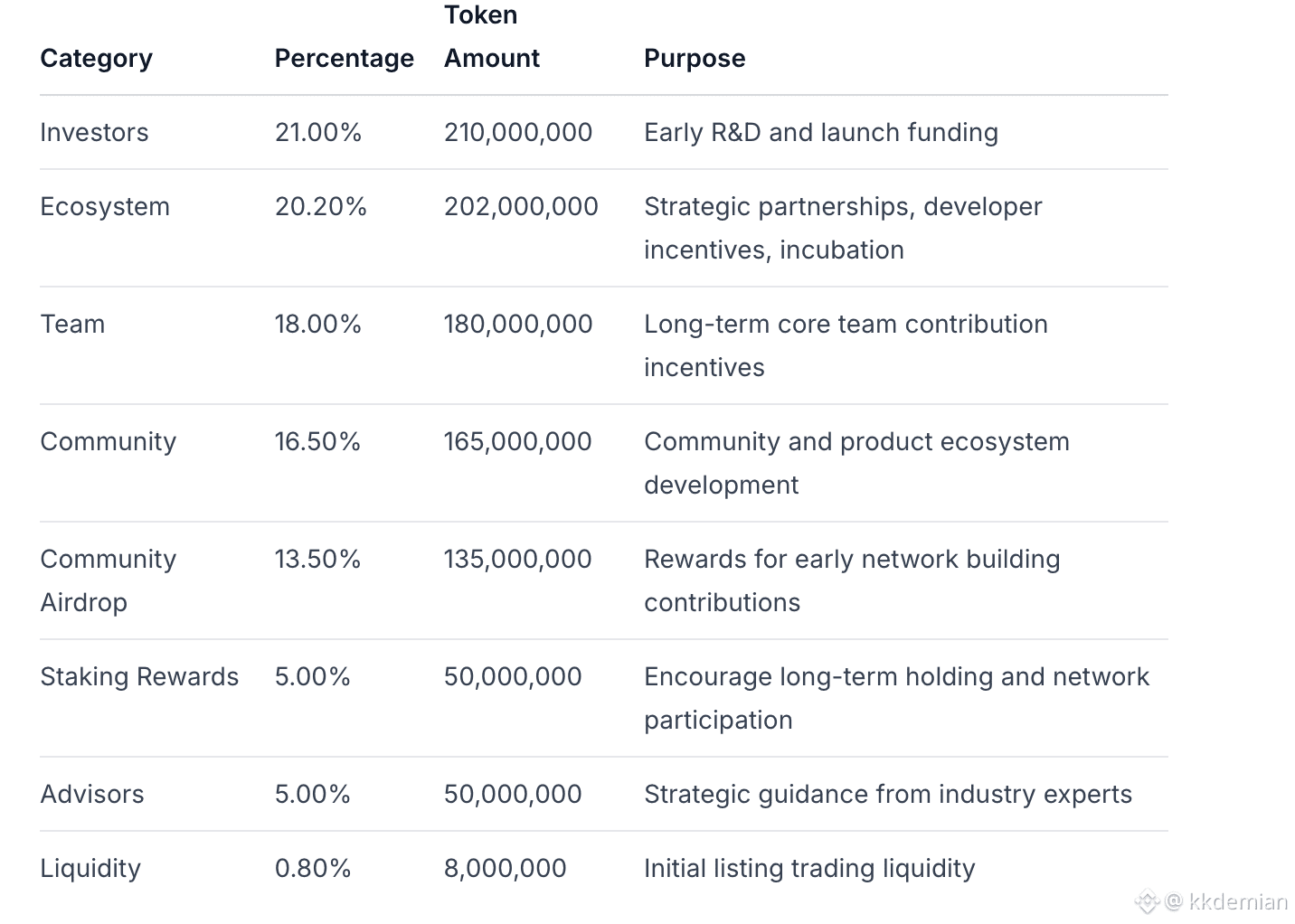
Token Distribution Structure:
DeAgentAI GitBook
Vesting Schedule:
Investors: 1-year cliff, followed by 3-year linear vesting
Team: 1-year cliff, followed by 3-year linear vesting
Ecosystem: Partial unlock at TGE for initial bootstrapping, core allocation locked long-term with 3-year linear vesting
Community Airdrop: Phased programmatic release over 2 years
Staking Rewards: Phased programmatic release over 1 year
Token Utility and Value Capture
Current Utility:
Network Service Medium of Exchange: Used for AI agent creation, subscriptions, invocations, and unlocking premium features
Staking Rewards: Users stake AIA to help secure the network and ensure data validation reliability
Basic Governance: AIA holders have voting rights on key foundation decisions and network parameters
Value Flywheel Design: DeAgentAI envisions an autonomous AI economy where the AIA token serves as the core economic bandwidth and value medium for the entire ecosystem. Through sophisticated incentive and value capture mechanisms, it deeply aligns the interests of all network participants (creators, users, validators, and AI agent trainers).
4. Agent Ecosystem, Users, and Adoption Signals
Existing Products and Adoption
AlphaX:
DeFi application running simultaneously on Bitcoin and BSC networks
Leverages AI agent infrastructure for autonomous trading strategies and portfolio management
Addresses issues of limited Bitcoin liquidity in DeFi and centralization risks of alternative venues
CorrAI:
Focuses on smart contract automation for the Sui ecosystem
Uses AIA for smart contract execution, eliminating the need for centralized intermediaries in transaction orchestration
Significantly improves transaction throughput and reduces operational costs of traditional manual contract management
Adoption Metrics:
Market Valuation: $30.71M (Rank #512)
Holder Addresses: ~1,101 active holders
Exchange Coverage: 6 exchanges, 8 trading pairs (4 active, 4 delisted)
Developer Ecosystem
Based on the depth and technical detail of the GitBook documentation, DeAgentAI demonstrates strong technical rigor:
Technical documentation comprehensively covers architecture design, token economics, and implementation details
Provides clear developer guides and integration examples
Multi-chain deployment support (Sui, BSC, BTC) demonstrates technical flexibility
Community and Market Sentiment
Recent Market Developments:
January 20, 2026: Binance relisted AIA perpetual contracts, triggering a price surge
January 16, 2026: Gate.io launched AIA/USDT perpetual contract trading
January 12-26, 2026: AIA Power Week in collaboration with AdaptHF, featuring $20,000 in prizes for community content creation
Social Media Sentiment: Twitter discussions show positive market sentiment, primarily centered around the Binance relisting catalyst:
19 high-engagement tweets within 24 hours, with total views exceeding 100,000
Community recognition of the project team's execution capabilities
Excitement around the "comeback narrative" (relisting after being delisted from exchanges)
5. Protocol Economics and Sustainability
Value Creation and Capture Mechanisms
DeAgentAI's economic model is designed around creating an autonomous AI economy, where value is primarily generated and captured through:
Protocol-Level Fees:
Agent creation and invocation fees: Paid in AIA tokens
Premium feature access: Requires staking or paying AIA tokens
Cross-chain operation fees: Fees generated from executing operations in multi-chain environments
Demand Drivers:
As the number of AI agents grows, demand for AIA tokens should theoretically increase
Staking mechanisms encourage long-term holding, reducing circulating supply
Governance rights give token holders the ability to influence protocol development direction
Sustainability Analysis
Strengths:
Multi-tier staking architecture provides flexible participation options
Long-term vesting schedule avoids short-term selling pressure
Protocol's built-in fee mechanisms are expected to create sustained demand
Challenges:
Current ecosystem adoption is low, limiting actual protocol revenue
Token vesting schedule may create long-term dilution pressure
Relies on ecosystem growth to justify current valuation
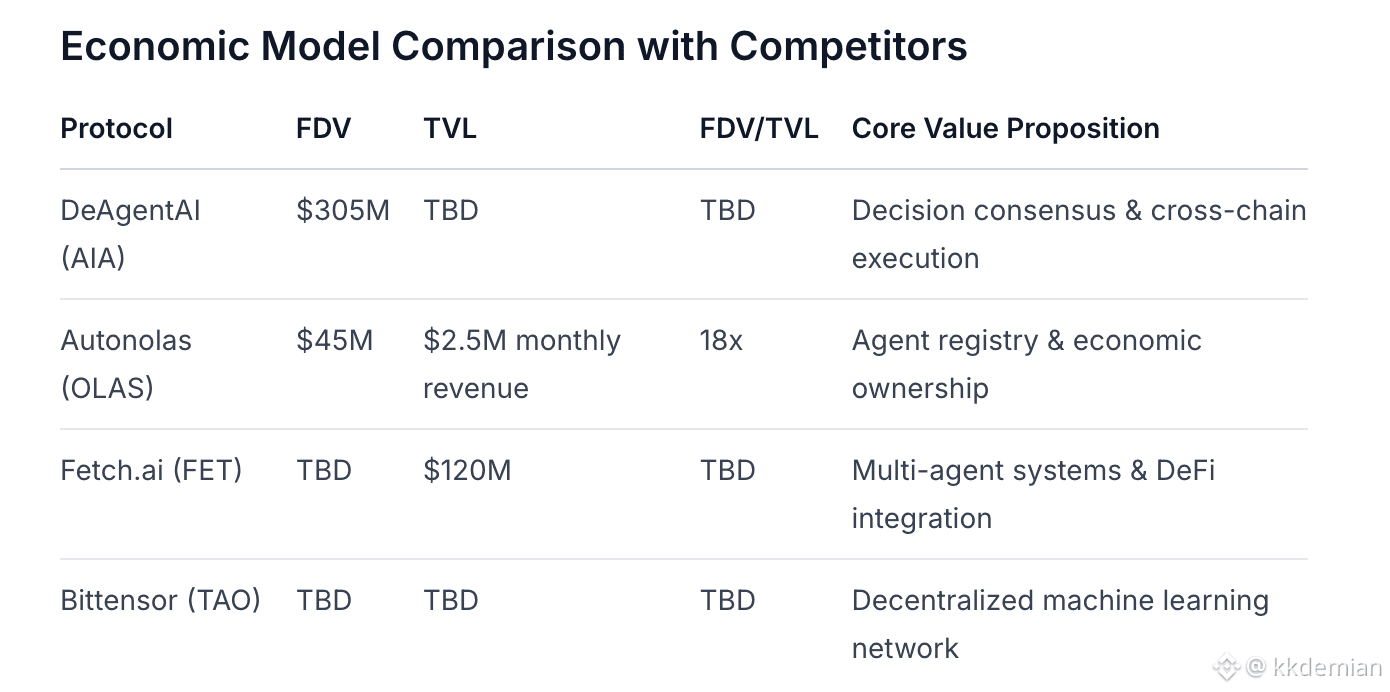
Economic Model Comparison with Competitors
6. Governance, Security, and Risk Analysis
Governance Structure
Current Governance:
Foundation-led governance model with team retaining significant control
AIA token holders have basic governance rights to vote on key decisions
Future plans to transition to a more decentralized DAO model
Governance Mechanisms:
Token-weighted voting system
Protocol parameters adjustable through governance proposals
Critical upgrades require community consensus
Security Architecture
Technical Security:
MPC execution layer eliminates single points of failure
ZK proofs ensure computational correctness
Decentralized verification network prevents manipulation
Economic Security:
Staking mechanisms encourage long-term participation and network security
Token vesting schedule aligns long-term interests
Multi-layer incentive structure reduces short-term behavior
Risk Factors
Technical Risks:
Challenges in verifying correctness of AI decisions
Adversarial agents could potentially compromise the system
Cross-chain coordination complexity may introduce vulnerabilities
Economic Risks:
Token Concentration: Top 10 addresses hold approximately 25%
Vesting Pressure: 39% of tokens will be released over the next 3-4 years
Insufficient Demand: Current ecosystem adoption is low with limited protocol revenue
Strategic Risks:
Large AI labs may commoditize agent frameworks
Open-source competitors may offer similar solutions
Regulatory scrutiny risks for autonomous agents
Competitive Risks:
Direct competition with projects like Autonolas, Fetch.ai, and Bittensor
Need to rapidly establish ecosystem moats and network effects
7. Project Stage and Strategic Trajectory
Development Stage Assessment
DeAgentAI is currently in the early ecosystem building stage, characterized by:
Completed Milestones:
Core protocol architecture design and implementation
Multi-chain deployment (Sui, BSC, BTC)
Initial token issuance and exchange listings
Basic developer documentation and tooling
Key Milestones Pending:
Full mainnet launch and adoption (Q1 2026)
Large-scale CorrAI DeFi tool adoption (Q2-Q3 2026)
AdaptHF integration and technical optimization (Q2 2026)
Ecosystem partner expansion (Throughout 2026)
DAO governance transition (Q4 2026)
Strategic Positioning Analysis
DeAgentAI positions itself as a decision coordination layer specialist in the AI agent space, with differentiated competition against:
vs Autonolas: More focused on decision verification rather than agent registry
vs Fetch.ai: More emphasis on cross-chain execution rather than multi-agent systems
vs Bittensor: More focus on decision consistency rather than machine learning models
Strategic Advantages:
First-mover technology in decision verification
Multi-chain architecture provides flexibility
Strong technical team and documentation
Strategic Challenges:
Need to rapidly establish ecosystem partnerships
Prove demand for real-world business use cases
Stand out in a crowded AI agent space
8. Final Investment Assessment
Dimensional Scoring (1-5 Scale)
Technical Architecture & Originality: 4.5/5
Innovative Lobe-Executor-Committer architecture design
Systematic approach to solving three core AI agent problems
Cross-chain execution capabilities demonstrate technical depth
AI Agent Framework Differentiation: 4.0/5
Unique positioning focused on decision verification
Clear differentiation from competitors
Multi-chain support provides strategic flexibility
Token & Incentive Design: 3.0/5
Economic model design is reasonable but carries concentration risk
Vesting schedule may create long-term selling pressure
Needs stronger value capture mechanisms
Ecosystem Expansion Potential: 3.5/5
Multi-chain deployment provides growth foundation
Existing products demonstrate practical value
Needs more ecosystem partners to prove viability
Competitive Positioning: 3.5/5
Has advantages in the decision verification niche
Faces competitive pressure from multiple directions
Execution speed will determine final market position
Governance & Execution Credibility: 4.0/5
Team demonstrates technical execution capabilities
Binance relisting shows market relationship capabilities
Needs more decentralized governance transition
Overall Score: 3.6/5
Investment Recommendation
Recommended Stance: Cautious Observation, Small Exploratory Position
Rationale: DeAgentAI demonstrates impressive technical depth and potential to solve real problems, particularly in AI agent decision verification and cross-chain execution. The team's technical execution capabilities and market resources (such as Binance relationships) have also been validated.
However, the project faces key challenges:
Token economics carry concentration and vesting pressure risks
Ecosystem adoption remains in very early stages
Competitive environment is intense, requiring rapid moat-building
Investment Strategy:
Short-term: Consider a small position, monitoring market momentum following the Binance relisting
Medium-term: Closely watch Q1 2026 mainnet adoption data and ecosystem partner progress
Long-term: Wait for token economics optimization and clearer adoption signals before increasing allocation
Key Monitoring Metrics:
Number of active mainnet agents and transaction volume
Actual protocol revenue generation capability
Progress on token holder decentralization
Quantity and quality of ecosystem partners
Data as of: 2026-01-21 04:13 UTC Data Sources: CoinGecko, DeAgentAI GitBook, CryptoRank, Twitter analysis, competitive protocol data