

Everyone keeps defending full replication as "simple and proven," but let's get real: simplicity at 25× overhead isn't a feature. It's a confession that you can't handle real scale. Walrus exists because infrastructure can't afford that tax anymore.
The Full Replication Myth
Here's what proponents won't admit: full replication works—for small networks and small datasets. Replicate across 25 nodes? Sure, simple. Replicate across thousands of nodes storing terabytes? The math breaks instantly.
Full replication means every node stores every piece of data. Claim 25× replication for Byzantine safety and you're saying each byte of user data costs 25 bytes of network storage. For a rollup trying to store transaction history affordably, that's crushing. For an archive protocol promising permanence, that's economically impossible.

The "simplicity" argument becomes absurd at scale. You're not simplifying the protocol—you're just hiding the cost in the economics. Someone's paying that 25× tax. Usually it's users through higher fees.
Why Traditional Consensus Uses Replication
The historical reason is defensible: Byzantine consensus protocols needed full replication because they lacked better tools. You could either replicate heavily or accept weaker guarantees. That constraint isn't technology—it's history.
We've moved past that constraint. Erasure coding, cryptographic verification, and intelligent repair have been theoretically sound for decades. The question isn't whether better approaches exist. It's why we keep defaulting to full replication when we know it doesn't scale.
The Real-World Failure Mode
Full replication fails gracefully in theory but catastrophically in practice. Here's what happens: you're storing 1 terabyte of data with 25× replication. That's 25 terabytes across the network. A node fails and takes a copy with it. The system reconstructs and you're back to 25 copies.
Sounds fine until you realize this happens dozens of times per day in real networks. You're spending massive bandwidth constantly reconstructing full copies. The overhead isn't just storage—it's computation and bandwidth and validator resources all burning on redundancy theater.
Add in validator churn—nodes joining and leaving constantly—and the reconstruction load becomes intolerable.
Why Walrus Exists: Economics at Scale
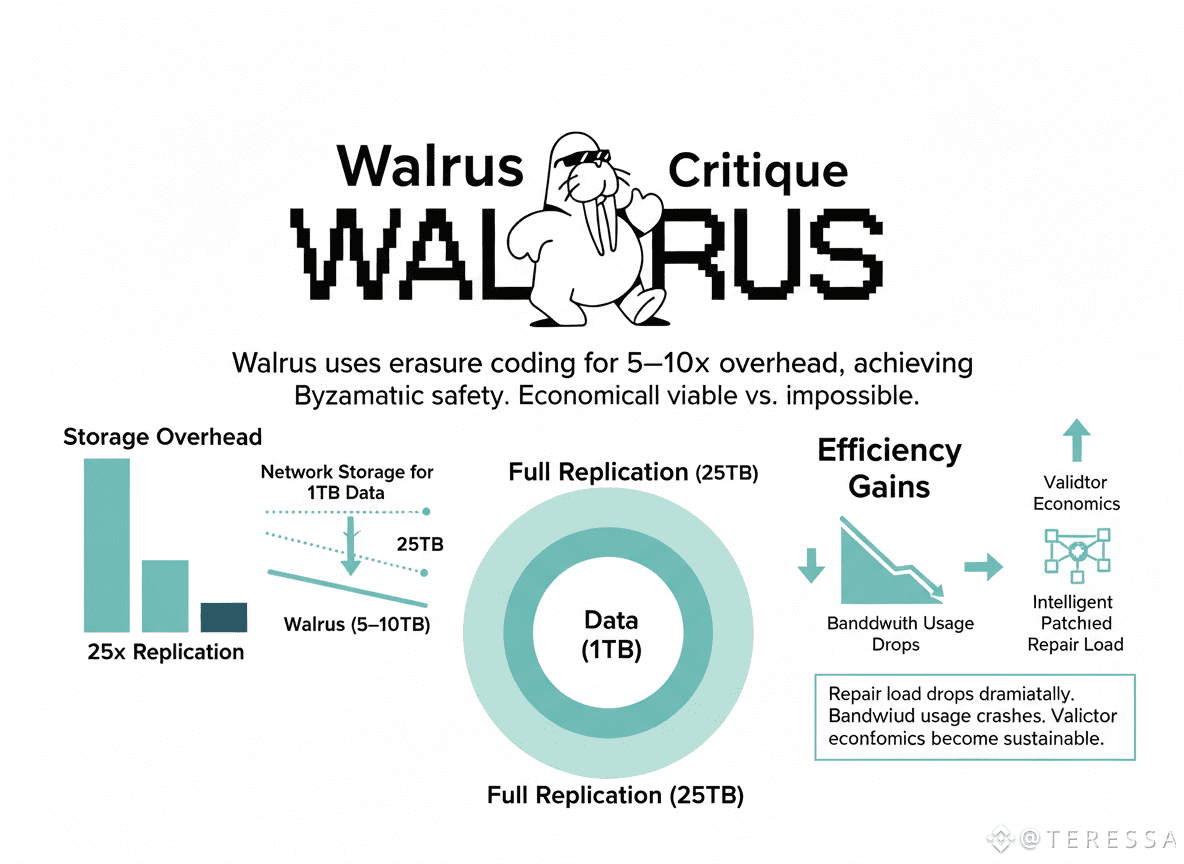
Walrus uses erasure coding to achieve the same Byzantine safety as 25× replication with 5–10× overhead. That's not a marginal improvement. That's the difference between economically viable and impossible.
With @Walrus 🦭/acc , that 1 terabyte of data costs 5–10 terabytes of network storage instead of 25. The repair load drops dramatically because you're not reconstructing full copies—you're intelligently patching missing pieces. Bandwidth usage crashes. Validator economics become sustainable.
This isn't theoretical. This is what enables real applications at real scale.
The Cognitive Bias Keeping Replication Alive
There's a cognitive bias protecting full replication from scrutiny: it's easy to understand. "Every node has every copy" requires no expertise to grasp. Erasure coding with Byzantine verification? That feels complicated.
But here's the truth: complex implementation beats simple overhead when scale is at stake. Users don't care that the system is theoretically simple if the economics are impossible. They care that storage works affordably and reliably.
Walrus trades simple for sustainable. That's a win in production infrastructure.
The Honesty Test
Ask yourself this: would you rather use storage with simple replication at 25× overhead, or sophisticated erasure coding at 5–10× overhead? Most people answer "I want the cheapest option that works." That's Walrus.
The only reason to defend full replication is if you're defending legacy systems or if you haven't thought about scale seriously.
What This Means for Future Infrastructure
The inflection point already happened. We collectively decided that storage overhead matters more than theoretical simplicity. Rollups are choosing Walrus over replication. Archives are choosing Walrus. Protocols that understand their economics are choosing Walrus.
This doesn't mean replication has no place. Small, specialized applications might choose simplicity over efficiency. But for Web3 infrastructure serving real users at real scale, the 25× overhead tax is unjustifiable.
Full replication is defended as proven and simple. It's also economically unworkable at scale. Walrus proves you don't have to choose between safety and efficiency. You get Byzantine fault tolerance with realistic overhead, repair mechanisms that don't burn the network, and economics that enable builders to actually ship applications. That's not theoretical advantage. That's real-world viability. For infrastructure that needs to serve Web3 at scale, this is non-negotiable.

