

A few years ago, I was working on a small side project that pulled in user-submitted images and short videos for a niche trading group. Nothing ambitious, but the storage problems showed up fast. Cloud bills crept upward without warning, and more than once an outage knocked files offline for hours. What bothered me was not just the inconvenience, but the contradiction. We talk about decentralization and permanence, yet the data most applications rely on still sits behind fragile, centralized gates. Putting everything onchain is not a real answer either. Costs explode, and networks bog down under data they were never meant to hold.
That tension is the core problem. Decentralized systems are excellent at agreeing on small pieces of state. They are terrible at holding large files for years without waste. Full replication across every node works for consensus, but it is impractical for datasets, media, or historical records. Developers end up compromising, pushing data offchain and hoping it stays there. The moment availability depends on goodwill or uptime promises, the trust model quietly breaks.
A simple way to picture the alternative is shared custody. Instead of copying an entire photo album for every person, you split it into pieces, add redundancy, and spread those pieces around. Lose a few, and the album can still be reconstructed. That is the basic idea behind erasure coding, and it is the foundation of what Walrus is trying to formalize.
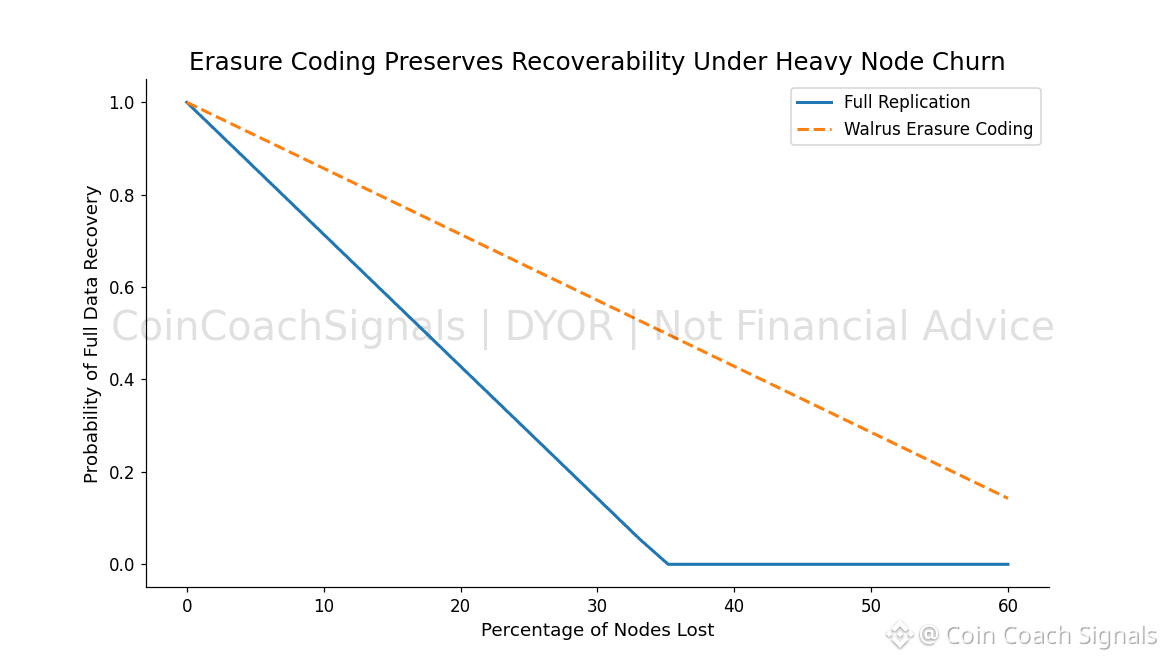
Walrus is built as a dedicated blob storage layer on top of Sui. Large binary objects, whether AI datasets, game assets, or archival data, are encoded using a two-dimensional erasure coding scheme known as Red Stuff. Data is split into slivers and distributed across specialized storage nodes rather than validators. Recovery only requires a subset of those slivers, which keeps redundancy around four to five times the original size instead of naive full replication. Sui itself does not store the data. It coordinates availability proofs, ownership metadata, and access rules through smart contracts, keeping verification onchain while storage remains external but accountable.
The design choice that stands out is how tightly storage is tied into the base chain’s logic. Blobs become programmable objects. Contracts can verify that data exists, extend its lifetime, or reference it directly, without pulling the data itself onchain. That makes storage feel less like an add-on service and more like a native extension of the execution environment.
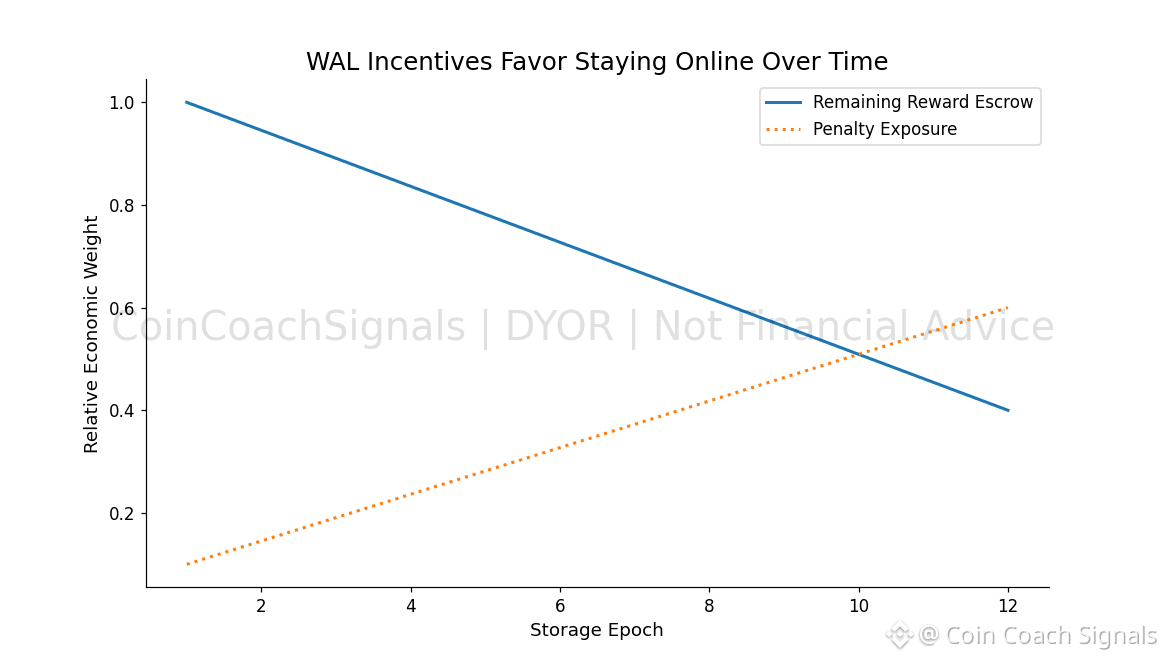
The $WAL token fits into this model without theatrics. It is used to pay for storage over fixed durations, to stake in support of storage nodes, and to participate in governance decisions such as tuning slashing or reward parameters. Rewards are tied to actual availability commitments, not speculative behavior. The token is there to align in practice, incentives so nodes stay online and data remains recoverable, not to manufacture demand.
From a market perspective, this approach has attracted attention. The team behind Walrus raised roughly $140 million from institutional backers, which signals confidence in the problem being worth solving. Current valuation places it firmly in mid-tier infrastructure territory. Not dominant, not obscure, and very much dependent on real usage inside the Sui ecosystem.
Short-term trading around infrastructure like this is usually noise. Price reacts to announcements, ecosystem momentum, or broader market swings. I have learned the hard way that those moves rarely reflect whether the system is actually being used. The longer-term question is simpler. Do developers rely on it. Do blobs accumulate. Do retrievals keep working when incentives fluctuate. If the answer stays yes, value accrues slowly and quietly.
There are obvious risks. Competition from Filecoin and Arweave is intense, with years of network effects behind them. Walrus also carries concentration risk. If too many storage providers leave at once, erasure coding thresholds can be stressed. A severe market downturn that triggers mass unstaking is the kind of scenario that really tests these guarantees.
This kind of infrastructure is not proven in months. It is proven in years, after hype fades and systems are judged by whether data uploaded long ago is still there when someone needs it. Walrus is making a clear bet that durability, verifiability, and boring incentive alignment matter more than spectacle. Whether that bet pays off will depend on usage, not narratives.
@Walrus 🦭/acc #Walrus $WAL