

Blockchain design usually follows habit.
A consensus model is chosen, throughput targets are set, virtual machines are tuned, and only later does the question arise: what will actually run on this system? By the time that question is asked, most architectural decisions are already locked in.
Vanar Chain breaks from that pattern in a subtle but consequential way. Its design order does not begin with block production or benchmark competition. It begins with an assumption about who — or what — will be operating on the network.
That assumption is not purely human.
An AI-first design order starts by acknowledging that future on-chain activity will not be dominated by manual interactions. Autonomous systems behave differently from users. They do not tolerate ambiguity, inconsistent state, or shifting execution rules. They do not pause between actions to re-authenticate intent. They expect continuity.
This changes what “infrastructure” even means.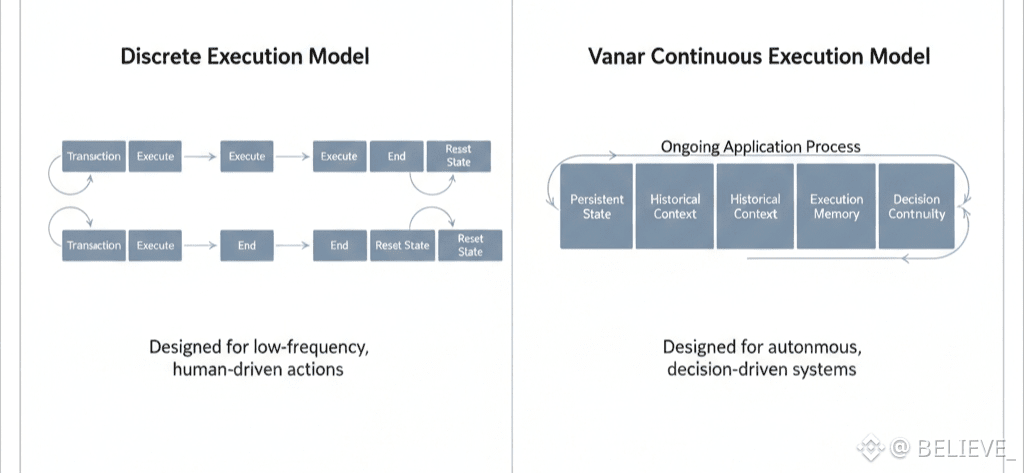
Most legacy chains were built for discrete execution. Each transaction stands alone. State exists, but context does not. That model works when interaction frequency is low and intent is explicitly re-declared every time. It begins to fail when behavior becomes continuous and decision-driven.
Vanar’s architecture reflects awareness of this shift. Instead of optimizing first for throughput, it optimizes for coherence. The system is designed so that applications can behave as ongoing processes rather than isolated calls. This is less visible than raw speed, but far more difficult to retrofit later.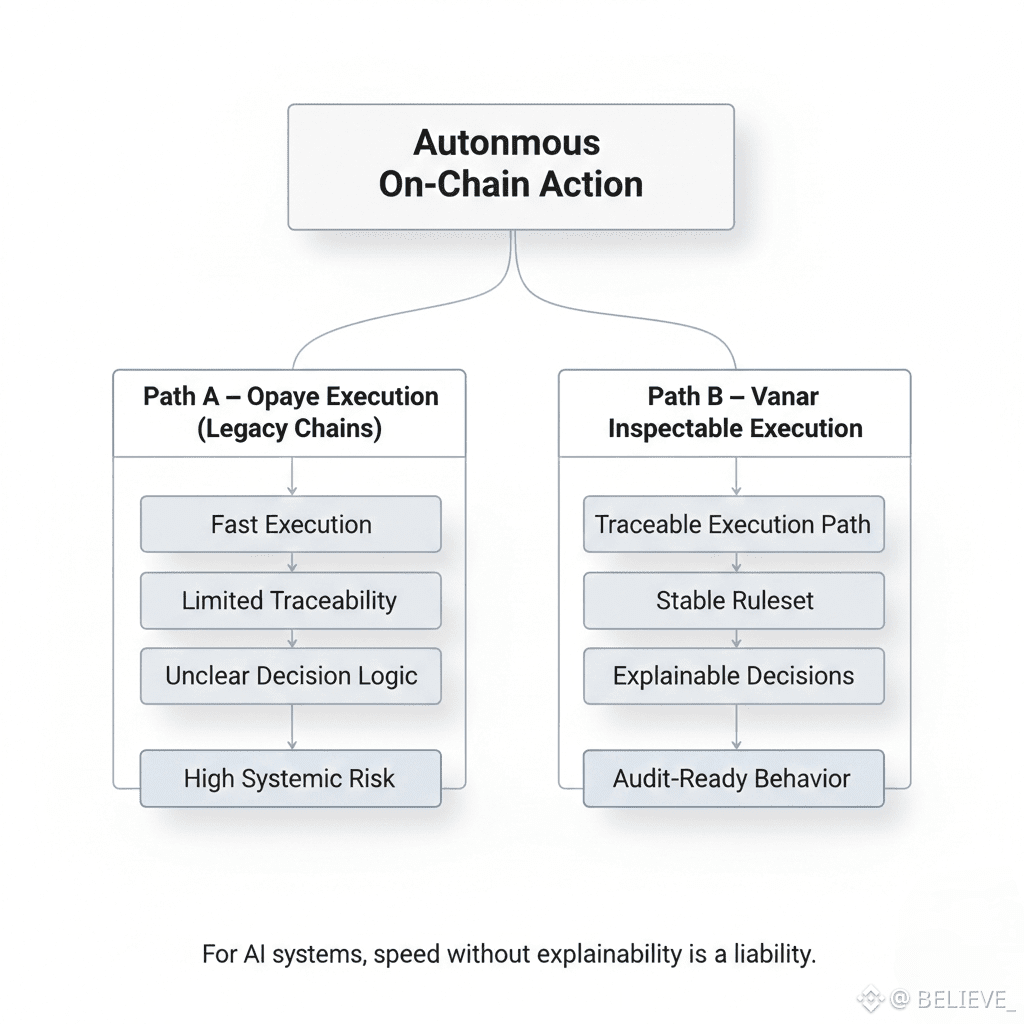
Another signal of Vanar’s AI-first thinking lies in how it treats execution transparency. Many chains focus on making execution fast, but not necessarily intelligible. For AI systems, that tradeoff is dangerous. Autonomous actions without explainability are liabilities, not efficiencies. When something goes wrong, the inability to trace logic becomes a systemic risk.
Vanar’s design emphasizes inspectable execution paths. Decisions are meant to be traceable, not opaque. This is not about academic purity. It is about making autonomous systems usable in environments where accountability matters — finance, brands, consumer platforms, and enterprise workflows.
There is also a noticeable restraint in how Vanar approaches flexibility. In crypto, flexibility is often celebrated as rapid change: frequent upgrades, parameter tuning, and evolving rulesets. For AI systems, that kind of fluidity is destabilizing. When assumptions change mid-operation, behavior becomes unpredictable.
Vanar appears to treat stability as a prerequisite rather than an afterthought. Governance and execution rules are structured to reduce surprise. This benefits developers, but it is especially critical for non-human operators that depend on consistent environmental logic.
This design order — coherence before speed, explainability before abstraction, stability before novelty — naturally aligns with Vanar’s focus on real-world adoption. Consumer platforms, games, and brand systems cannot afford fragile infrastructure. Users may forgive occasional glitches, but they abandon systems that feel unreliable or inconsistent.
That is why Vanar’s background in entertainment and consumer technology matters. Those industries punish theoretical elegance and reward operational reliability. Infrastructure that survives there must work under load, under unpredictability, and under human behavior that doesn’t follow clean models.
The AI-first mindset also reframes how the network’s economics function. Instead of designing token mechanics around attention cycles, Vanar positions its native token as operational fuel. Execution, security, and participation are tied to activity, not storytelling. This creates a quieter feedback loop: usage drives demand, demand reinforces stability, stability attracts more serious builders.
It is not a strategy that explodes overnight.
It is a strategy that compounds when systems stay online.
Importantly, Vanar does not present itself as a universal solution. It does not attempt to be everything to everyone. Its design choices reflect a clear prioritization: systems that need to run continuously, behave predictably, and support intelligent execution without constant human intervention.
That focus inevitably limits certain narratives. It makes Vanar less flashy in comparison charts. It makes it harder to market in short cycles. But it also makes the infrastructure harder to displace once embedded.
In the broader context of Web3’s evolution, Vanar’s design order signals a shift away from speculative optimization toward operational readiness. As AI systems move from experiments to participants, the chains that support them will not be chosen by hype. They will be chosen by behavior.
Vanar seems built with that selection process in mind.
Not to win benchmarks.
Not to chase cycles.
But to remain functional when intelligence stops asking for permission and starts acting on its own.
That is what an AI-first Layer-1 looks like — not in slogans, but in the order of decisions that shaped it.
