
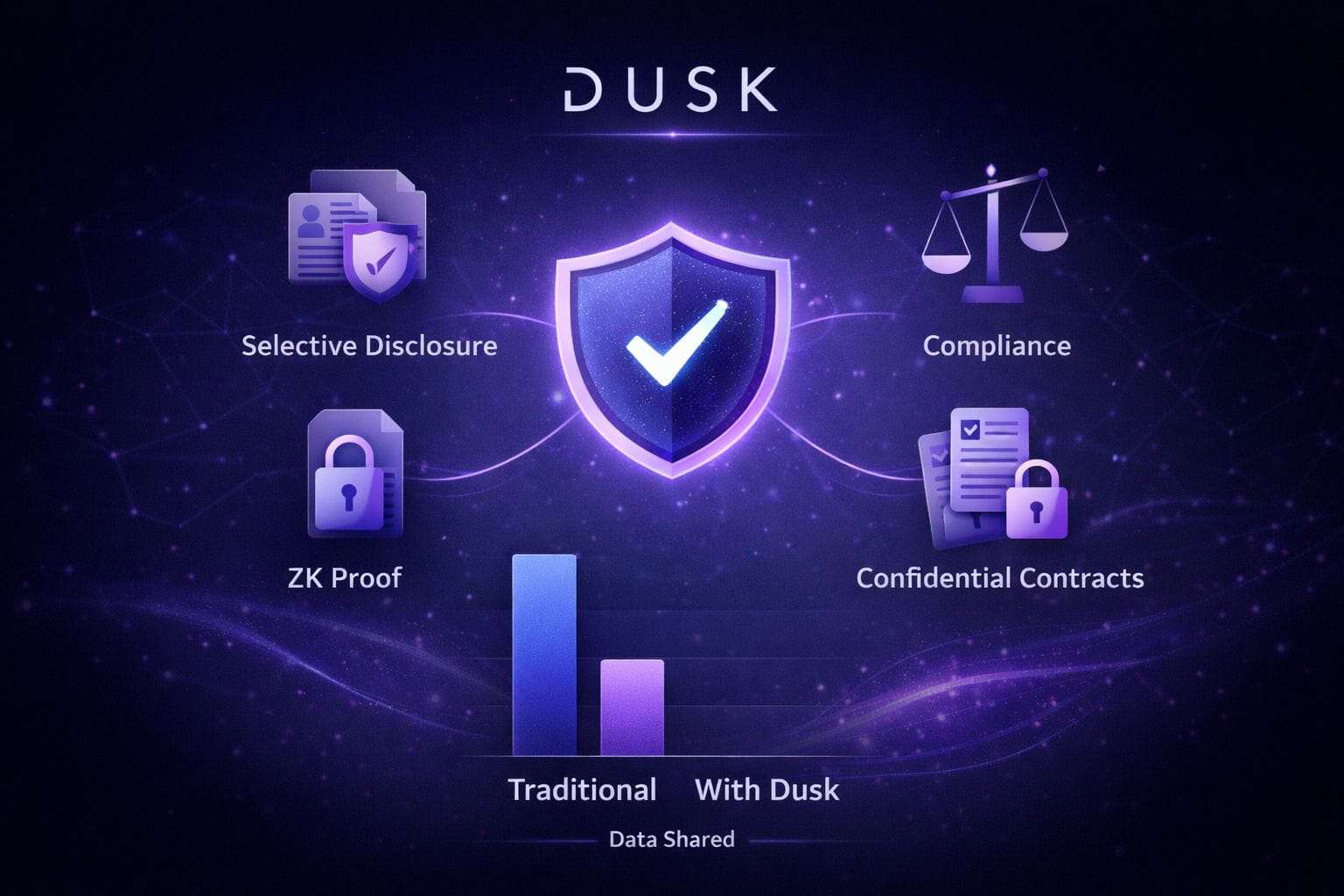
 You ever notice how the world asks you to “prove it”… and then takes way more than it needs? One simple fact. And suddenly you’re handing over a whole folder. Picture this. You’re trying to join a new app, open a line of credit, or get cleared to trade a token that has rules around who can touch it. The prompt is always polite. “Upload your ID.” “Upload your bank file.” “Upload your tax paper.” And you pause for a second because, well… why do they need all of that to learn one thing? That tiny moment of doubt matters. Because once a file leaves your hands, it lives a new life. It gets copied. Stored. Shared inside teams. Or sits in a database you’ll never see. Most firms are not evil. They’re just… messy. People are busy. Systems are old. Data piles up. And the worst part is you don’t even get a clean trade. You didn’t sell your privacy for money. You gave it away just to pass a gate. This is where Dusk Foundation (DUSK) leans in with a sharper idea: selective disclosure. Prove a fact. Keep the file. Think of selective disclosure like showing a cinema ticket without handing over your whole wallet. The staff only needs to know “valid ticket, right time.” They don’t need your address, your full name history, your photos, your notes, your other cards. Just the one thing. Yes or no. In crypto, the “one thing” is often about rules. Are you on an allow list? Did you pass checks? Are you over a limit? Is your fund report real? Did the numbers match? And here’s the trick that feels like magic at first: you can prove it with math, not with documents. You’ll hear a term like “zero-knowledge proof.” Sounds heavy, I know. But the simple meaning is this: it’s a proof that shows you’re telling the truth, while hiding the extra details. Like proving you solved a puzzle without showing the steps on your paper. The checker gets confidence. The checker does not get your full page. Dusk’s whole point is to make this kind of privacy work where rules still exist. Not “hide everything and hope.” More like: keep the rules, reduce the data spill. A bank, a fund, or a platform can say, “We must only serve approved users,” and Dusk can support a way to answer, “Yes, approved,” without sending the full ID file across the internet again. That’s selective disclosure in plain words. And it changes the vibe of trust. Because trust stops being “please store my private life carefully.” Trust becomes “you don’t need to store it at all.” Why does this matter beyond a neat tech trick? Because money rails are turning into data rails. Every loan, every fund share, every token tied to real stuff comes with checks. If the only way to do checks is by collecting huge files, then you get the same old world again. Big forms. Big leaks. Big fear. People avoid the system, not because they hate rules, but because they hate giving up control. Selective disclosure flips that. It lets a person, or a firm, share just enough to move forward. No more. A lender can ask, “Does this user meet the income rule?” and get a proof back instead of a pay slip. A token fund can publish “our net value matches the report” without exposing each trade. A platform can show it blocked bad actors without doxxing every good user. You get a trail that auditors can trust, but not a pile of raw files that attackers love. And there’s another quiet win. Less data stored can mean less risk later. If you don’t hold what you don’t need, you can’t lose what you don’t have. That’s not a promise. It’s just basic logic. Fewer copies, fewer doors, fewer accidents. Of course, none of this is a magic wand. Proof systems still need good code. Good setup. Good checks. Bad inputs can still produce bad outputs. Humans can still cheat around the edges. So the goal isn’t “perfect.” The goal is cleaner trade-offs. Better defaults. That’s why Dusk’s angle is interesting in a grown-up way. It’s not yelling “privacy!” like a slogan. It’s offering a practical middle path: rules stay, proof gets stronger, and your private file stays… yours. Not Financial Advice. Just a way to think about where compliant crypto might go when people get tired of handing over their whole life to prove one small fact. So here’s the real question. If you could prove what you need to prove, without exposing the rest… why would you ever go back?
@Dusk #Dusk $DUSK #Write2EarnUpgrade
