

One thing I have learned from watching both technology systems and financial systems is that the most fragile ones react instantly to everything. They execute without judgment. They treat every input as equal. Over time, that behavior creates noise, inefficiency, and eventually failure. This is why the way Vanar Chain approaches execution keeps my attention.
Vanar does not seem designed to execute blindly. It is designed to decide. When historical context is stored on chain and AI agents can evaluate that context, execution stops being a reflex and starts becoming selective. Some actions are prioritized. Some are constrained. Some are rejected entirely. That is how real systems protect themselves as they grow.
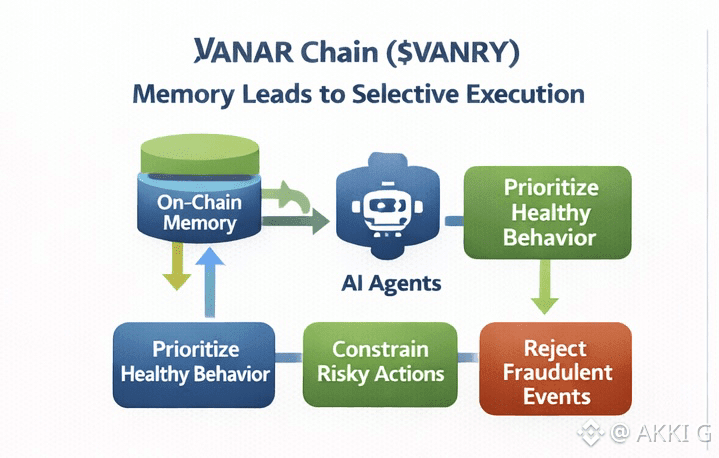
What matters here is not just intelligence, but restraint. In most blockchains, scalability means doing more of everything, faster. On Vanar, scalability feels closer to doing the right things more often. Memory allows the network to recognize patterns of healthy behavior and patterns of risk. Over time, this leads to a system that does not need constant external intervention to remain stable.
$VANRY sits at the center of this logic. Every layer of selective execution consumes VANRY, whether it is querying historical state, running adaptive contract logic, or coordinating AI-driven decisions. That means VANRY demand is tied to judgment, not just throughput. As applications become more complex and decisions become more nuanced, the economic role of VANRY deepens.
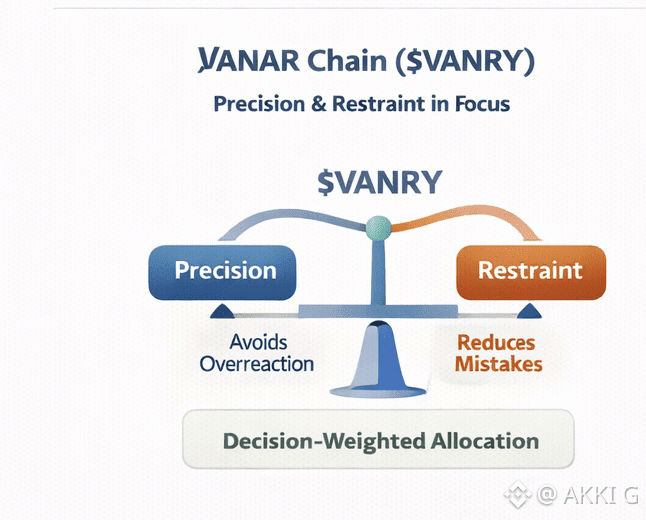
I also think this design aligns well with environments where mistakes are expensive. Financial applications, identity systems, and compliance-heavy workflows cannot afford indiscriminate execution. They need systems that can slow down when necessary and tighten parameters when risk rises. Vanar’s architecture feels built for that kind of responsibility rather than for spectacle.
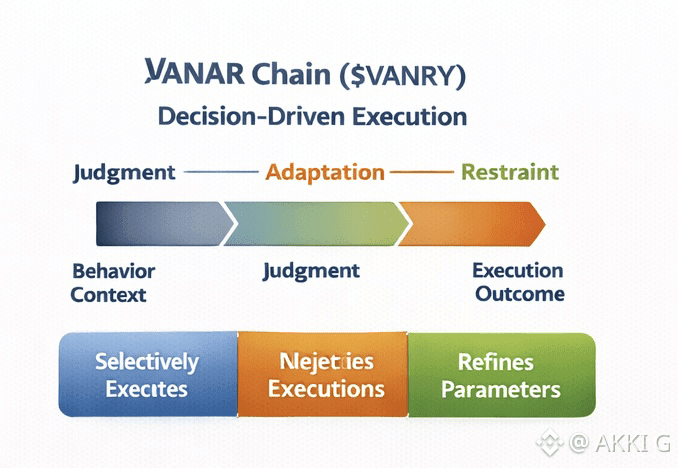
My take today is that Vanar Chain is quietly reframing what execution means in Web3. Instead of asking how fast the network can react, it asks how well the network can decide. In the long run, that distinction is often the difference between systems that burn out and systems that endure.