
Rules don’t usually knock. They don’t sit down politely and ask DeFi how it’s feeling today. They show up like a surprise inspection… and suddenly everyone starts speaking in shorter sentences. I’ve seen it happen in real time. A team builds a clean lending app. It works. Users love it. Then a partner asks, “Can a regulated fund use this?” And the room goes quiet. Because “fund” means rules. Rules mean checks. Checks mean records. Records mean… oh no… data. And DeFi hates data the way cats hate water. It splashes everywhere, it sticks, and you can’t pretend it never happened.
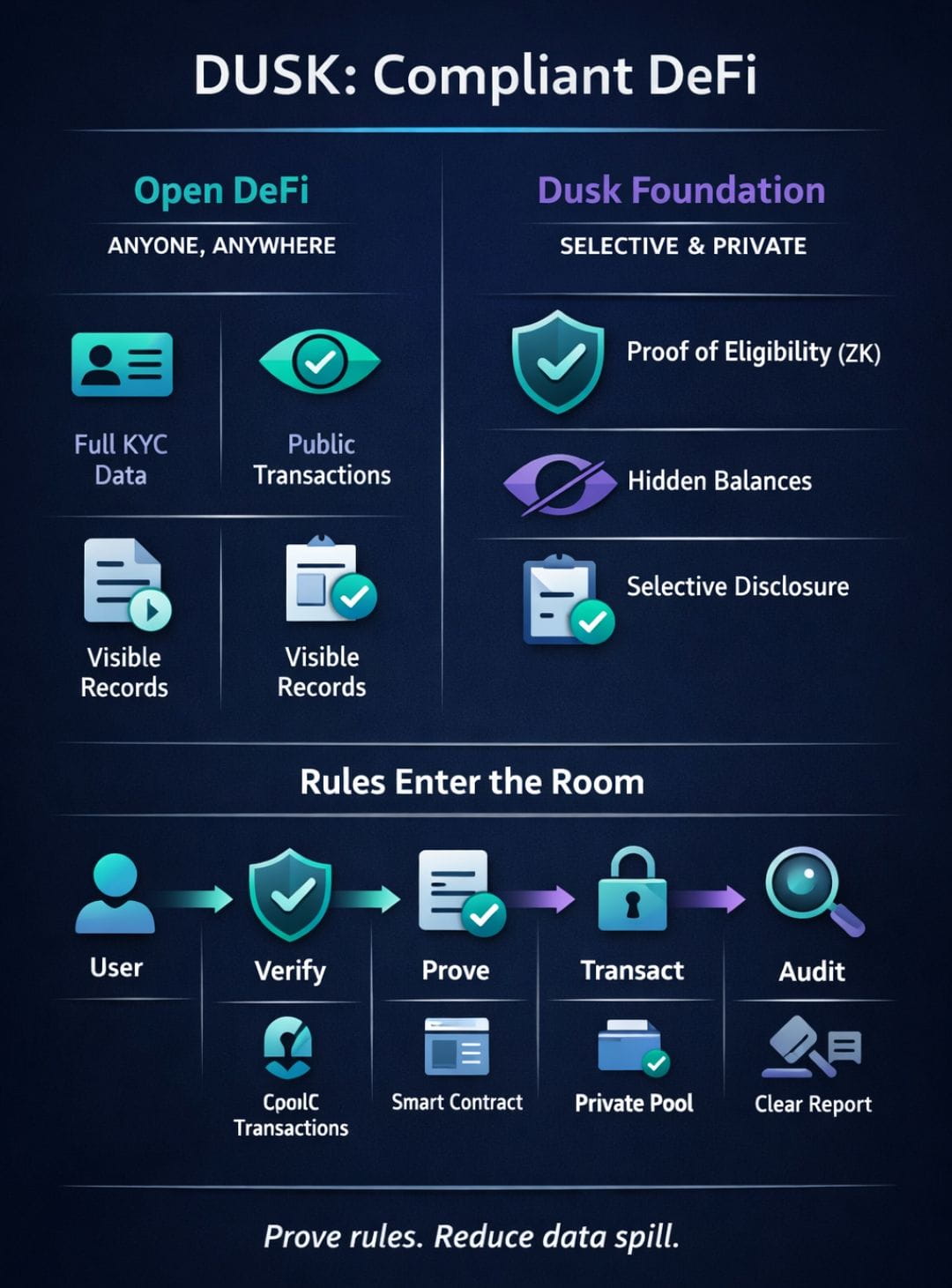
That’s the tension Dusk Foundation (DUSK) keeps poking at: what if we could bring rules in, without turning DeFi into a full-time surveillance machine? Because let’s be honest. Most “compliance” talk in crypto has been clumsy. It often sounds like: “We’ll just KYC everyone and store it somewhere.” That’s not a plan. That’s a leak waiting to happen. It also misses the deeper point. Compliance isn’t just “know the name.” It’s “prove the system behaved.” Did limits work? Did blocked users stay blocked? Did the app prevent bad flow? Did the firm meet its duty? A regulator, or an auditor, doesn’t always need your whole identity story. They need answers to strict questions. This is where Dusk’s framing gets interesting. It treats privacy like a control tool, not a blindfold. A way to share just enough. No extra spill. That “just enough” idea is often done with zero-knowledge proofs. Big name. Simple vibe: you can prove a claim is true without showing the raw facts behind it. Like saying, “I’m over 18,” without showing your birth date. Or “I’m allowed,” without showing your passport scan. It’s not magic. It’s math used with discipline. And once you accept that idea, compliant DeFi starts to look less like a contradiction and more like a design problem you can solve. First, the user journey changes. In open DeFi, you show up and trade. In compliant DeFi, you show up and qualify. That word “qualify” sounds harsh, but it’s normal in finance. It can mean you passed KYC. Or you’re not from a restricted place. Or you’re within a risk tier. Or you’re part of an allowlist. The key detail is where that info lives. If the system stores identity data on-chain, that’s permanent exposure. If the system uses proofs, the chain can verify the rule without holding the private file. That’s the Dusk-style direction: rules can be enforced, but the chain doesn’t become a public filing cabinet. Second, liquidity becomes “clean” by design. In normal DeFi, liquidity is like rainwater in the street. It flows everywhere, mixes with everything. In compliant settings, money can’t mix freely. A fund may need to prove its funds come from approved sources. A platform may need to show controls against sanctioned flow. That creates “permissioned pools” or “gated markets.” People get nervous when they hear “permissioned,” like it automatically means centralized. But permissioned can mean rule-based access, not single-party control. The trick is making that access check verifiable and fair. That’s where privacy tech matters. It can stop the check from becoming a doxx event. Third, the meaning of “audit” changes. Traditional finance is used to audits that pull files, review logs, check controls. Public blockchains give you the opposite problem: too much public data, but not in the form compliance wants. You can see transfers, but you can’t always tie them to legal duties in a clean way. Compliant DeFi wants audit trails that answer specific questions. Not full exposure. Dusk’s core idea lines up here: selective disclosure. Reveal what’s needed, to who needs it, when they need it. Think of it like a folder with tabs. You don’t dump the whole folder on the table. You open tab 3 only. The rest stays shut. Now here’s the part people don’t say out loud: rules also change incentives. In open DeFi, the fastest growth often comes from letting everyone in and letting everything happen. In compliant DeFi, growth can come from trust. Not “trust me,” but “this system can prove it did the right thing.” That attracts a different crowd. Firms that need guardrails. Funds that can’t touch a protocol unless they can explain it to a board. Real issuers that don’t want their cap table and cash flow visible to the whole internet. But it’s not free. The UX gets more steps. The system design gets heavier. The culture shifts too. Some users will hate it. They’ll say it’s not “real DeFi.” And sometimes they’ll be right, depending on what they value most. The question is not who is morally correct. The question is: what DeFi do you want to exist five years from now? Because rules are already in the room. The only choice left is whether DeFi pretends it can’t see them… or learns how to live with them without becoming a data-hungry mess. Dusk Foundation’s pitch is basically that: build DeFi that can pass a serious compliance conversation without forcing everyone to strip naked in public. Privacy as restraint. Compliance as structure. A system that can say, “Yes, the rule is met,” while still saying, “No, you don’t get my whole life.” Not Financial Advice. So, if “compliant DeFi” sounds like an oxymoron to you… maybe the real oxymoron is thinking DeFi can scale into the real world while ignoring the room it’s trying to enter.
@Dusk #Dusk $DUSK #Web3 #Write2EarnUpgrade
