
Picture a trading desk at 1:30 a.m. Screens glow. Phones buzz. A deal is ready to move. Then someone asks the quiet question that kills the mood: “Cool… but can we prove who’s allowed to touch this, without leaking the whole file?”
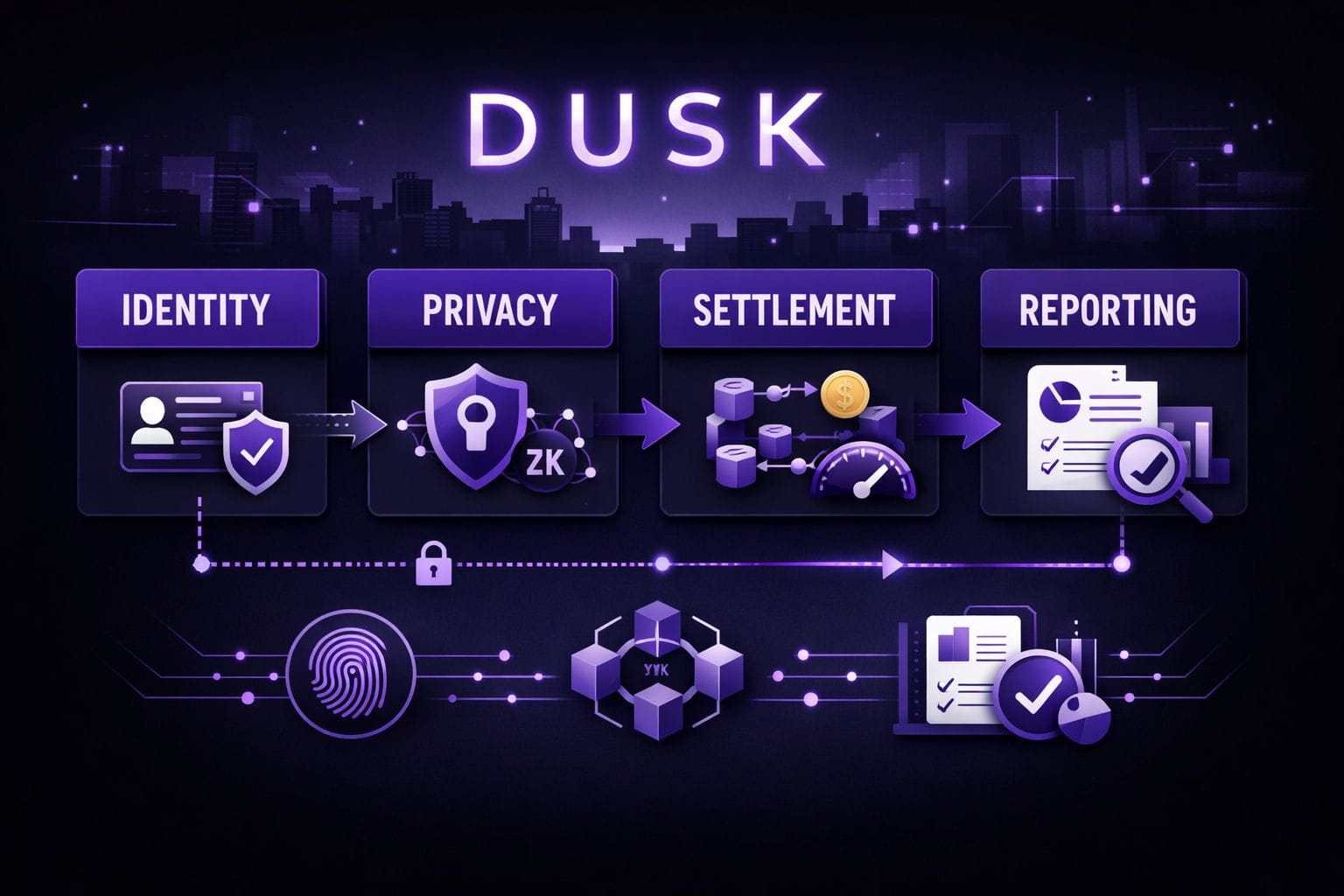
That’s the weird stress point in modern finance. We need rules. We need checks. We need clean logs. But we also need privacy, because real money comes with real limits. Dusk Foundation leans into that tension instead of dodging it. Not as one giant “do-everything” chain. More like a modular stack you build step by step. Like bricks. Identity first. Then privacy. Then settlement. Then reporting. One by one, so each part can do its job without turning the whole system into a mess. Start with identity, because in regulated markets, “anyone can join” is not how it works. Identity here does not mean doxxing yourself on-chain. It means you can prove you meet a rule. For example, “I’m approved,” or “I’m in this region,” or “I’m not on a block list.” Without posting your name and life story. Dusk talks a lot about selective share, which is just a simple idea: show only what is needed, not all you have. It’s like walking into a venue and showing a wristband, not your full ID card to every stranger in line. You still pass the check. You just don’t hand out extra data for free. Now the privacy layer. This is where people get lost, so let’s keep it plain. When you hear “zero-knowledge proof,” think of it like this: you can prove a claim is true without showing the math on the board. You can say, “This trade follows the rule,” without showing every detail of the trade to the whole world. That sounds small, but it changes everything. Because it means banks and funds can use chain tools without turning their books inside out. And it also means users can keep some dignity. Less data spill. Less risk from leaks. Less “oops, we exposed the full list of who holds what.” The part that surprised me, honestly, is how this modular setup can calm the usual fight between privacy and trust. In most systems, you pick one. Private means “trust me, bro.” Public means “everyone sees everything.” Dusk tries to split the difference. Privacy for the raw data. Proof for the trust. That’s the trick. And yes, it’s hard. But at least the goal is clear: keep the rules, reduce the spill. Then comes settlement, the moment where things stop being a promise and become a fact. Settlement is just the final “done.” Money moved. Asset moved. No take-backs. In old systems, settlement can take days. In crypto, it can be fast, but often messy. Dusk’s angle is more “finance-grade.” Clean flows. Clear state. A chain that can handle real value moves while still respecting the identity and privacy layers sitting above it. Think of settlement like the rails under a train. You don’t stare at the rails all day. But if the rails are weak, every fancy passenger car is pointless. In a modular stack, settlement should not need to know your whole identity file. It should not need to broadcast private deal terms. It just needs the right proofs that the deal is allowed, then it locks it in. That separation matters. It keeps the system simpler. And simpler systems break less. And then the last piece people forget: reporting. Because regulators, auditors, risk teams… they don’t accept vibes. They want records. The problem is, normal reporting often forces full exposure. Dusk’s concept is closer to “proof-based reporting.” You can show that limits were followed, that access rules were used, that totals match, that a fund’s numbers line up. Without dumping every client detail on a public feed. Reporting, in this frame, is like giving an auditor a sealed folder plus a set of keys that only open the pages they’re allowed to see. Not the whole office. Not the whole server. Just the parts they need. That’s what “compliant privacy” is trying to feel like. Not secrecy for fun. Privacy with guardrails. So yeah… identity, privacy, settlement, reporting. Four blocks. Built in a line. Each one doing one job. That’s the modular finance stack idea in plain terms. And it’s not magic. It’s design discipline. If Dusk gets that right, it becomes less about slogans and more about a workflow institutions can actually live with. Not financial advice. But as a market watcher, I’ll say this: chains that respect how finance really works tend to last longer than chains that pretend rules don’t exist. The real question is simple. If you could prove you’re compliant without leaking your data… why wouldn’t you want that?
@Dusk #Dusk $DUSK #Write2EarnUpgrade
