

For the past few years, the blockchain industry has been obsessed with a single metric: speed. We have seen countless Layer 1s compete over who can process more Transactions Per Second (TPS). However, as we enter the age of decentralized intelligence, the market is realizing that TPS is old news. High speed is a baseline requirement, not a competitive advantage. The real question for the next decade isn't "how many transactions can your chain handle?" but rather "is your infrastructure AI-ready?"
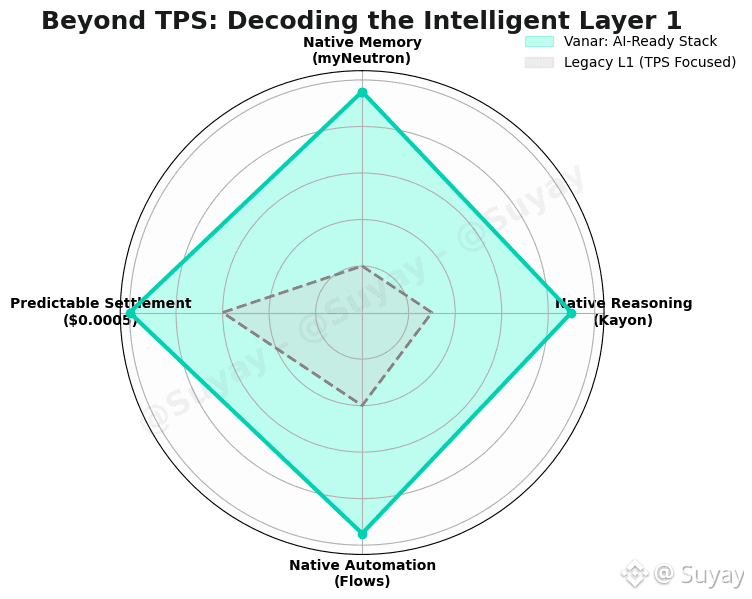
But what does "AI-ready" actually mean? In the context of Vanar Chain, it isn't just a marketing label. It is a technical standard that requires four fundamental pillars: native memory, reasoning, automation, and seamless settlement. To decode Vanar’s infrastructure is to understand how $VANRY provides a home for autonomous agents that simply cannot exist on traditional, human-centric blockchains.
Pillar 1: Native Memory (The myNeutron Advantage)
One of the greatest limitations of current blockchains is their "stateless" nature. Smart contracts react to inputs, but they don't truly "remember" context in a way that is useful for artificial intelligence. AI agents require semantic memory—the ability to store and retrieve persistent context to personalize their actions.
Vanar solves this through myNeutron. This isn't an external database; it is a proof that semantic memory can exist at the infrastructure layer. By providing AI agents with a native memory bank, Vanar allows them to learn from past interactions and operate with a level of sophistication that goes beyond "if-this-then-that" logic. Without native memory, an AI on a blockchain is like a computer without a hard drive; with Vanar, it has a brain.
Pillar 2: Native Reasoning (Kayon and the Logic Layer)
Reasoning is what separates a basic script from true intelligence. Most blockchains are rigid environments where logic is hardcoded into immutable smart contracts. While this is great for security, it is terrible for the flexibility required by AI.
Kayon is Vanar’s answer to this challenge. It provides a framework for reasoning and explainability natively on-chain. This means that when an AI agent makes a decision—whether it’s a trade, a content moderation action, or a gaming move—that decision is backed by on-chain logic that is both verifiable and explainable. This transparency is crucial for building trust in decentralized AI systems.
Pillar 3: Native Automation (Flows and Action)
Intelligence is useless if it cannot translate into action. In traditional Web3, every action requires a "human-in-the-loop" to sign a transaction with a private key. This is the ultimate bottleneck for AI agents.
Flows is the architectural piece that unlocks safe, automated action. It allows AI agents on Vanar to execute complex workflows autonomously based on real-time data and reasoning. Because Flows is integrated at the protocol level, it ensures that this automation is secure and follows the strict rules of the network. This turns AI from a passive observer into an active economic participant.
Pillar 4: Predictable Settlement (The $0.0005 Rail)
Finally, an AI-ready chain must be economically viable for high-frequency activity. AI agents don't think like humans; they might need to perform thousands of micro-transactions to optimize a strategy or manage a game economy.
If transaction fees are volatile, the AI agent’s logic breaks. Vanar’s fixed-fee system ($0.0005) provides the predictable settlement layer that agents need. When combined with compliant payment rails, it allows machines to settle value globally without the friction of traditional wallet UX.
Why Legacy L1s are Falling Behind
Most new L1 launches are still trying to solve the problems of 2020. They are launching with high TPS but zero products that prove AI readiness. Vanar is different because it isn't just providing "block space"; it is providing an "Intelligent Stack."
As a creator or developer, $VANRY presents exposure to this infrastructure. It is the fuel that powers the memory, reasoning, and automation of the decentralized future. We have moved past the era of "dumb" pipes; we are now in the era of the Intelligent Layer 1. Decoding Vanar means recognizing that the future of blockchain belongs to the machines that can finally live on it.
