


Dusk Network is a Layer 1 blockchain protocol designed specifically for privacy-preserving financial applications, such as tokenizing securities, enabling compliant decentralized finance (DeFi), and automating regulated processes while maintaining strong privacy guarantees. At the heart of its smart contract execution environment lies Rusk VM (often referred to in documentation as Dusk VM or the virtual machine within the Rusk platform), a groundbreaking zero-knowledge-friendly virtual machine that enables native confidential smart contracts.
What is Rusk VM?
Rusk VM serves as the execution engine for Dusk Network's smart contracts. It is a highly optimized WebAssembly (WASM)-based virtual machine, built around high-performance WASM runtimes (such as Wasmtime in recent iterations, with earlier mentions of Wasmer or custom forks like Piecrust for hyper-optimization).
Unlike traditional VMs like the Ethereum Virtual Machine (EVM), which execute smart contracts in a transparent manner, Rusk VM integrates deeply with zero-knowledge cryptography (particularly Plonk-based proofs used in Dusk's ecosystem). This makes it the world's first true Zero-Knowledge Virtual Machine (ZK-VM) implementation tailored for blockchain use. It allows smart contracts to process and handle sensitive data without revealing it on-chain, while still enabling verifiable computation.
Key highlights from Dusk's developments:
Rusk VM 2.0 (shipped in late 2023 as a major milestone toward mainnet) introduced native support for privacy-preserving smart contracts.
It enables ultra-light clients, instant trustless synchronization for nodes and wallets, and efficient execution even for complex ZK-based logic.
Privacy and compliance are built-in: Contracts can enforce regulatory requirements (e.g., selective disclosure or compliance checks) without compromising user privacy.
How Doesn't Rusk VM Work?
Rusk VM expects smart contracts compiled to WASM bytecode. Developers write contracts (primarily in Rust, given Dusk's Rust-centric stack), compile them to WASM, and deploy them to the network.
Core technical features include:
Custom modifications to the underlying WASM runtime for Dusk-specific needs:
Specialized memory management.
Support for Dusk's custom ABI (Application Binary Interface) via the dusk-abi crate, which handles contract communication, panic handlers, and no_std environments.
Inter-contract calls.
An "argument buffer" (argbuf) a dedicated 64KB memory region for passing data between host and contract.
ZK integration The VM works seamlessly with Dusk's Plonk proving system and other ZK primitives, allowing contracts to generate and verify proofs during execution. This supports confidential transfers, shielded logic, and private state transitions.
Host-side interface Rusk VM acts as the bridge between the blockchain node (Rusk reference implementation) and contract code, managing system-level operations, gas metering, and state access.
Modular execution Dusk supports multiple environments, including Dusk VM for native privacy-focused contracts and DuskEVM for compatibility with Ethereum tooling, both settled via the same underlying consensus and data availability layer.
Contracts run in a deterministic, verifiable way, with gas fees accounted for (even in ZK contexts), and the VM ensures isolation and security.
Why Rusk VM Matters for Privacy and Finance
Traditional blockchains expose transaction details and contract states publicly, which is unsuitable for regulated assets like securities, bonds, or institutional finance. Rusk VM changes this by making privacy the default:
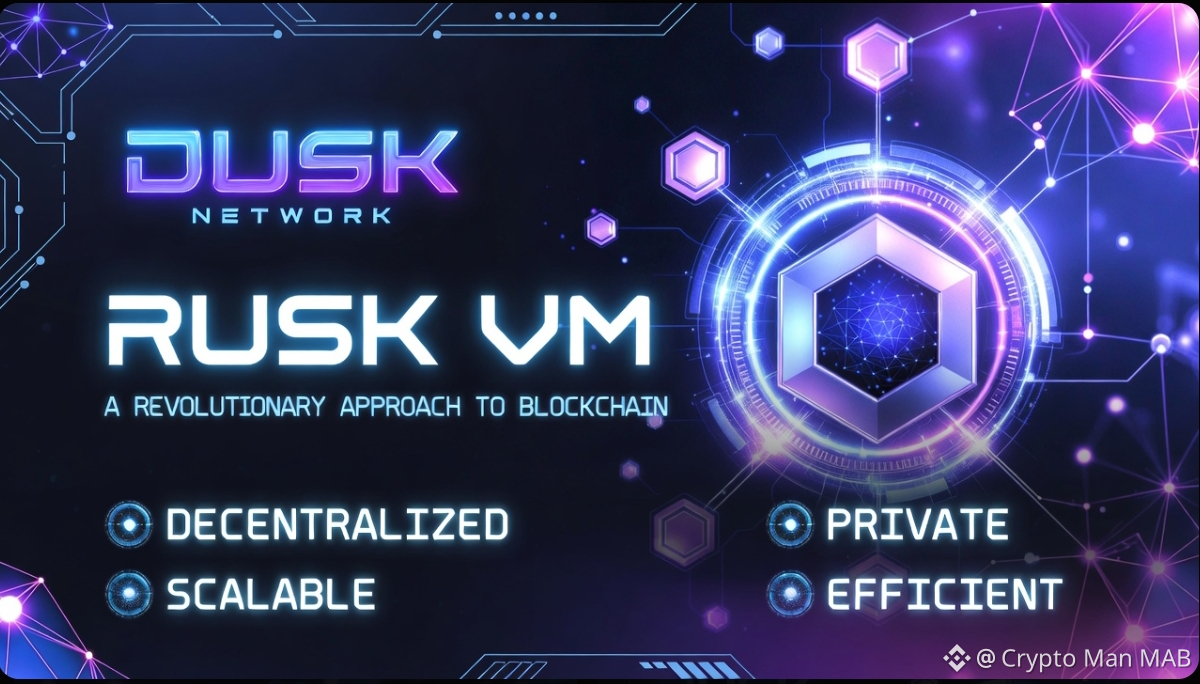
Native confidential smart contracts Logic and data can remain private while proofs confirm correctness.
Compliance without exposure Features like selective transparency or zero-knowledge KYC (paired with tools like Citadel) allow meeting regulatory needs.
Scalability and efficiency Optimized for lite clients and fast sync, reducing barriers for adoption.
Financial use cases Tokenization of real-world assets (RWAs), automated settlement, private trading, and more become feasible without sacrificing decentralization or privacy.
Dusk positions Rusk VM as what makes it the only ZK-friendly L1 capable of true confidential smart contracts at the protocol level.
Current Status and Development
Rusk (the broader platform including the VM) continues active development in repositories like dusk-network/rusk (the main node and smart contract platform) and related crates. The VM has evolved through iterations (e.g., from earlier Rusk-VM/Piecrust designs to Rusk VM 2.0 and beyond), focusing on performance, security, and mainnet readiness. Developers can explore the code on GitHub, experiment with Rust-based contracts, and leverage documentation at docs.dusk.network for deep dives into Dusk VM.
In summary, Rusk VM represents a major leap in blockchain execution environments turning privacy from an add-on into a foundational capability. For projects bridging traditional finance and crypto, it offers a powerful, compliant, and truly private infrastructure.
