
DXC Technology (NYSE: $DXC) has announced a strategic collaboration with Ripple aimed at integrating blockchain-based capabilities directly into its Hogan core banking platform, marking another step toward the institutional adoption of digital assets within traditional financial infrastructure. The partnership is designed to allow banks to introduce digital asset services without disrupting their existing core systems—an issue that has long hindered modernization efforts across the banking sector.
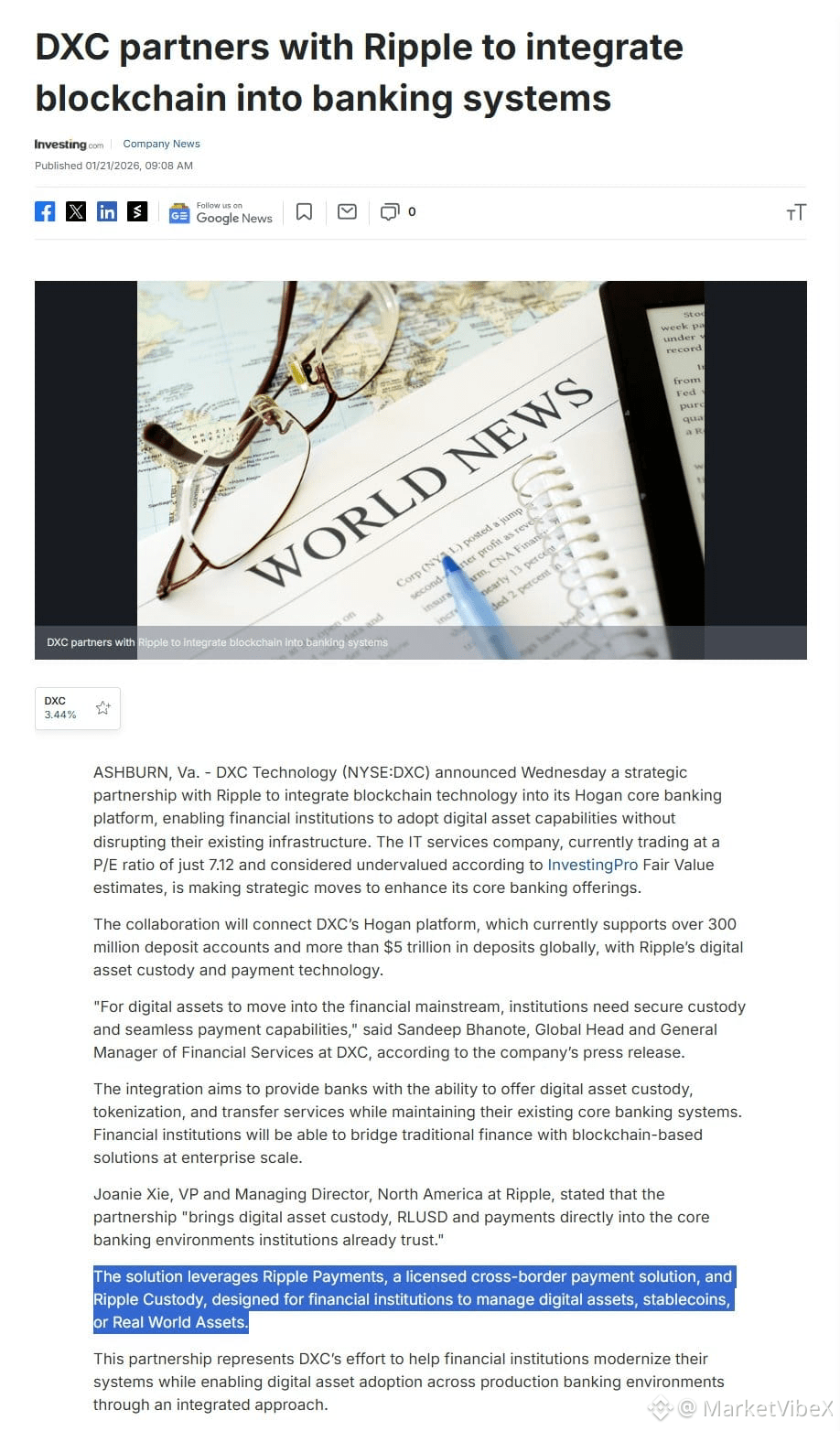
Hogan is one of the most widely deployed core banking platforms globally, currently supporting more than 300 million deposit accounts and managing over $5 trillion in deposits across multiple regions. By linking Hogan with Ripple’s blockchain solutions, $DXC is effectively opening a pathway for large financial institutions to engage with digital assets at scale, while preserving operational continuity and regulatory controls.
At the heart of the integration is the goal of enabling banks to offer digital asset custody, tokenization, and blockchain-based payments as native services. Rather than forcing institutions to rebuild or replace legacy infrastructure, the solution positions blockchain as an extension layer—bridging conventional banking operations with emerging decentralized technologies.
This approach reflects a broader industry shift. Financial institutions are increasingly exploring digital assets not from a speculative standpoint, but as functional tools for settlement, liquidity management, and asset servicing. DXC’s collaboration with Ripple addresses this demand by providing enterprise-grade connectivity between traditional finance and blockchain networks.
The solution leverages $Ripple Payments, Ripple’s licensed cross-border payments platform, alongside Ripple Custody, a digital asset custody solution purpose-built for regulated financial institutions. Through this framework, banks can securely manage cryptocurrencies, stablecoins such as RLUSD, and even tokenized real-world assets, all within a controlled and compliant operating environment.
Strategically, the partnership underscores DXC’s intent to keep Hogan relevant as banking enters a new phase of digital transformation. As customer expectations evolve, banks are under pressure to support digital assets while maintaining the reliability, compliance, and resilience required in production environments. By embedding blockchain capabilities into its core offering, DXC positions itself as a facilitator rather than a disruptor of institutional change.
For Ripple, the agreement represents a significant expansion into the operational core of global banking. Instead of operating at the edges of the financial system, Ripple’s technology is being positioned closer to where deposits are managed, transactions are settled, and assets are safeguarded. This shift reinforces Ripple’s long-standing narrative of focusing on infrastructure and utility rather than speculative use cases.
From a market perspective, the collaboration also strengthens the ecosystem surrounding $XRP and RLUSD. While neither asset is framed as a retail investment product in this context, both play roles within a broader institutional framework—XRP as a liquidity and settlement asset, and $RLUSD as a stable medium for custody and transfer. Their integration into core banking workflows signals growing confidence in blockchain-based financial rails.
More broadly, the DXC–Ripple partnership highlights how the boundaries between traditional banking and blockchain technology are steadily eroding. As regulatory clarity improves and enterprise-grade solutions mature, digital assets are increasingly being woven into the fabric of mainstream financial operations. What was once experimental is now moving closer to becoming standard infrastructure.
