
When developing a major on-chain application for the first time, you discover something that most whitepapers fail to acknowledge: the blockchain is rarely the difficult part. Everything surrounding it, including files, user information, private records, trading logs, receipts, proof documents, creator assets, and AI datasets, is difficult. Additionally, builders covertly revert to the same old centralized stack when that data cannot live privately on-chain. Decentralization begins to leak at that point.
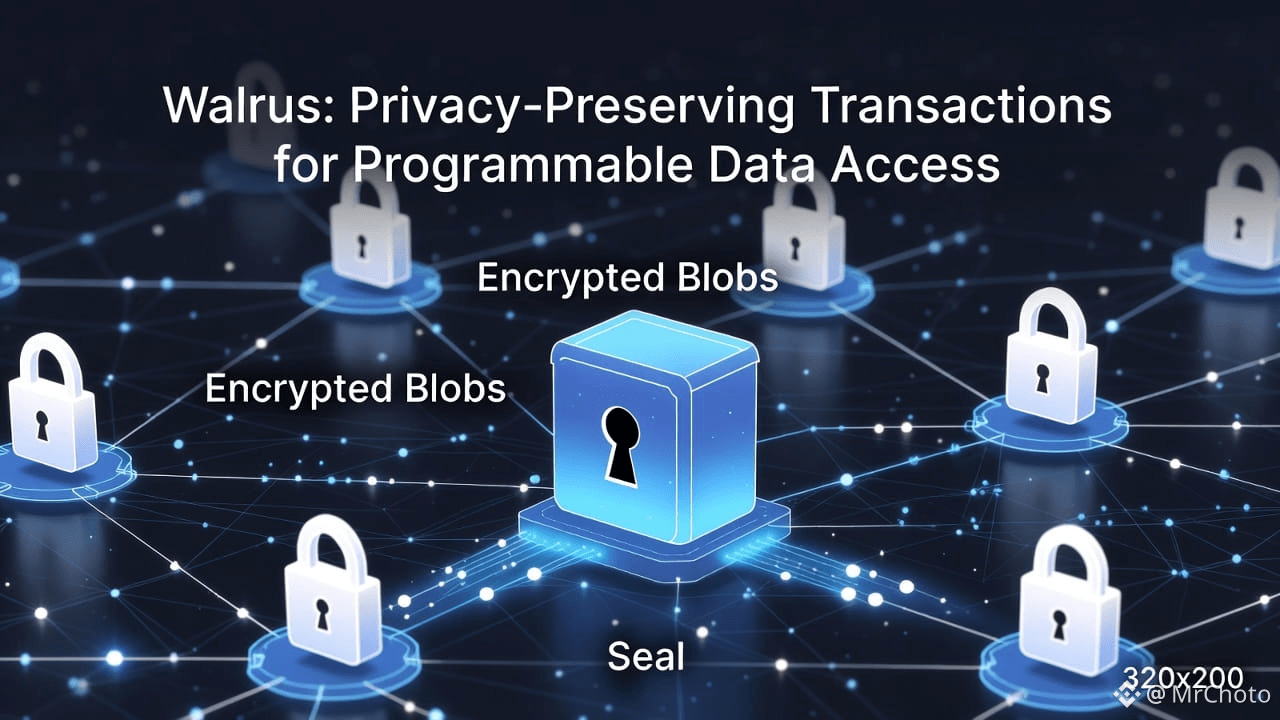
Walrus is there to stop that leak.
Fundamentally, Walrus is a decentralized "blob storage" and data availability network for big files, photos, movies, archives, and app content. It was created to operate closely with Sui while remaining useable from other ecosystems. Erasure coding is used in its storage design to divide data into encoded segments and distribute them among nodes, allowing the original file to be recreated even in the event that network components fail. According to Walrus' documentation, this is a cost-effective method that maintains robustness while having storage overhead that is about five times the size of the stored blob—much less than complete replication methods.
The unsettling aspect that affects privacy, however, is that Walrus blobs are public and discoverable by default.
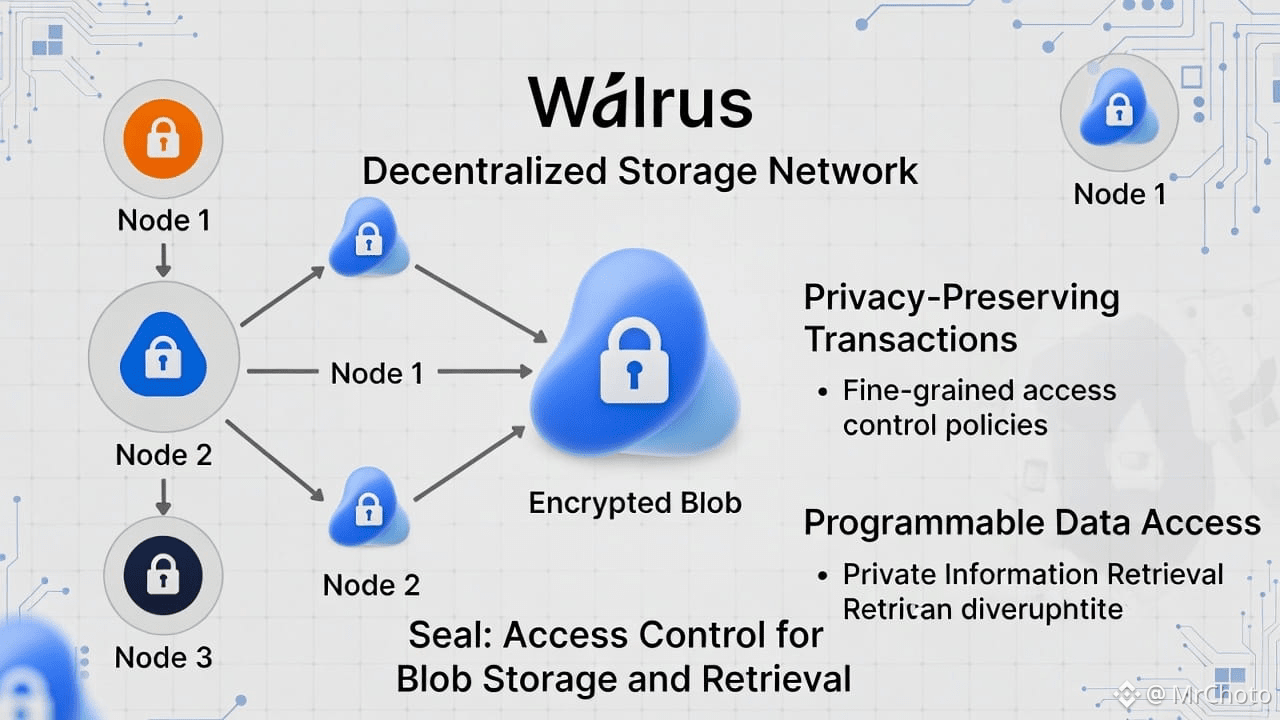
Walrus doesn't conceal that. The official documentation makes it clear that you must secure the data before uploading it if you require access control or secrecy. Access control must be built on top of client-side encryption.
Therefore, the true response to the question, "How does Walrus integrate privacy-preserving transactions?" is more sophisticated than most cryptocurrency narratives: Walrus does not automatically make storage private. It combines cryptographic access control and decentralized storage to make privacy programmable.
For traders and investors, this distinction is important since "privacy-preserving transactions" include more than just concealing transfers. Sensitive app flows, such as who viewed which file, what proof was given, which dataset was bought, whose creator enabled premium content, what a user's wallet performed inside a dApp, and when, are all protected. The transaction itself may not always be as illuminating as such metadata traces.
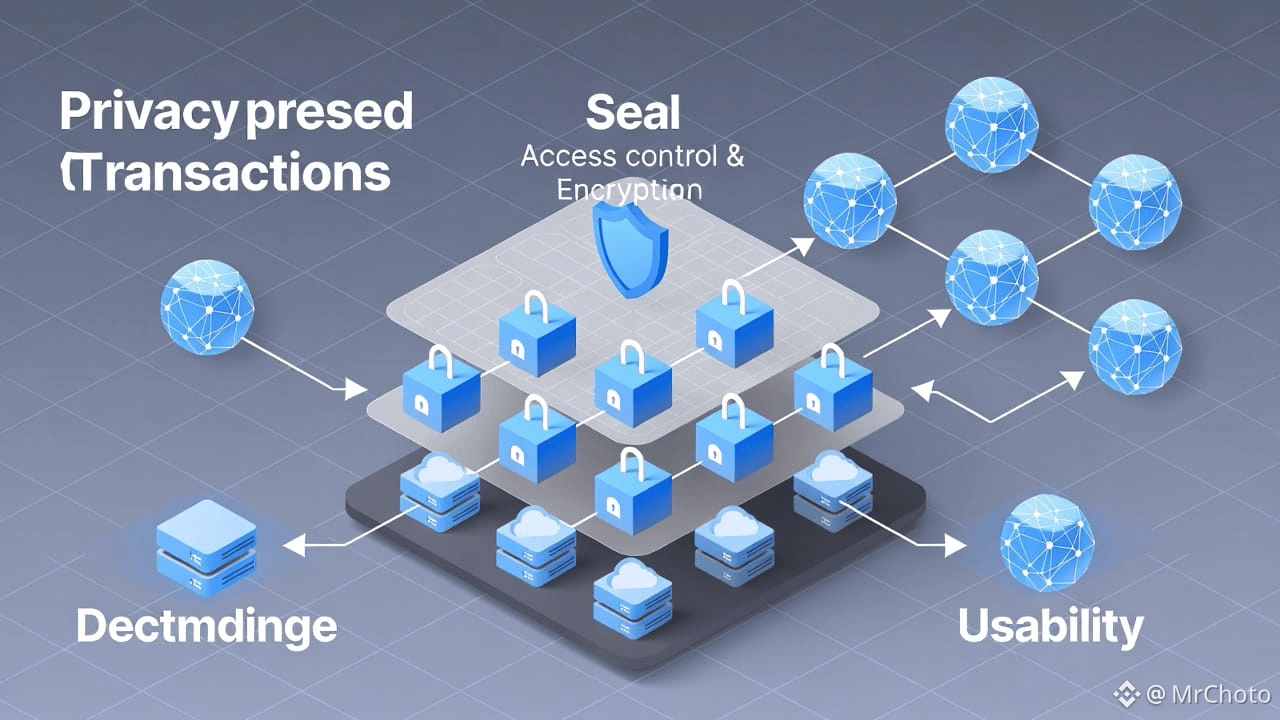
Walrus takes a stack-based approach to privacy.
Decentralized storage and availability are present at the base layer; content is dispersed among nodes, preserved by financial incentives, and strengthened by redundancy and coding.
Next is the privacy layer, where Walrus implemented Seal, its most significant "privacy integration" change.
Applications may maintain the blob's decentralization while limiting who can decrypt or access it thanks to Seal, Walrus' access-control and secrecy framework that permits encryption-based data gating. According to the Walrus team, Seal enables programmable data access at scale by introducing encryption and access control that are "now available with Walrus Mainnet."
This serves as a link between "privacy-preserving usage" and "public decentralized storage."
Put simply, since the data being saved is encrypted, it is possible to store content openly over a decentralized network without actually revealing the content. Everyone else just sees meaningless ciphertext; users who satisfy the access requirements receive keys or decryption rights.
Confidentiality with verifiability is what actual markets refer to as privacy-preserving.
Applications that are concerned with regulated workflows or commercial advantage trading dashboards that store strategy backtests, OTC desks that store settlement proofs, RWA platforms that store issuer documents, DePIN apps that store device logs, and AI apps that store datasets and model artifacts will find Walrus especially useful. These are not speculative. If "decentralized" means "everyone can see everything," then adoption stops in precisely these categories.
Let's now discuss the aspect that most investors overlook: privacy is retention, not simply a feature.
This is the most severe form of the Web3 retention issue: users stay because your chain is slow. They depart because they feel vulnerable.
Users act differently if every file your software interacts with is publicly discoverable. They upload fewer files. They participate less. They disconnect wallet connections. They never come back. Even worse, no one wants their research materials, portfolio screenshots, or execution proofs hanging about in a publicly accessible content-addressed index for trading-related items.
Thus, privacy turns into UX in the retention struggle.
Walrus' decision to endorse access restriction via Seal goes beyond simple "ethical privacy." It's a strategy for product survival. Apps that are unable to secure user data will lose users. Additionally, apps that are unable to retain users do not produce long-lasting on-chain activity, which means they do not produce long-term fee flow, token utility, or ecosystem gravity.
From a market standpoint, WAL serves as the governance and incentive layer that keeps this system running. Governance is defined as parameter adjustment nodes voting on fines and system settings using stake-weighted power on the Walrus token page. This is important because privacy and access control are dynamic requirements that change in response to threats, laws, and app design. Over time, networks that are unable to adjust security and economic criteria often become fragile.
This is made concrete by a real-world example.
Consider developing a Web3 research portal that offers traders access to premium datasets, backtest results, private alpha reports, and possibly even AI-generated strategy notes. You've essentially constructed a public library with a paywall label on it if the files are kept on conventional decentralized storage without encryption gating. People are going to scrape it. It will be leaked by subscribers. Your most valuable users will become aware of the danger and cease posting anything worthwhile.
You can do something different with Walrus + client-side encryption + Seal-based access control: the blobs live on Walrus for decentralization and availability, but only authorized wallets can decrypt them. Access can be terminated at the key level if a subscription expires. Instead of using trust, cryptographic constraints can be used to ensure a user's desire to resell access.v
That isn't advertising. Decentralized apps begin acting like legitimate businesses in this way.
Therefore, rather than assuming that the storage layer itself should be private by default, Walrus incorporates privacy-preserving transactions by treating privacy as a programmable layer on top of decentralized storage, particularly through Seal's encryption and access control.
The practical lesson for traders is that private data transfers are alpha protection. The structural lesson for investors is that networks that solve privacy and usability will win retention, and retention is what makes infrastructure an economy. @Walrus 🦭/acc $WAL

