
When I first attempted to onboard a "normal" friend into Web3, the word "blockchain" didn't turn them off. At the fifth step, I lost them. Get a wallet. Keep a seed phrase. Connect a token. Change a network. Determine the gas. That—rather than volatility, regulations, or even skepticism—is the true threat to consumer growth. Friction is the cause. Because the concept is flawed, Web3 does not lose consumers. Because it feels like homework, it loses them.

When considering Vanar, traders and investors should do it via that lens. Not as "another Layer-1," but rather as a network that is attempting to address adoption through cross-vertical products, which means that unlike DeFi or meme trading, it isn't placing all of its bets on a single niche. The concept is straightforward: recurring reasons to return are what drive customer growth rather than a single game-changing app. Gaming, AI-native features, digital worlds akin to the metaverse, tools for creators and brands, and payment-focused flows. The same building, different doors. If Vanar does that correctly, the chain will resemble a consumer platform rather than a speculative venue.
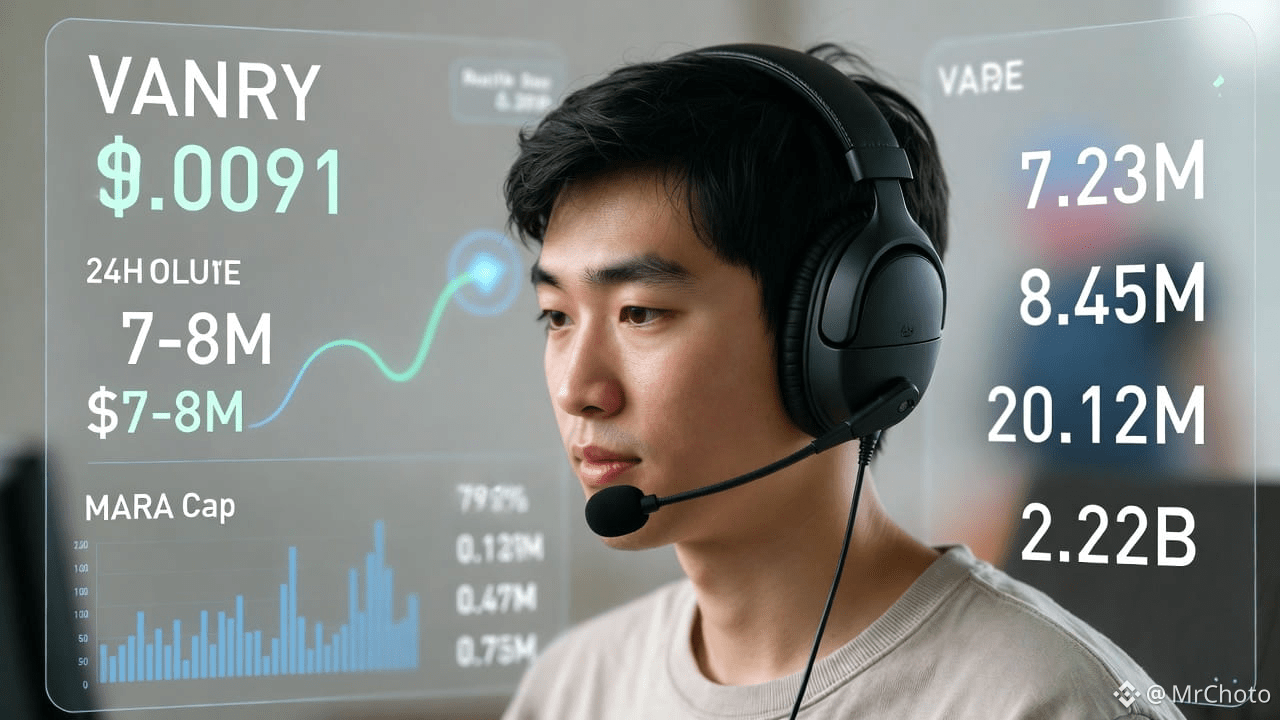
According to today's market data, VANRY is trading at about $0.0091 with a 24-hour volume of about $7–8 million, a market cap of about $20 million, and a circulating supply of about 2.22 billion with a maximum supply of 2.4 billion. That's small cap territory, which is precisely why narratives are less important than execution. You don't win at this size just because you have a weekend trend. If users stick around, you win.
This is where Vanar's "cross vertical" strategy transcends beyond a catchphrase. There is a retention issue with Web3. The majority of chains can employ incentives to create users for a day. However, rewards don't foster loyalty. Individuals arrive, cultivate, and depart. The foundation of real consumer platforms is habit loops: you come back because something is entertaining, helpful, social, or non-extractive.
Because gamers are already familiar with digital economies, gaming is the most powerful retention engine Web3 has ever had. They had been residing there for more than 15 years. They purchase skins, complete quests, exchange goods, join guilds, and develop their identities. Vanar places a strong emphasis on gaming and virtual world infrastructure, including links to Virtua Metaverse other VGN-style gaming networks that are discussed under ecosystem coverage. Retention ceases to be theoretical if a chain is able to integrate itself into gaming loops. It turns into a behavior.
However, stacking verticals on top of one another is the deeper edge. Consider a user who enters to play a quest-based game. They receive something. In a metaverse setting, the object becomes an identity. Content is produced by their action. Creator tools are used to disseminate content. Sponsored drops or quests are layered with brand agreements. Stablecoins are used for payments since users don't willing to take on price risk. AI features optimize app economy, suggest quests, and personalize the experience. This is the true meaning of cross-vertical: "each product feeds the other product's retention," not "we do many things."
Vanar has been promoting the concept of AI-native infrastructure for Web3 applications, presenting their stack as designed for AI workloads rather than AI marketing. AI is essentially the modern UX cheat code, therefore it matters from the perspective of customer growth even if the market agrees in the long run. Customers now demand personalization. They anticipate smoother flows, fewer clicks, intelligent discovery, and recommendations. In the past, Web3 has produced the opposite results: increased danger, confusion, and clicks. Vanar is a retention tool if it can make apps feel "intelligent by default."
The non-obvious point from an investor's point of view is that cross-vertical product strategy modifies the definition of "network growth." Growth in DeFi initial ecosystems is based on volume and TVL. Growth in consumer ecosystems is measured by sessions, time spent, conversion from visitor to wallet, and repeat users. Vanar's product mix indicates that it is pursuing customer metrics instead of just financial metrics, which is a more difficult but, when successful, more justifiable course of action. If millions of people use the app every day, you don't need limitless liquidity.
Additionally, there are tangible indications that the ecosystem is still being actively promoted. For instance, on January 20, 2026, Binance Square launched a VANRY CreatorPad campaign that offered token voucher rewards based on user involvement. Such campaigns don't demonstrate long-term success, but they do demonstrate that the team is still creating distribution channels and purchasing attention, which is important in consumer markets where awareness is half the battle.
However, none of this eliminates danger. Because they lose focus, cross-vertical methods consistently fail. Nothing becomes sticky if every product is "coming soon." Users abandon gaming apps if they feel like financial apps dressed in game skins. Consumer usage collapses if the chain is unable to handle affordable, dependable transactions at scale because customers cannot stand uncertainty.
Therefore, hype cycles are not a clean tool to track Vanar. It's through retention. Are customers coming back without being bought off? Do apps use the chain not for grants but because it lowers friction? Is there a discernible vertical loop connecting one product to another?
If you are trading VANRY, consider it as it is today: a small-cap asset whose upward case rests on consumer adoption compounding across goods, but whose sentiment can swing sharply. If you're investing, consider the more mature question: is it possible for non-crypto people to engage in cryptocurrency activities on Vanar without being aware of it?
Now that's the bar.
Don't only consider the cost if you wish to implement this thesis. Observe the merchandise. This week, choose one Vanar consumer app or ecosystem product, use it like a regular user, and give it a harsh evaluation. It's alpha if it feels smooth. If it seems like homework, the retention issue is back.#vanar $VANRY
