

Vanar Chain is a Layer1 blockchain designed not around speculation, but around broad practical adoption. Built from the ground up with an eye on gaming, entertainment, artificial intelligence, ecological sustainability, and brand integration, Vanar aims to bring the next three billion consumers into Web3. This is not a small claim; it’s a roadmap toward bridging mainstream digital experiences with decentralized infrastructure.
At its heart lies VANRY, the native token powering the network and fueling its economy. VANRY is listed on major exchanges like Binance, where real-time price data, market cap, and trading volume can be tracked, making the token both accessible and transparent for retail and institutional participants alike.
From Vision to Reality: What Vanar Chain Is Solving
Blockchain adoption has historically struggled on three fronts:
High Costs & Slow Transactions – Even with Layer-2 solutions, many platforms struggle to facilitate near-instant, cheap interactions that users accustomed to Web2 expect.
Complex Onboarding – Most blockchains require deep technical fluency, from wallet management to gas optimization.
Limited Real-World Utility – Beyond trading or DeFi, real-world brand use cases remain niche.
Vanar directly addresses these issues. It was engineered to be fast, cost-effective, and accessible—tailored for games, entertainment platforms, AI applications, and consumer brands instead of purely financial ecosystems. According to the project’s official documentation, Vanar has ultra-fast transaction throughput and very low fees (around $0.0005 per transaction), designed to rival Web2 responsiveness.
This foundation makes it possible for developers to build apps with real-time user interactions—whether for in-game purchases, virtual experiences, or AI-backed digital services.
A Blockchain Built on Innovation
Layer-1 Core with EVM Compatibility
Vanar is a true Layer-1 chain, meaning it operates as an independent blockchain rather than as a sidechain or Layer-2 rollup. It offers compatibility with the Ethereum Virtual Machine (EVM), which makes it familiar to developers who already build on Ethereum and other EVM-compatible platforms. This design choice significantly lowers the barrier for migrating existing decentralized apps (dApps) or creating new ones with minimal friction.
AI-Native Architecture
Vanar stands out by integrating artificial intelligence directly into the blockchain layer. Tools like Neutron (AI data compression) and Kayon (on-chain reasoning engine) are embedded within the protocol. This approach enables smart contracts and on-chain agents to store, compress, reason about, and act on data without external dependencies, solving a key limitation of many blockchains that rely on off-chain storage like IPFS or AWS.
For example, Neutron can compress files significantly—reported up to 500:1—and store them as “Seeds” that remain accessible on-chain. Kayon enables contracts to query and reason over these datasets. These capabilities transform the blockchain from a static ledger into a dynamic computational substrate for AI-driven apps, smart agents, and context-aware Web3 interactions.
Hybrid Consensus Mechanism
Vanar’s consensus model combines elements of Proof of Stake (PoS), Delegated PoS (dPoS), and Proof of Reputation (PoR). Rather than solely rewarding the most capital-rich stakeholders or the most computationally powerful, the network emphasizes validator credibility and reliability—a system meant to encourage participation from respected institutions and real-world entities alongside traditional stakers.
This hybrid setup helps maintain transaction speed, energy efficiency, and security, while mitigating some of the centralization risks seen on purely PoS or PoW networks.
Vanar’s Product Ecosystem: Beyond the Blockchain
Vanar isn’t just “another chain.” It’s a platform of products and tools built to accelerate tangible Web3 adoption.
1. Virtua Metaverse
Virtua Metaverse represents Vanar’s entry into immersive digital worlds—virtual spaces where users can interact, socialize, and transact using blockchain technology. This isn’t just a conceptual virtual universe; it’s designed to integrate with the broader Vanar ecosystem, with NFTs, in-world assets, and microtransactions enabled through VANRY.
2. VGN Games Network
Gaming represents one of the most accessible and engaging onboarding vectors for everyday consumers. The VGN Games Network provides developers with the infrastructure to build games that run natively on Vanar, with blockchain features like player ownership of in-game items, low-fee microtransactions, and integrated token economies.
This setup removes the friction of typical Web3 gaming—no high gas costs or clunky bridges are needed for users to interact with the blockchain. As a result, game developers can focus on gameplay, and players can enjoy seamless experiences that feel more like modern Web2 games than early blockchain experiments.
3. Vanar AI Tools
Vanar’s AI integration extends beyond infrastructure. It includes tools for content personalization, generative environments, and interactive AI agents that can respond to real-time events. This AI layering enables dynamic experiences—like characters that interact using natural language or contract systems that adjust behavior based on learned patterns—which are impossible on most other chains without heavy off-chain computation.
4. Eco & Brand Solutions
Recognizing the growing demand for sustainability and enterprise integration, Vanar includes modules for ecological tracking and transparency—helping brands quantify blockchain energy consumption and align with environmental goals. Additionally, Vanar’s brand solutions toolkit makes it easier for mainstream companies to experiment with Web3 without needing extensive in-house blockchain expertise.
5. PayFi & Real-World Assets
Vanar also positions itself for PayFi (Payment Finance) and tokenized real-world assets, suggesting a future where everyday financial activities—like cross-border payments or asset tokenization—are settled on chain with minimal friction.
VANRY Token: The Economic Engine
The VANRY token is the heart of the Vanar ecosystem. Originally issued as $TVK under the Terra Virtua Kolect identity, the token was swapped 1:1 to VANRY during a rebrand that coincided with Vanar’s strategic shift toward broader adoption. Binance supported this transition, enabling deposits and withdrawals of VANRY and discontinuing $TVK support.
Here’s what you need to know about VANRY:
Utility & Mechanics
Gas & Transaction Fees: VANRY is the native gas token on Vanar Chain, required for all transactions and contract executions.
Staking & Network Security: Holders can stake VANRY to participate in network validation, earning rewards in the process.
Governance (Future Potential): As the network evolves, VANRY holders may gain voting rights on protocol upgrades and ecosystem decisions.
Supply & Tokenomics
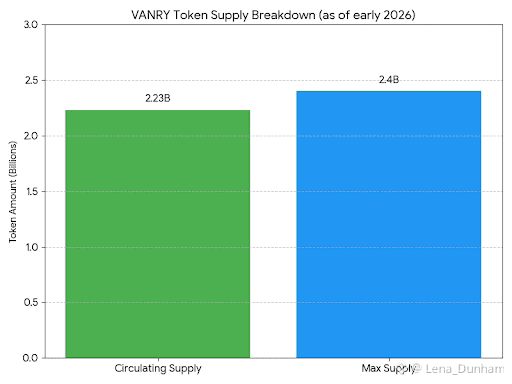
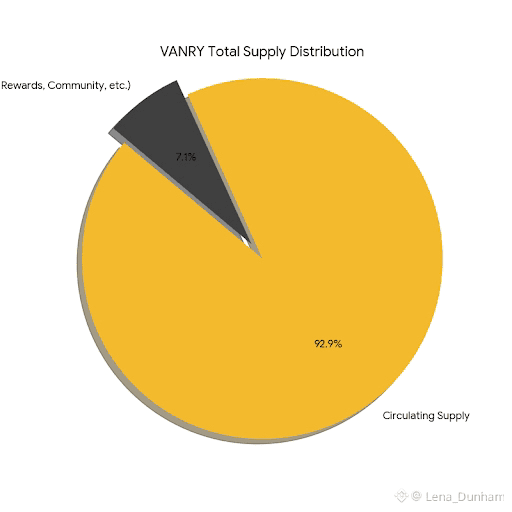
Vanar’s tokenomics are designed for long-term sustainability. The total maximum supply is capped at 2.4 billion tokens, with a significant portion allocated for validator rewards over approximately 20 years. Token allocation also includes community initiatives and development incentives, and notably no dedicated team allocation—underlining a community-centric ethos.
Market Performance: Real Numbers from Binance
According to Binance’s official market page, VANRY is actively traded and has a live price (as of early 2026) of approximately $0.0091 per token, with a circulating supply of around 2.23 billion tokens and a market cap near $20.22 million USD. The asset appears on various trading pairs, including VANRY/USDT, and supports straightforward spot trading and wallet storage via Binance’s platform.
While prices are volatile (like most crypto assets), exchange data show active trading volumes and accessibility—key pieces of evidence for real liquidity and community engagement.
Where Vanar Fits in the Broader Blockchain Landscape
Vanar Chain stands at a unique intersection:
Mainstream Utility – It isn’t focused purely on DeFi or speculation, but on real applications consumers interact with daily.
AI & Web3 Fusion – By embedding AI logic into the blockchain itself, Vanar proposes a future where contracts are not just static code, but active, intelligent participants in decentralized systems.
Brand & Entertainment First – Partnerships with game studios, entertainment companies, and even financial platforms underline Vanar’s practical focus.
Challenges & Realities Ahead
For all its promise, Vanar also faces challenges:
Adoption against Giants: Competing with entrenched ecosystems like Ethereum, Solana, and others for developer mindshare isn’t easy.
Real-World Integration: Getting mainstream brands to adopt decentralized infrastructure requires not only technical capability but also legal clarity and clear ROI.
Market Dynamics: Like all crypto, VANRY’s price and sentiment swing with broader market trends.
Yet, Vanar’s focus on practical utility, supported by real exchange listings like Binance and ongoing ecosystem growth, suggests it isn’t merely another speculative project. Instead, it represents a strategic evolution in how blockchains can serve both developers and everyday users.
Conclusion: Toward a Web3 That Works for Everyone
Vanar Chain is more than a technical experiment it’s a vision for an accessible, useful, and scalable Web3 future. By addressing speed, cost, usability, and real-world applications and backing it all with a comprehensive product ecosystem and live market presence on exchanges like Binance aims to redefine what mainstream blockchain adoption looks like. Whether you’re a game developer building the next immersive title, a brand exploring decentralized engagement, or a curious user watching blockchain evolve, Vanar offers a compelling glimpse into what comes next.#Vanar @Vanarchain $VANRY
