

Walrus is a decentralized storage network but not merely another distributed disk drive. It addresses the technical and economic limitations of previous decentralized storage projects by combining several key innovations:
1. Designed for Large Unstructured Data
Walrus enables developers and users to store large files like videos, images, and datasets — referred to collectively as “blobs” — in a decentralized network of storage nodes. These are typically too large and too costly to store directly on most blockchains, but Walrus makes this both feasible and cost‑effective.
This capability creates a path for true Web3 data storage — where data isn’t hosted on AWS, Google Cloud, or other centralized servers, but across a distributed network that’s resistant to censorship, downtime, and central point of control.
2. Built on the Sui Blockchain
Walrus is natively integrated with the Sui blockchain, a high‑performance layer‑1 network designed for low‑latency smart contracts and data management. Sui’s infrastructure allows Walrus to store metadata and cryptographic proofs of storage availability on‑chain, while the bulk of large data files live in a distributed backend controlled by the protocol.
This integration enables:
Smart contract composability, meaning storage references can be used directly in decentralized applications (dApps).
On‑chain verifications, so anyone can confirm that data is held correctly without downloading terabytes of files.
Scalable performance, enabling real‑time access to large datasets in ways that older decentralized storage systems struggled to achieve.
3. Red Stuff: Efficient Erasure Coding
A standout technical feature of Walrus is its use of an advanced erasure‑coding algorithm called “Red Stuff.” Rather than complete replication (which is costly), this algorithm breaks files into encoded fragments that are spread across storage nodes.
This approach dramatically improves resiliency and reduces cost — even if many nodes go offline, the data can be reconstructed from a subset of fragments.
How Walrus Works — A Practical Look
To understand Walrus in real‑world terms, imagine:
Uploading a video or dataset — Instead of storing it on a single centralized server, the file is fragmented and encoded.
Distributed storage — These fragments are distributed across many decentralized nodes.
Proof of availability — Cryptographic proofs are written on the Sui blockchain, confirming each fragment is held by storage nodes.
Efficient retrieval — When needed, fragments are gathered and recombined to produce the original file — often delivered through standard web interfaces and content delivery networks (CDNs).
This architecture ensures:
Decentralization: No single party controls the data.
Security & privacy: Access and storage proofs are verifiable and tamper‑resistant.
Cost‑efficiency: Storage is significantly cheaper than fully replicated systems.
Use Cases: Beyond Just Storage
Walrus targets multiple real‑world applications, making it more than just a file repository:
Decentralized Web Hosting
Walrus enables developers to host fully decentralized websites (called Walrus Sites) that live on the decentralized storage layer and can be referenced on‑chain. These pages remain accessible even if individual nodes fail or traditional hosting providers go offline.
NFTs and Multimedia DApps
Rather than storing the media part of NFTs (like images or videos) on centralized IPFS gateways or cloud servers, Walrus supports on‑chain data references with decentralized storage — a true expression of Web3 ownership.
AI and Large Datasets
AI models rely on massive datasets. Walrus’s architecture lets developers store and verify these datasets in decentralized environments — offering trust, accessibility, and decentralized auditability for AI‑powered systems.
Blockchain History and Data Archives
Walrus can serve as an alternative storage layer for blockchain state, checkpoints, and archival history, offering decentralized availability that doesn’t burden the underlying blockchain’s main ledger.
The WAL Token — Crypto Fuel for Decentralized Storage
The WAL token is the native utility and governance token of the Walrus protocol. It anchors the entire Walrus economy and is crucial to how the network functions.
Core Token Functions
1. Payment for Storage Services
Users pay WAL when uploading and storing data on the network. Payments are distributed over time to storage node operators and other participants who maintain the system.
2. Staking and Network Security
Storage nodes must stake WAL tokens to participate, while token holders can delegate tokens to nodes and earn a share of rewards. This Delegated Proof‑of‑Stake (DPoS) mechanism incentivizes good behavior and ensures reliability across the network.
3. Governance
WAL holders participate in governance decisions — choosing parameters like storage pricing, penalties, slashing conditions, and other protocol upgrades. This gives the community a voice in the future of the network.
Tokenomics at a Glance
Maximum Supply: 5,000,000,000 WAL
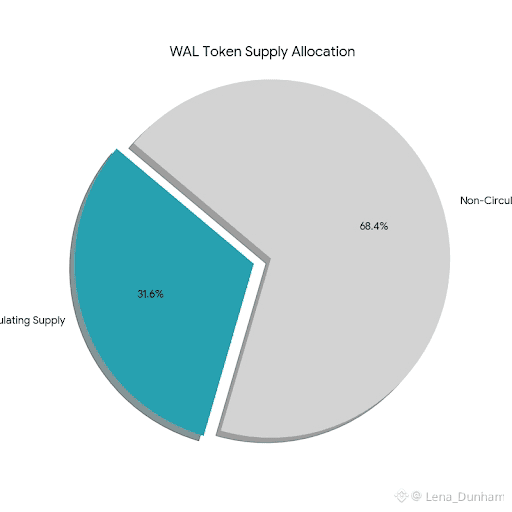
Circulating Supply: Around 1.58 billion at the latest measurement, indicating broad participation but with significant tokens yet to be unlocked or distributed.
Deflationary Elements: Some fee structures and burning mechanics (depending on network policies) help manage inflationary pressures.
Walrus in the Market: Real Data from Binance
Walrus is not just a theoretical protocol — it’s actively traded and tracked in real markets. According to Binance’s official price page (as of January 2026), the WAL token is:
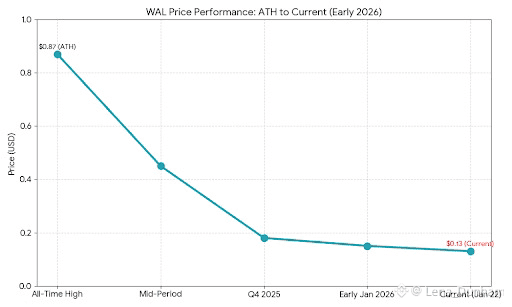
Trading around: ~$0.13 per token (WAL / USD)
Market Cap: Approximately $208 million USD
24‑Hour Trading Volume: Around $13.7+ million USD, indicating solid market activity.
Circulating Supply: ~1.58 billion WAL — about 31.5% of the total.
All‑Time High: Around $0.87 USD — showing that the token has seen much higher prices earlier in its lifecycle.
This price range and market presence reflect increasing investor interest in data infrastructure tokens, a category that stands alongside decentralized computing and oracle networks as vital Web3 infrastructure.
Binance listed Walrus with multiple trading pairs — including WAL/USDT, WAL/USDC, WAL/BNB, WAL/FDUSD, and WAL/TRY — and featured it as part of a HODLer Airdrop program, which helped introduce the token to a wider audience by rewarding active holders of BNB with WAL tokens.
Why Walrus Matters in the Broader Blockchain Landscape
Walrus addresses a foundational pain point: how to store data on Web3 networks without relying on centralized cloud providers. This matters for:
NFT platforms that want decentralized media storage.
AI systems that need tamper‑proof datasets.
DeFi and dApp ecosystems that depend on large data availability.
Enterprise applications that cannot tolerate single points of failure.
By bringing programmable, efficient, decentralized storage into mainstream use — backed by real token economics and active exchange listings — Walrus is building a bridge between current blockchain limitations and future decentralized applications that require massive, reliable data storage.
Conclusion — Beyond the Buzz
Walrus is more than another crypto token: it’s a practical infrastructure protocol designed for the next wave of decentralized applications. Through its integration with Sui, advanced data storage algorithms, real utility tokenomics, and active trading market, it’s helping pave the way for a blockchain world where data is truly decentralized and owned by its creators and users — not corporations.
As we see blockchain evolve beyond simple smart contracts and financial applications into areas like AI, media, and real‑time data services, protocols like Walrus remind us that data infrastructure is just as important as the chains themselves.

