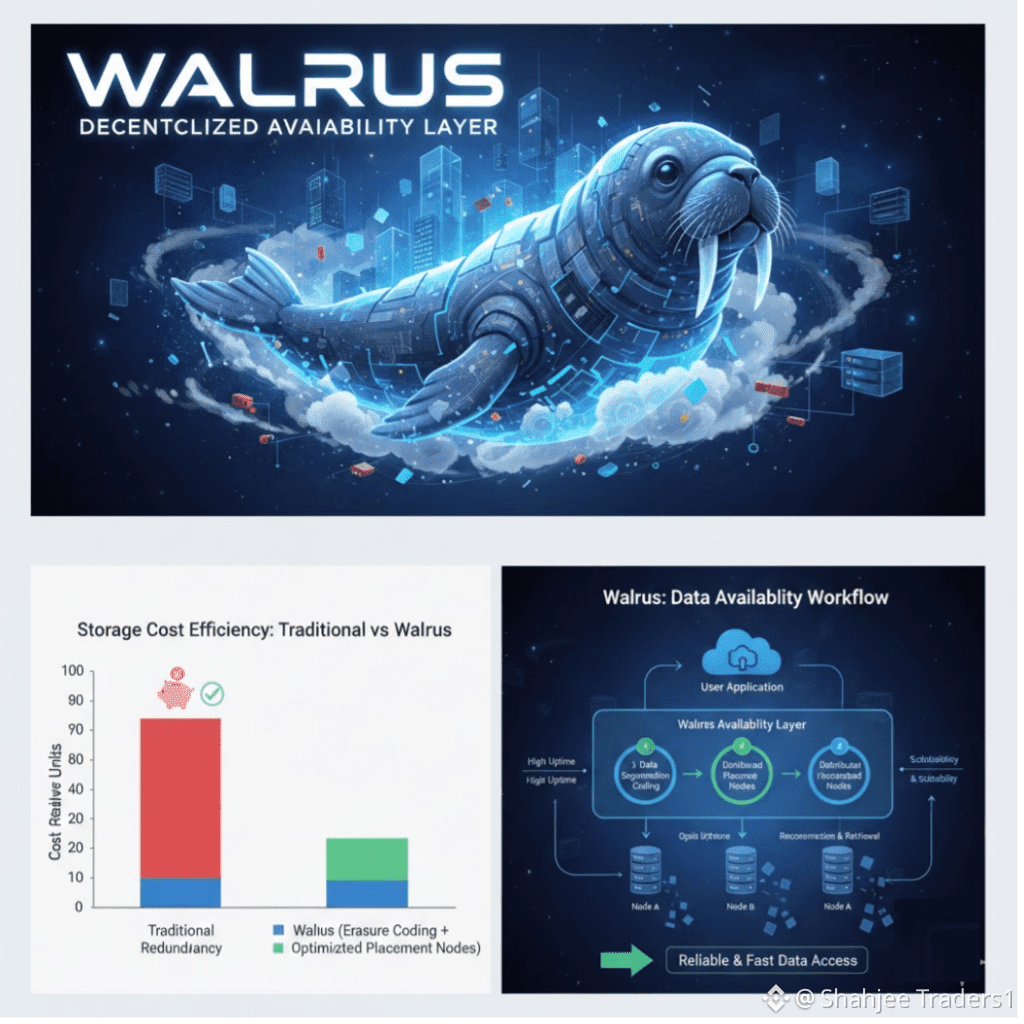
People often talk about storage in terms of having extra copies and keeping things forever. These things are important. They do not really meet the needs of real world applications. Walrus looks at the problem in a way. It focuses on making sure decentralized storage is available when you need it than just keeping your data safe. Decentralized storage like Walrus is really, about being able to get to your stuff when you want to.
So when we talk about availability we are talking about whether we can get to the data when we need it. This is important because even if the data is actually there it might not be available when we need it. This can happen for a lot of reasons like when the data's broken up into little pieces or when the systems that are supposed to work together fail to do so or when the network is really busy.
The Walrus system is designed to fix this problem by making sure that the data is shared and retrieved and put back together in a way that works. The Walrus system does this by coordinating how the data is distributed and how it is retrieved and reconstructed which's what the Walrus system is all about making data availability better, with the Walrus system.
The main idea of Walrus is that storage systems need to think about how things work. Sometimes nodes are not working networks are slow. People access things at different times. Walrus does not assume everything is perfect. Walrus structures the availability of data around what's likely to happen based on how systems really behave. This is what Walrus is, about it is the core of Walrus.
Walrus is really good at keeping the data you need separate from the parts of your system that use that data. This means that your applications can count on Walrus to make sure your data is always available, without having to worry about how the data's stored.
The main advantage of this is that you get a system that is made up of parts, where the parts that do the work can be made bigger or smaller without affecting the parts that store your data. This way your data is always safe. You can still use it when you need to. Walrus makes this happen by being an availability layer.
The main thing, about Walrus is that it uses something called erasure coding. It also uses coordinated placement. This means that the data is broken down into pieces and then these pieces are spread out across many different nodes. This way even if some of the pieces are not available the data can still be recovered. Walrus does this to make itself more resilient. It does not need to make a copy of everything, which is a good thing because making copies of everything can be very inefficient when you are dealing with a lot of data.
Walrus also says that it is very important to get the data in a way that we can trust. It is not about getting the data back but also about how fast and how well we can get it back. Walrus makes sure that the way it gets the data back is always the same so we can get it back quickly and reliably. This is very important for things that need to work like some applications that use Walrus. Walrus does this by making the path to get the data back very smooth and by working with other things, which helps to reduce the time it takes to get the data back. This is what Walrus is good, at making sure that the data is always available when we need it and that we can get it back quickly and reliably with Walrus.
The cost is a thing to think about. Traditional storage systems that use redundancy are very expensive because they cost more and more as you add copies. Walrus is better because it finds a balance, between having extra copies and being able to recover things when they go wrong so you get the things you need without having too many extra copies. Walrus does this by making sure that it can always get your things back. It does not make too many extra copies, which keeps the cost down.
When we think about the applications that use Walrus we see that Walrus helps systems that need to get to their data in a way that's reliable. For example Walrus is useful for things like rollups and content distribution layers. It is also useful for applications that need to get to data that is not on the blockchain. If these applications cannot get to their data when they need it the whole application can stop working. Walrus is important for these types of applications, like applications and rollups because they need dependable data access.
The Walrus thinks about availability in a way. It is not something that happens with storage. The Walrus treats availability as a part of the whole system. This is important because decentralized applications are being used more and more for things. When this happens it is really important that the system is always working and that people can get to it all the time. The Walrus and its availability are crucial, for these decentralized applications.
By focusing on availability under real conditions, Walrus provides infrastructure that aligns with how distributed systems are actually used. The design reflects a shift from theoretical guarantees to operational reliability, positioning Walrus as a foundational layer for data-dependent decentralized applications.