

Walrus, a decentralized storage and data availability protocol intended to change how applications, developers, and enterprises store large files in a trustless network — not just tokenized assets or simple smart contract state, but real-world data and media at scale.
Built on the Sui blockchain, Walrus blends advanced storage engineering, cryptographic proofs, and on-chain programmability to offer a compelling alternative to centralized cloud storage like AWS or Google Cloud — and even to earlier decentralized solutions such as IPFS, Arweave, or Filecoin. The native token that powers this ecosystem is WAL, which plays a central role in payments, staking, governance, and network security.
The Problem Walrus Aims to Solve
Traditional blockchains were never designed to store large binary data efficiently. On networks like Ethereum and Bitcoin, every byte stored on-chain must be replicated across every node — which makes storing large files prohibitively expensive and highly inefficient. Meanwhile, centralized cloud storage means entrusting data to corporations that could censor, modify, or restrict access.
Walrus approaches this gap with a hybrid decentralized system that stores only critical metadata on chain (such as proofs of storage and blob identifiers), while the actual data blobs (large binary objects like videos, datasets, etc.) are stored across a dispersed network of independent storage nodes.
By architecting storage this way, Walrus combines:
Decentralization: No single point of control or single cloud provider owns the data.
Cost efficiency: Uses erasure coding to spread data fragments across nodes in a highly efficient manner.
Programmability: Developers can write and store big data objects while still interacting with them through smart contracts.
This means Web3 applications can finally treat data as a first-class programmable asset — just like tokens and smart contracts.
How Walrus Works: Technology and Architecture
At the core of Walrus are several key technological innovations that make decentralized storage practical, resilient, and verifiable:
1. Blob Storage and Metadata on Sui
Walrus treats large files as “blobs” — binary large objects that are too big to store directly on a blockchain. Instead of embedding the data itself on chain, only metadata and proof of availability is maintained on the Sui Layer-1. This allows for:
Smart contracts to reference large data assets.
On-chain verification that a file exists and can be retrieved.
Interactions with data without unnecessary gas costs.
Because of this hybrid design, developers can build applications that seamlessly combine smart contract logic with real data storage without facing the high costs usually associated with storing big files on blockchain networks.
2. Erasure Coding (Red Stuff)
Instead of traditional full replication — where every node stores a complete copy of every file — Walrus uses a sophisticated erasure-coding algorithm called Red Stuff. This technique splits data into many fragments, encodes them, and distributes shards to many storage nodes. As a result:
The network can reconstruct data even if many nodes go offline.
Storage redundancy is maintained efficiently, using only a fraction of the space traditional replication methods would require.
Costs are significantly reduced compared to full replication solutions.
This approach makes Walrus more durable and cost-effective while still meeting strong security and availability guarantees.
3. Delegated Proof of Stake (dPoS)
Walrus uses a delegated proof-of-stake mechanism where WAL token holders can delegate their tokens to storage nodes, which then participate in storing and serving blob data. This serves multiple purposes:
Incentivizes node operators to reliably host and serve data.
Creates economic disincentives (via penalties/slashing) for underperforming behavior.
Incentivizes token holders to participate in network governance and resource allocation.
4. Flexible Developer Access
Developers can interact with Walrus via a variety of interfaces — including command-line tools, SDKs for popular languages, and even HTTP APIs — allowing integration into both Web3 and traditional Web2 environments. This flexibility bridges the gap between decentralized storage and mainstream development workflows.
Core Uses and Use Cases
Walrus is not just a storage silo. Because it’s programmable and integrated with Sui’s smart contract environment, it unlocks a range of powerful real-world use cases:
Decentralized Web Hosting
With Walrus Sites, developers can host entire decentralized front-end applications directly on the network. These sites are stored on Walrus and referenced on chain, ensuring censorship resistance and persistent availability — even if centralized servers go down.
NFTs and Rich Media
NFTs have often relied on centralized storage for their media (images, videos, etc.). Walrus offers a way to store rich NFT media in a decentralized, verifiable, and cost-efficient way, which is critical as NFTs expand into high-resolution and dynamic content.
AI Datasets and Models
Artificial intelligence applications often rely on massive datasets or large trained models. Walrus enables developers to store and serve these large datasets in a decentralized fashion, while ensuring proofs of storage and retrievability remain verifiable on chain — a major technical advantage for decentralized AI architectures.
Blockchain Data Archiving
Walrus can serve as an alternative storage layer for full blockchain history, checkpoints, and other large on-chain datasets — keeping them accessible, available, and resistant to censorship. This is particularly valuable for scaling networks and archive nodes.
The WAL Token: Fueling the Ecosystem
The WAL token is the heartbeat of the Walrus protocol. Built natively on the Sui blockchain, it serves several critical functions:
1. Payment for Storage
Users pay in WAL when uploading data to the network. These fees are distributed over time to storage node operators and stakers as rewards, aligning incentives across the system.
2. Staking and Security
WAL can be delegated or staked to storage nodes, strengthening network security. Well-performing nodes are rewarded; underperforming ones may face slashing when that feature is activated.
3. Governance Participation
Token holders can participate in governance, voting on parameters such as pricing, penalty settings, and future upgrades to the protocol. This decentralized governance model helps align community and long-term development incentives.
Token Supply and Economics
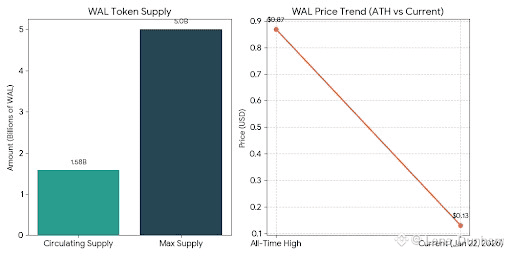
Max Supply: 5,000,000,000 WAL tokens.
Circulating Supply: As of early 2026, around 1.58 billion WAL tokens are in circulation.
This distribution leaves a significant portion of the token supply yet to be unlocked or vested, which could factor into long-term ecosystem incentives and governance.
Market Performance: Latest Data from Binance
According to official price data from Binance, WAL is trading around $0.13 USD per token, with a market capitalization of approximately $206 million and 24-hour trading volume around $14 million USD as of January 22 2026. It has a circulating supply near 1.58 billion, with a maximum supply capped at 5 billion.
This price level is significantly below its all-time high of roughly $0.87, which reflects broader cyclical trends in infrastructure tokens as well as evolving adoption dynamics in data-centric crypto projects.
WAL’s trading pairs on Binance include WAL trading against USDT, USDC, BNB, FDUSD, and TRY — providing accessible liquidity for both retail and institutional participants.
Why Walrus Matters in Web3 and Beyond
What distinguishes Walrus from many blockchain projects is its practical infrastructure focus. Instead of chasing speculative narratives around DeFi yield or meme token trends, Walrus is building the fundamental plumbing of tomorrow’s decentralized internet and decentralized AI infrastructure. It moves beyond speculative token narratives to real utility — making it possible for developers to build apps that actually need decentralized large-file storage, verifiable data availability, and programmable data assets.
As Web3 and decentralized applications mature, the ability to store, retrieve, verify, and build with data — not just tokens — will become increasingly important. Whether it’s NFTs with rich media, decentralized games, AI model hosting, or decentralized web hosting, Walrus is positioned to be a key part of that foundation.
Looking Ahead: Challenges and Opportunities
Walrus has clear potential, but it also faces challenges common to DePIN and decentralized storage networks:
Competing ecosystems like Filecoin, Arweave, and emerging layer-2 storage approaches.
The need for broader developer adoption and tooling maturity.
Market sentiment and liquidity dynamics that influence price and incentives.
Still, the protocol’s integration with Sui, its real use cases, and its robust design make it a standout project in decentralized storage — one that could play a significant role as Web3 moves beyond tokenization into data-driven applications and services.
Conclusion: Moving Beyond Hype into Real Utility
Walrus isn’t just another blockchain token — it’s an infrastructure protocol built for data. Its design reflects a deep understanding of the core problems facing decentralized storage: cost, scalability, verifiability, and programmability. Supported by smart contract integration on Sui, advanced erasure-coding technology, token-based economics, and decentralized governance, Walrus empowers developers, enterprises, and everyday users to store and use large data on chain — in a way that traditional solutions simply can’t match.
By solving one of the longest-standing challenges in Web3 infrastructure, Walrus stands as a practical, powerful, and forward looking component in tomorrow’s decentralized ecosystem driven not by hype, but by real technical innovation and market engagement.#Walrus @Walrus 🦭/acc $WAL