

Walrus is a next generation decentralized storage and data-availability network designed to make storage secure, private, programmable, and affordable unlocking new opportunities for builders, enterprises, and users in Web3.
A New Infrastructure for Data in the Web3 Era
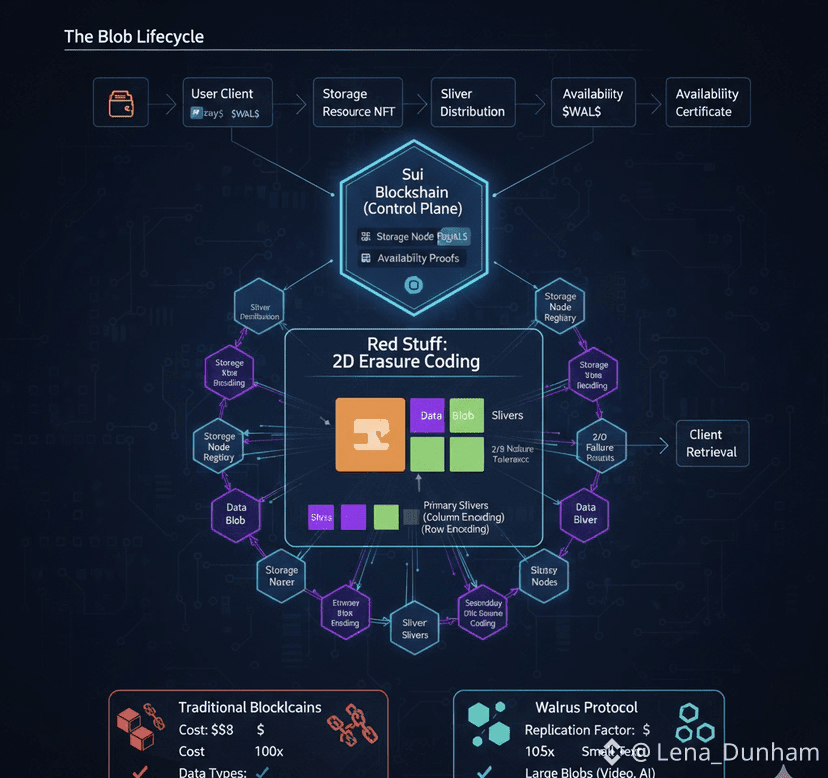
At its core, Walrus is not just a storage service — it’s a foundational infrastructure layer that treats data as a first-class programmable asset. Instead of forcing developers to store large files on-chain (which is prohibitively expensive and inefficient), the protocol stores only on-chain metadata and proofs of availability, while the raw data itself (“blobs”) is distributed across a network of decentralized storage nodes.
This model ensures that:
Data remains decentralized and censorship-resistant — no single party controls access.
Costs are significantly lower compared with traditional cloud or full-replication decentralized storage.
Data can be verified programmatically using cryptographic proofs that are recorded on the Sui blockchain.
The key innovation that makes all this possible is Red Stuff, Walrus’s custom erasure-coding algorithm. When a file is uploaded, it’s split into dozens (or more) of smaller pieces called slivers, which are stored across a wide network of nodes. Even if some nodes go offline, the original file can be reconstructed from a subset of slivers — a design that achieves high availability and resilience with efficient storage overhead.
How Walrus Works: Blobs, Slivers, and Proofs
1. Blob Storage & Encoding
When a user uploads a file — whether a video, dataset, or NFT media — it’s divided into fragments and encoded by the Red Stuff algorithm. These fragments are then distributed to storage nodes across the network. This distribution ensures that no single node holds the complete file, boosting security and decentralization.
2. On-Chain Metadata
Instead of writing the entire file to the Sui blockchain (which would be costly and slow), Walrus stores only metadata and cryptographic proofs of availability on chain. These proofs allow anyone to confirm a file’s presence and retrievability without needing to download the entire file.
3. Efficient Retrieval
When a stored file is requested, an aggregator collects the necessary slivers from different nodes, reconstructs them, and delivers the original content efficiently. This system works well even for large datasets, making it suitable for applications like decentralized web hosting, AI model storage, or NFT media delivery.
Walrus in Action: Real-World Use Cases
Walrus is not a niche experiment — it’s built for broad practical applications that are already emerging across Web3 sectors:
Decentralized Web Hosting
Developers can host fully decentralized websites (Walrus Sites) directly on the network. Content is stored across nodes and can be tied to human-readable names via SuiNS (Sui Name Service). This approach creates websites that are truly censorship-resistant and don’t depend on centralized servers.
NFTs and Media-Rich DApps
NFTs often include media assets like high-resolution images or videos. Walrus enables developers to store these assets securely and decentralized, ensuring that the media remains accessible even if traditional hosting services fail.
AI Datasets and Models
AI applications require storage for large datasets and model weights. Walrus makes this possible in a decentralized way, with programmatic access and verifiable availability — a game changer for decentralized AI systems.
Blockchain Data Archiving
The protocol can also serve as an alternative storage layer for blockchain history, checkpoints, and large data records, offering another layer of security and redundancy beyond the base blockchain itself.
The WAL Token: Powering Storage, Governance, and Security
The native WAL token is central to the operation and economics of the Walrus protocol. According to real-time market data from Binance, Walrus (WAL) is trading around ~$0.13 USD, with a market capitalization of approximately $206.7 million USD and a circulating supply near 1.58 billion tokens against a maximum supply of 5 billion WAL.
Core Functions of WAL
Storage Payments: Users prepay in WAL for data storage. Storage fees stabilize pricing and ensure predictable long-term costs.
Staking & Security: WAL tokens can be delegated or staked to storage nodes, securing the network and rewarding participants for uptime and reliability.
Governance: WAL holders participate in protocol governance, voting on key parameters like storage pricing, penalties, and upgrades.
Over time, as the network and decentralized applications grow, demand for WAL may increase because it’s not just a speculative asset — it’s a payment and utility token essential to the protocol’s core use cases.
Growing Ecosystem and Adoption Trends
Since its mainnet launch in early 2025, Walrus has attracted attention from developers, builders, and enterprises seeking decentralized alternatives to cloud storage. The project has been backed by notable venture capital and ecosystem partners, and its listing on major exchanges like Binance has increased liquidity and visibility.
Beyond traditional storage use cases, Walrus is also positioning itself as a data infrastructure layer for the AI era — enabling open data markets, programmable storage access, and provable data lived records. Partnerships with AI platforms and media tools further expand its real-world relevance.
Why Walrus Matters for Web3
Traditional cloud storage providers like Amazon Web Services or Google Cloud dominate today’s web infrastructure, but they come with centralization, control, and censorship risks. Decentralized alternatives like Filecoin or Arweave pioneered blockchain-based storage, but they are often limited by cost, scalability, or programmability.
Walrus takes lessons from these earlier efforts and improves upon them by offering:
Programmable storage integrated with smart contracts — developers can reference and manipulate stored data directly on chain.
Scalable and resilient architecture — data remains available even when many nodes are offline.
Lower cost per unit of storage compared to full replication models.
Integration with Sui’s high-speed, high-throughput blockchain — making storage interactions faster and more efficient.
This combination makes Walrus a compelling foundation for building next-generation decentralized applications that rely on rich data, from NFT marketplaces and gaming platforms to AI training environments and decentralized media networks.
Conclusion: A Foundation for Decentralized Data
Walrus represents a significant step forward in decentralized infrastructure. By making large data storage and retrieval secure, efficient, programmable, and decentralized, it tackles one of the most practical challenges standing between Web3 theory and real-world adoption. Its integration with Sui, innovative encoding methods, and utility-driven tokenomics position it as a key layer in the future of decentralized storage.
Whether you’re a developer building decentralized apps, a business seeking censorship-resistant storage, or a user interested in data sovereignty, Walrus offers a robust and forward-looking platform that pushes the boundaries of what blockchain networks can do with data beyond simple token transfers.

