The first time I saw a walrus cry, I didn't believe it was possible.
I was volunteering at a marine rehabilitation center in Nova Scotia, cataloging intake photos for animals that had washed ashore sick or injured. Most of the images were clinical—sea lions with fishing line embedded in flippers, seals with infections, the occasional dolphin. Then I opened a file labeled simply "Walrus_juvenile_male_2019" and stopped breathing.
The walrus was young, maybe two years old, hauled onto a veterinary table that seemed absurdly small for his bulk. But it was his eyes that stopped me. Around them, tracks of moisture had carved lines through the sediment and salt on his face. He was looking directly at the camera, and the expression was so unmistakably one of bewilderment and fear that I had to close the laptop and walk away.
"They have tear ducts," the center director told me later, misunderstanding my reaction. "To flush salt and debris. It's just physiology."
But I'd seen enough frightened animals to know the difference between moisture and tears. That walrus knew something was wrong. He was alone, far from any ice, far from any other walrus, and he knew it.
He died three days after the photo was taken. Malnutrition and exhaustion. The necropsy found nothing else wrong—no disease, no injury. He'd simply given up, or his body had given up for him, which amounts to the same thing.
I think about him more than I should. I think about him every time someone tells me animals don't have feelings.
The Weight of Being Known
There's a walrus I know personally now. I don't mean "know of"—I mean know, the way you know a coworker you see every day but never socialize with outside work. Her name is Pakak, and she lives at the Mystic Aquarium in Connecticut, and I've been visiting her approximately once a month for three years.
I started coming because I was writing an article about Arctic mammals and needed firsthand observation. I kept coming because Pakak recognized me.
The third time I visited, she swam directly to the viewing window when I approached, even though there were a dozen other people scattered around the tank. She pressed her snout to the glass in front of me specifically, her whiskers—each one as thick as my finger—splaying out like a starburst. Then she waited.
I pressed my hand to the glass opposite her nose. She exhaled, creating a cloud of bubbles, then spun in a slow barrel roll and came back to the same spot. Pressed her nose to the glass again. Waited.
This became our routine. I'd arrive, find a spot at the viewing window, and within a few minutes she'd come. We'd press hand and nose to opposite sides of the glass. She'd spin. Come back. Sometimes she'd vocalize—soft grunts that vibrated the glass. Sometimes she'd just float there, looking at me with eyes that seemed impossibly human in that very inhuman face.
The aquarium staff confirmed what I'd suspected: she didn't do this with other regular visitors. Just me. For reasons that no one, including me, could adequately explain, this walrus had decided I was worth knowing.
The weight of being recognized by a walrus is heavier than you'd think. It means accepting that something is happening behind those eyes—not human thought, but thought nonetheless. Preference. Memory. Something that makes her seek out one particular mammal among all the mammals that pass by her window. Something that makes her return, again and again, to press her face against the barrier between us.
I'm not sentimental enough to call it friendship. But I'm not detached enough to call it nothing.
The Mathematics of Warmth
A walrus's body is a physics problem that somehow solved itself.
They live in water that hovers just above freezing—cold enough to kill an unprotected human in minutes. They haul out onto ice in Arctic air that can drop to minus-fifty degrees. And yet they can overheat. A walrus basking on an ice floe under the midnight sun, or exerting itself in a hunt, faces the paradoxical problem of being too well insulated.
Their solution is elegant and weird: they turn pink.
A walrus's skin contains an elaborate network of blood vessels that can constrict or dilate like a city adjusting traffic patterns. When cold, they constrict surface vessels, shunting blood to their core and appearing pale gray or almost white. When warm, they flush those surface vessels with blood, turning their skin a rosy cinnamon color that makes them look sunburned.
But here's the part that haunts me: this system can create temperature gradients of more than sixty degrees Fahrenheit across a single animal's body. A walrus in cold water might have flippers approaching freezing temperatures while maintaining core body heat of 98 degrees. They can be simultaneously hypothermic and overheating in different parts of themselves.
What's it like, I wonder, to contain such extremes? To be warm and cold at once, to feel your own body making calculations you can't control about which parts of you get heat and which get sacrificed to the cold?
Maybe you already know. Maybe we all do.
The Museum of Everything Lost
In the Smithsonian's National Museum of Natural History, in a drawer most visitors never see, there's a walrus penis bone.
I know this because I requested access to their pinniped collection for research, and the collections manager showed it to me with the weary air of someone who's explained this particular specimen too many times to gawking journalists. It's called a baculum, she told me, and it's common in many mammals. In walruses, they can grow up to two feet long, making them the longest of any mammal.
What stayed with me wasn't the object itself—which is impressive in a purely anatomical sense—but the label. Specimen collected 1893, Point Barrow, Alaska. Male, age approximately 15 years. Harvested by Inuit hunters.
Fifteen years old in 1893 means born around 1878. This animal was alive when there were only 38 states, when the light bulb was a new invention, when my great-great-grandparents were children. He survived whatever it took to reach maturity in the Arctic—the storms, the predators, the long dark winters. He probably fathered calves. He definitely lived.
And now he's a bone in a drawer, labeled and catalogued, visited occasionally by researchers and gawking writers who request access to pinniped collections.
The museum holds thousands of specimens like this. Skulls, tusks, skin samples, skeletons. Each one was an individual animal that experienced cold water and hunger and probably fear. Each one is now data, which is another way of saying: no longer alive, but still useful.
I thought about Pakak while I stood in that collections room. Someday, probably, parts of her will end up in a drawer like this. Her skull will be measured. Her teeth will be sectioned to count growth rings and determine her age at death. She'll become data points in someone's research about walrus populations in human care.
The intimacy of our meetings at the glass—her recognition, her choice to approach, whatever it is that passes between us—will be completely absent from the record. Science has no place for it. There's no field on the specimen label for "had a strange friendship with a human who visited monthly."
I'm not criticizing science. We need data. We need specimens. We need to understand these animals if we're going to have any hope of protecting them.
But standing in that collections room, I felt the weight of everything that gets lost in the translation from lived experience to data. All the individual moments of being alive—being cold, being hungry, being frightened, being curious, being whatever it is a walrus experiences that we don't have words for—reduced to measurements and storage.
The Mechanics of Touch
A walrus's whiskers are called vibrissae, and each one is a marvel of biological engineering. They're not like human hair—they're stiff, thick, and rooted in tissue rich with nerve endings. Each whisker can vibrate at slightly different frequencies, creating a sensory array that can detect prey buried six inches deep in seafloor sediment through water too murky to see through.
But they're also incredibly sensitive to direct touch. When Pakak presses her snout to the glass, her whiskers splay out and quiver slightly. I've watched her do this a thousand times, and I've never stopped wondering: what does she feel?
The glass between us is an inch thick. She can't feel the warmth of my hand, can't detect my scent, can't hear me beyond muffled sound. And yet she returns to this ritual, pressing her face to the barrier, splaying those magnificent whiskers against the glass as if trying to read my palm through a medium that makes reading impossible.
I asked a marine mammal researcher once what she thought was happening. She said walruses are tactile animals—they touch constantly in the wild, lying in massive heaps on ice floes, rubbing against each other, using their whiskers to investigate everything. In an aquarium, touch-starved despite the best efforts of enrichment programs, Pakak might be seeking any approximation of contact she can get.
Which is the saddest possible explanation and probably partially true.
But I've also seen Pakak ignore other visitors who press their hands to the glass. I've seen her swim past people trying to get her attention. She's selective about this interaction, which means it's not just about touch-starvation. She's choosing something about these specific moments with me.
What? I don't know. Maybe I never will.
But I keep showing up, and she keeps pressing her face to the glass, and we keep trying to touch across a barrier that makes touching impossible. Which might be the most walrus thing I've ever done.
The Haul-Out at the End of the World
In September 2019, a documentary crew filming for Netflix's "Our Planet" captured footage of walruses falling off cliffs.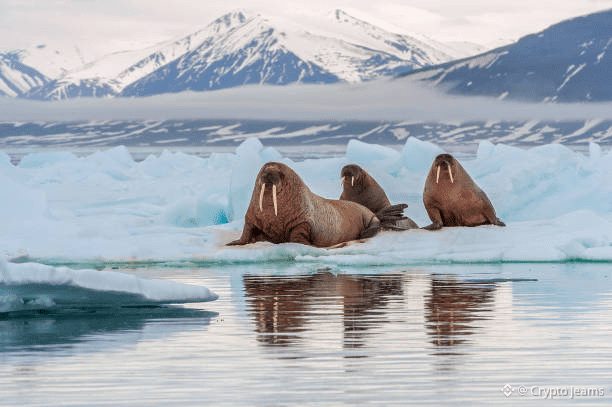
The scene is brutal to watch. Thousands of walruses crowded onto coastal cliffs in Russia—not beaches, but vertical rock faces—because there was no sea ice to rest on and no room on the limited shoreline. Exhausted and desperate for rest, walruses hauled out onto terrain they were never meant to climb. When spooked—by polar bears, by other walruses, by their own overcrowding—they tumbled over the edges.
The documentary shows walruses falling fifty, eighty, a hundred feet onto rocks below. Most died on impact. Some survived with injuries and dragged themselves back into the sea. The documentary estimated hundreds died this way, though the true number is probably higher.
The internet did what the internet does: people argued about whether this was really caused by climate change or whether it was "natural." As if anything that happens to animals in the Anthropocene can be meaningfully called natural. As if it matters whether the walruses were directly fleeing melting ice or simply caught in the cascade of consequences that flow from it.
I watched that footage once and never again. But I think about it constantly.
I think about how there's probably no conscious thought process behind hauling out onto a cliff. A walrus doesn't reason "this is dangerous but necessary." It just needs to rest, and this is the only place available, so it climbs. The same evolutionary programming that served walruses perfectly for millennia—find solid ground, rest on it—becomes a death sentence when the only available ground is a cliff edge.
Perfect adaptations to the wrong world become catastrophic maladaptations.
I think about this when I catch myself falling into old patterns that don't serve the life I'm trying to build. When I haul myself onto emotional cliff faces because they're familiar, because my instincts say "rest here," even though I can see the drop. When I do the things that worked once in situations they don't work for anymore.
We're all just following programming that was perfect for a world that doesn't exist anymore, trying to rest in places that weren't meant for resting, hoping we notice the cliff edge before it's too late.
What We Owe Them
Pakak was born in captivity. She's never felt Arctic ice under her body, never dove in water cold enough to make her whiskers ache, never jostled for space in a haul-out of thousands. She's never been truly cold or truly hungry. She's never had the option of swimming until the coast was out of sight and then swimming farther still, just because she could.
Is her life better or worse than a wild walrus's life? The question is unanswerable and maybe meaningless. She lives in safety and enrichment and dies of old age rather than predation or starvation. But she lives in a pool a fraction of the size of her ancestral range, in water that's temperature-controlled, in a life circumscribed by walls she can see through but never cross.
When I press my hand to the glass and she presses her nose to the opposite side, I feel the weight of what I represent: the species that put her here. That put walls around her life. That changed the climate so drastically that wild walruses are falling off cliffs trying to find somewhere to rest.
She didn't choose any of this. She was born into captivity, which is another way of saying: born into consequences of human choices made before she existed.
What do we owe her? What do we owe the wild walruses crowding onto beaches in unprecedented numbers, the juveniles getting trampled in stampedes, the ones starving because the ice has retreated over water too deep for them to reach food?
I don't have a satisfying answer. Conservation efforts, obviously. Climate action, desperately. Continued research, respectfully. But these feel abstract against the immediacy of Pakak's whiskers pressed to glass, the memory of that juvenile walrus's wet tracks around his eyes, the thought of animals falling from cliffs because there's nowhere else to rest.
Maybe what we owe them is just this: to look directly at what we've done and not turn away. To press our hands to the glass and acknowledge the barrier between us is one we built. To witness their adaptations failing in the world we've created and feel the full weight of that failure.
To keep showing up, even when—especially when—there's nothing we can fix.
The Last Visit
I went to see Pakak last week, and she didn't come to the glass.
She was there, floating in the middle of the pool, but when I approached our usual spot she glanced at me and looked away. No nose-press. No barrel roll. No greeting.
I stood there for twenty minutes, hand pressed to the glass like an idiot, hoping she'd change her mind. She didn't.
Maybe she was tired. Maybe she didn't feel well. Maybe she's finally lost interest in this strange ritual with a human who can't even properly touch her. Maybe this was never about me specifically and I've been projecting meaning onto random animal behavior for three years.
Or maybe she knows something I don't. Maybe she feels the same exhaustion I feel when I watch news about Arctic ice loss, about mass haul-outs, about the shrinking window for meaningful climate action. Maybe even a walrus in a controlled environment can sense that something fundamental is wrong with the world, and she's simply done trying to connect across barriers that shouldn't exist.
I don't know. I'll probably never know.
But I'll go back next month, and I'll press my hand to the glass, and if she comes I'll be grateful. And if she doesn't, I'll understand.
Because sometimes the only honest response to an impossible situation is to stop participating in the rituals that pretend everything's okay.
Sometimes the kindest thing is to just float in the middle distance, acknowledging the barrier, and rest.