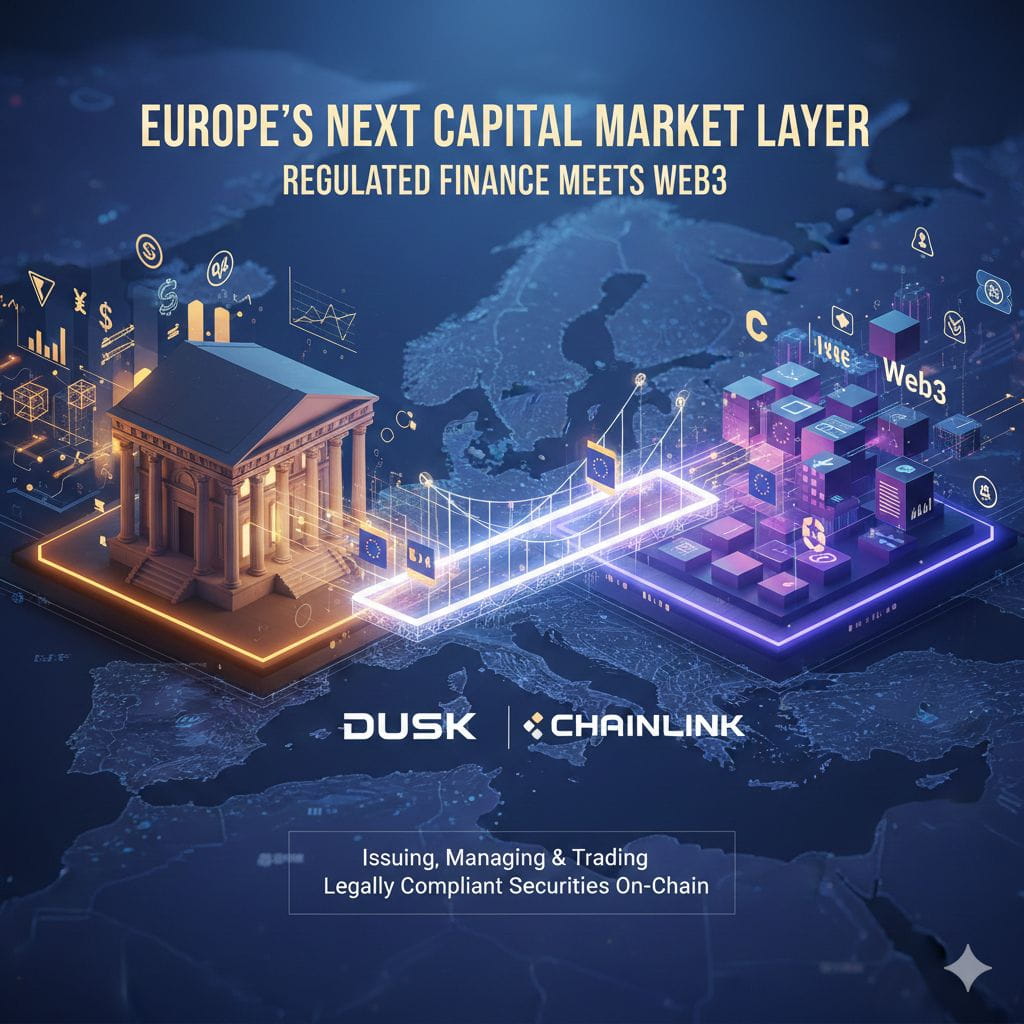
The collaboration between Dusk and Chainlink represents a serious, infrastructure-level move to bring regulated European securities onto blockchain rails in a way that is practical, compliant, and scalable. Rather than focusing on speculative tokenization narratives, this initiative is designed around real financial use cases: issuing, managing, and trading legally compliant shares and bonds on-chain while preserving issuer control, investor protections, and regulatory oversight.
At a strategic level, the partnership combines three critical pillars of modern financial infrastructure: a compliance-first blockchain (Dusk), a global interoperability and oracle standard (Chainlink), and regulated market data pipelines designed for institutional use. Together, these elements form a new foundation for tokenized capital markets that goes far beyond proof-of-concept experimentation.
A Purpose-Built Stack for Tokenized Securities
The technical architecture of the Dusk–Chainlink integration is centered on three core capabilities: secure cross-chain movement, standardized token logic for regulated assets, and authoritative market data delivered directly on-chain.
First, interoperability is handled through a controlled cross-chain framework that allows assets issued on Dusk to move across other blockchain networks without relying on fragile, liquidity-dependent bridges. Instead of locking tokens into third-party pools, the system uses canonical transfer models and mint-and-burn mechanics. This ensures that total token supply remains consistent, auditable, and under issuer control across all supported chains. For regulated securities, this precision is not optional — it is a legal and accounting requirement.
Second, standardized cross-chain token architecture allows issuers to define how their tokenized securities behave at the protocol level. This includes programmable compliance rules, jurisdiction-based transfer permissions, rate limits, upgrade paths, and emergency controls. In practical terms, this means a company can embed shareholder restrictions, lock-up periods, voting rights, and dividend logic directly into smart contracts while still retaining the ability to update those rules in response to regulatory changes.
Third, the integration of institutional-grade market data feeds brings official exchange information on-chain in near real time. These data streams are designed to publish authoritative pricing and trading activity, enabling smart contracts, trading applications, and automated settlement systems to operate on trusted information rather than fragmented or manipulable off-chain sources. This data layer is essential for serious financial use cases such as compliant trading venues, collateralized lending, and structured products built around tokenized securities.
Why Dusk Is a Strategic Base Layer for Regulated Assets
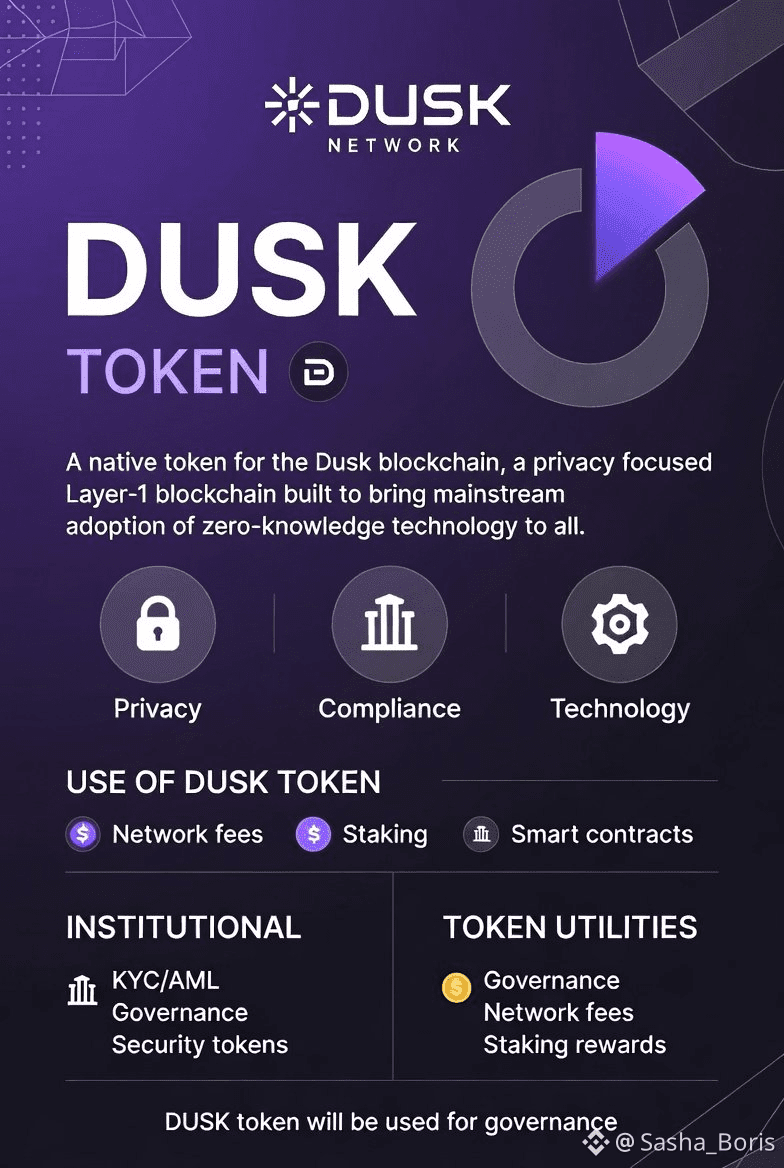
Dusk was engineered specifically for financial instruments, not just general-purpose decentralized applications. Its design emphasizes selective privacy, regulatory compatibility, and performance — three requirements that traditional blockchains often struggle to balance.
Through the use of zero-knowledge cryptography, Dusk enables confidential transactions that can still be audited by regulators and authorized parties. This is critical for protecting sensitive financial data such as shareholder identities, transaction amounts, and corporate actions, while maintaining the transparency required for legal compliance.
Dusk also supports both EVM compatibility and WebAssembly execution. This dual approach gives developers flexibility: existing Solidity-based applications can be deployed with minimal friction, while more advanced financial logic can be built using high-performance execution environments. For institutions and fintech developers, this significantly lowers the barrier to entry for building regulated financial applications on-chain.
From an issuer’s perspective, this means equity and debt instruments can be tokenized with built-in compliance, governance, and reporting logic. From an investor’s perspective, it means faster settlement, improved transparency, and programmable ownership rights — without sacrificing regulatory protections or legal clarity.
Transforming Capital Access for European SMEs
One of the most important implications of this partnership is its potential to reshape how European small and medium-sized enterprises raise capital.
Today, access to public markets is slow, expensive, and heavily intermediated. Legal fees, administrative overhead, and long settlement cycles create structural barriers that disproportionately affect smaller companies. Tokenized securities offer a path to reduce these frictions.
By issuing tokenized shares or bonds on Dusk, SMEs can fractionalize ownership, automate compliance processes, and streamline corporate actions. Dividend distributions, shareholder voting, cap-table updates, and disclosure requirements can be executed programmatically, reducing both operational costs and human error.
For investors, tokenized SME securities could unlock new liquidity pathways. Instead of being confined to opaque private markets or multi-day settlement cycles, investors may eventually be able to trade compliant security tokens on regulated venues or approved on-chain marketplaces, with settlement measured in minutes rather than days. This has the potential to make smaller companies more investable and to broaden participation in early-stage and growth-stage financing.
Institutional Implications: Data Integrity and Cross-Chain Reach
The integration of official exchange data into blockchain environments is a major institutional milestone. Reliable, real-time pricing is a prerequisite for any serious financial market activity, whether that involves automated market making, collateralized lending, or structured investment products.
With authoritative data available on-chain, developers can build trading engines, settlement systems, and risk-management tools that operate with the same informational foundation as traditional exchanges. This bridges a critical trust gap that has historically limited institutional participation in blockchain-based finance.
At the same time, cross-chain portability dramatically expands the strategic reach of tokenized securities. Assets issued on Dusk are no longer confined to a single ecosystem. Under strict compliance controls, they can be moved into other blockchain environments where additional financial services exist, such as compliant lending protocols, custody solutions, or institutional DeFi platforms. This creates the foundation for an interconnected financial layer in which regulated assets can interact with decentralized infrastructure without losing their legal and regulatory anchors.
Security, Compliance, and Governance in Practice
Security is addressed through a layered design that combines decentralized oracle validation, controlled token mechanics, and continuous monitoring. Instead of relying on a single bridge operator or custodial intermediary, the system distributes trust across multiple verification layers, reducing single points of failure.
Compliance remains central to the entire model. Tokenized securities still require robust off-chain processes, including identity verification, custody agreements, regulatory reporting, and legal wrappers that map on-chain ownership to legal share registers. The blockchain does not replace regulation; it augments it by making compliance more programmable, auditable, and efficient.
Governance is also built directly into the token architecture. Issuers retain the ability to update contract logic, freeze transfers if required by law, and enforce jurisdiction-specific rules. While these features may seem antithetical to the ethos of permissionless systems, they are a practical necessity for regulated finance and a key reason why this model has a realistic path to mainstream adoption.
What to Watch Next
The real test of this infrastructure will come with live deployments and production usage. Key milestones to monitor include:
The launch of production-grade tokenized securities on Dusk
Custodian and exchange integrations that support on-chain settlement
Demonstrations of compliant cross-chain transfers for regulated assets
The rollout of official market data feeds for real trading activity
Regulatory approvals and legal frameworks that formalize tokenized ownership
Each of these steps will serve as a validation point for whether the system can scale beyond pilot programs into functioning capital markets.
The Strategic Bottom Line
This partnership is not about speculative tokens or short-term hype. It is about building a regulated, standards-based bridge between traditional finance and programmable blockchain infrastructure.
By combining Dusk’s compliance-first blockchain design with Chainlink’s interoperability and data layers, the collaboration lays the groundwork for a new generation of financial instruments — assets that are legally recognized, technically portable, and operationally efficient.
If executed successfully, this model could become a blueprint for how regulated securities are issued, traded, and settled across Europe over the coming decade, positioning blockchain not as a parallel financial system, but as the programmable backbone of the next era of capital markets.