

At every cycle of the markets, there comes a time when noise subsides and constructors get back to its basics. That has been the case with the last year in crypto. Less show business, more technology. Less promise, more proof. The story of Plasma was in this stage not so much a renaissance of an old concept, but instead a conscious re-evaluation of what the blockchains are actually expected to accomplish as they come of age. Following the development of plasma now seems less of a trend and more of a machine to be reminded of its purpose of being.
Plasma used to be talked of primarily on academic terms, which is a scaling concept that was first proposed when Ethereum was still a young and sanguine project. At the time, it used to be a discussion on theory: child-chains, exit-games, cryptographic-guarantees. The ambition is not changing, but the context. Blockchains are no more of an experiment on pure idealism. They represent settlement layers to real values, real business and real users who are not concerned about beautiful charts when transactions fail or the fee skyrockets. The current trend of plasma is indicative of the maturity.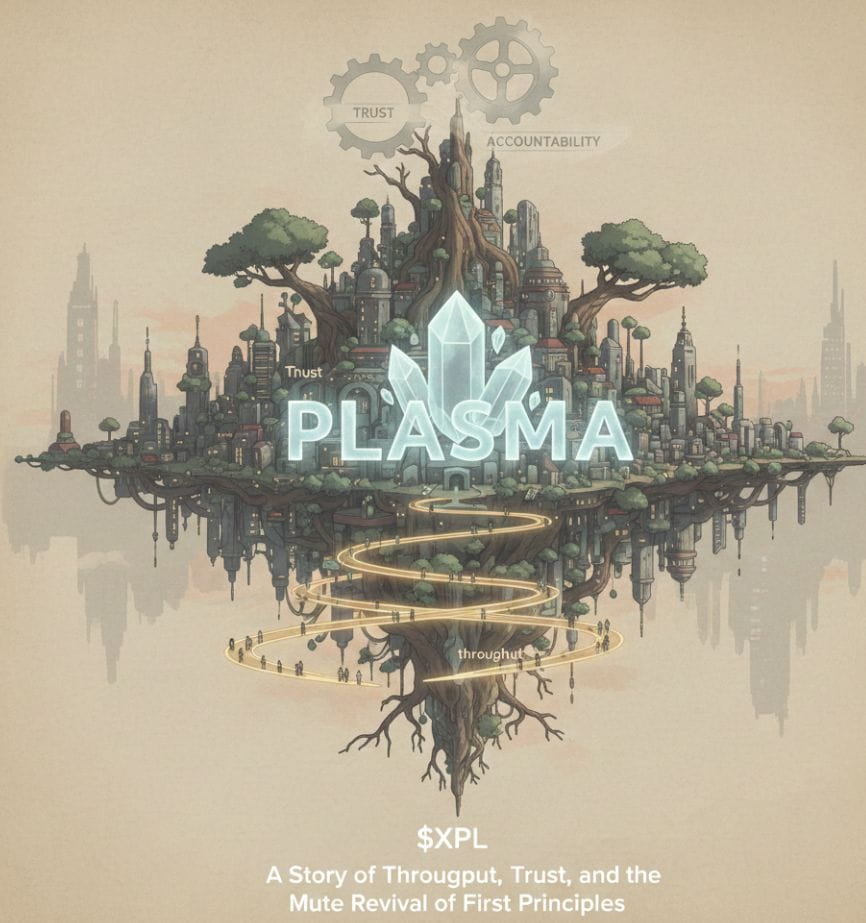
Speed is part of the most interesting thing about Plasma today, despite its importance. It is in the manner in which the system redefines scalability as no longer being about raw performance but rather it is a matter of economic realism. Plasma is rather a network design in which a layered architecture is used and responsibility is allocated as cleverly as possible as opposed to growing block sizes and relying on non-transparent off chain commitments. Significant computation and regular transacting occur at the point of reasonableness, whereas security and finality are pegged to a strong foundation. This division of powers is almost conservative and that is what makes it work.
To know how Plasma applies now suppose that we have a city that had grown too large in such a way that its roads could not cope. The first option will be to continue to expand highway until they cannot be maintained. The other is redesigning traffic itself, local streets, express routes, and clear guidelines of what is in what place. The second route is followed by plasma. It does not deny that not all transactions must have the same degree of visibility in the world, but demands that all transactions must be verifiable. Judiciousness, not blind faith, Where its power consists.
This philosophy is reflected evidently in the manner the Plasma ecosystem is aligning itself over $XPL. The token is not simply presented as a means of transaction, but is a way of alignment between users and operators to the rest of the network. With the marketing language commonly stretched thin by words of token utility, the strategy of Plasma feels more solid. Hype does not add value, but engagement on a scaling system that is responsible does. Such a difference is now important in a way that it was not as high as it was at the speculative peaks in the earlier cycles.
Another difference between Plasma and others is its timing. The industry has also come to realize through collective pressure that scalling is not a one trick show made but a never-ending dance which involves security, decentralization and usability. Part of the problem is solved through the use of rollups, modular chains, and data availability layers. Plasma does not pre-empt by screaming louder, but instead compliments by situations in which high throughput and low latency are absolutely necessary, but no reduction of the trust can be compromised. Checks, video games economy, small scale settlements, and business processes all exist within that gray area where Plasma prospers.
It is a silent faith in the contemporary communication of the project. Plasma does not offer to replace the existing chains, rather, it talks the language of integration and coexistence. This is not accidental. Mature infrastructure seldom succeeds in toppling all that has preceded it but it succeeds by becoming necessary. The finer the layers of the ecosystem are broken, the more useful a solution will be discerning how to join them it will not make them any more delicate. The design of plasma is written in that manner considering that future.
Chronologically, as a narration of events, the history of Plasma follows the progression of blockchain. The initial enthusiasm was broken by miserable limitations. Those limitations made a thinker out of one. Solutions less flashy but more long-lasting are started to arise now. Plasma reads as a last chapter written after the protagonists have been corrected on their mistakes. It does not reject the experience of the past, it is based upon it. The fact that continuity is not common in an industry whose new is its treasure is not uncommon.
This change is also evident in the community surrounding the account of plasma. The discussion is getting more technical, practical and long term. Throughput benchmarks, security assumptions and real deployment scenarios are discussed as opposed to speculation on the price alone. It does not imply that XPL will not be imperfectly sensitive to market forces but it does imply that it will have a more robust market. The systems that operate ultimately get a reward in the markets, particularly where passion ceases to drive capital.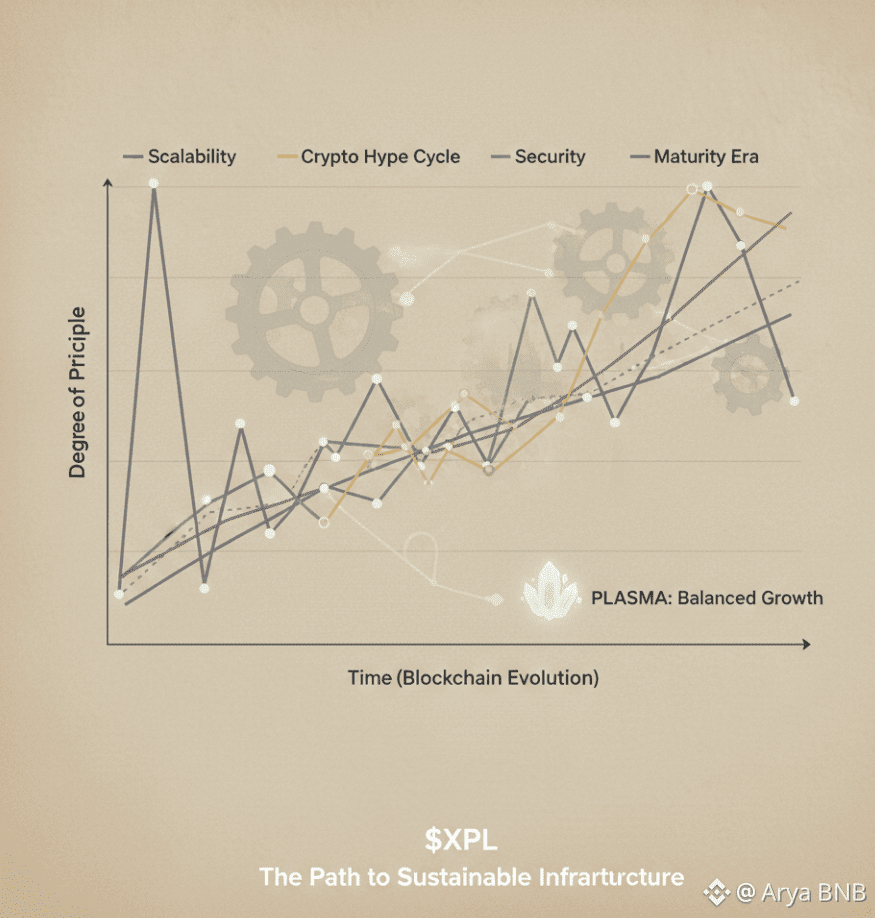
In the future, the role of Plasma might not be as important as it appears in newspaper headlines, but the infrastructure just works. Due to the performance requirements associated with the applications and the expectation of non-stuttering services, the acceptance of congestion and unexpected charges will remain in a downward trend. The ability of solutions to absorb activity without destroying trust will turn into an unseen phenomenon and invisibility on a large scale is an indicator of success. Plasma appears to be at ease with this end result.
Plasma in most respects is a kind of throwback to first principles: scale cannot weaken security, efficiency cannot kill accountability, and growth cannot be had without whistle-blowing. Such is not a revolutionary idea but one done to last. Since this is an ecosystem that is growing up, endurance might become more useful than upheaval. The current trend of plasma implies a somewhat less immediateist project, less concerned with applause in the present and more anxious about coming to be there when the next wave of actual adoption comes.
Provided that the previous cycle was focused on demonstrating that blockchains can exist, the concern is the that they can be made to last. The Plasma narrative is not exhaustive yet the trend is evident. It is constructing a world in which throughput is presupposed, trust is not negotiable and infrastructure is part of the air because it works. In that regard, Plasma is never chasing the future, it is anticipating it, in a composed, meticulous and with an acuity that seems to be growing rare.

