
Look, here's the thing nobody talks about until it happens to them. You don't really think about where your stuff lives online until something breaks. And I don't mean in some dramatic Hollywood hacker way—I'm talking about the real frustrating stuff. Like when your account just randomly locks and support takes three days to respond. Or your monthly bill suddenly triples because your little project actually started working. Or you're launching something important and the whole service just crashes. And you're just sitting there, totally helpless, watching everything fall apart.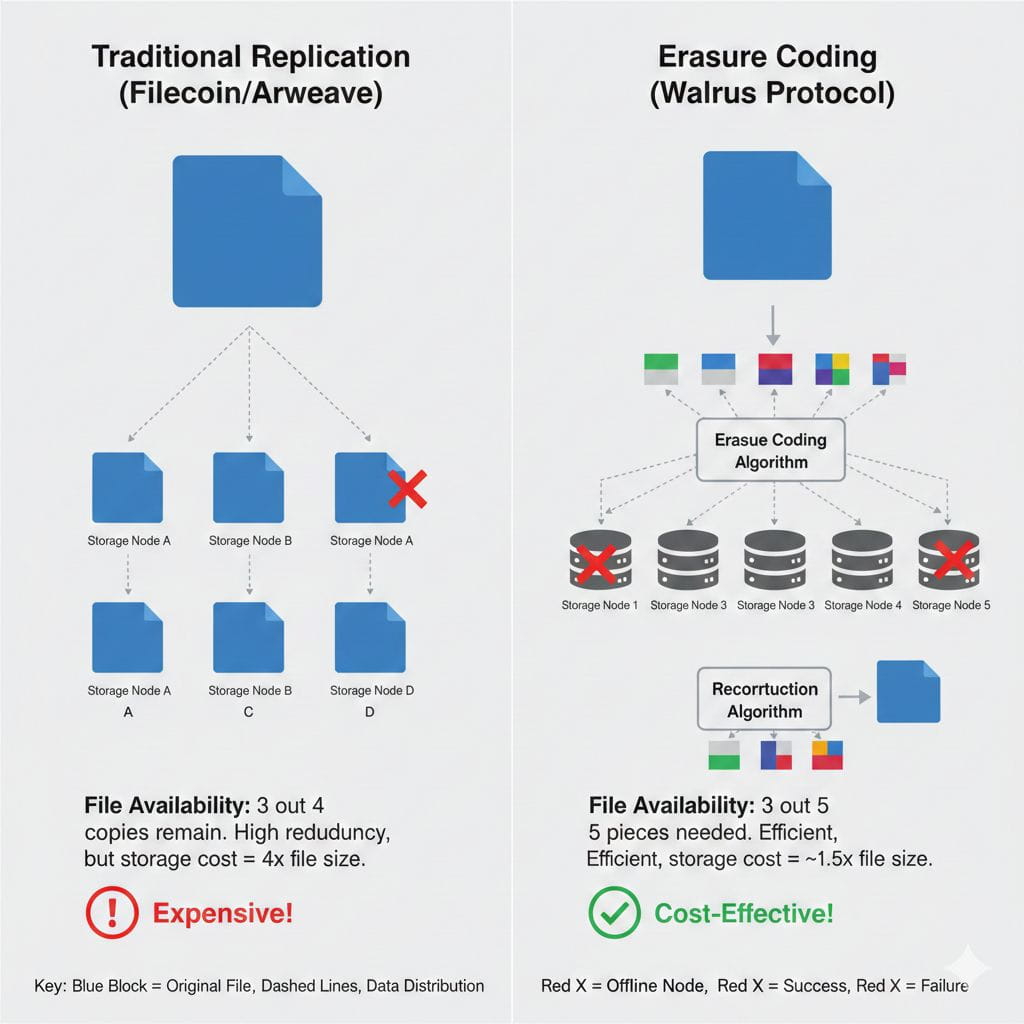
That gut-punch feeling? That's the moment you realize "the cloud" is literally just someone else's computer, and they're the ones calling all the shots.
This is exactly why people who actually build things are getting serious about decentralized storage. Not just the crypto obsessives or tinfoil hat types anymore. Real developers. Especially the ones who've been screwed over before or who understand that whoever controls the infrastructure basically controls the game.
So there's this thing called Walrus. And yeah, I know—before you check out thinking it's another half-baked "decentralized Dropbox" that crashes trying to load a single photo, just hear me out.
What's Walrus Actually Trying to Do?
Here's what's different: Walrus isn't stupidly trying to replace everything about cloud storage. That would be insane. Instead, it's focused on solving one specific problem that's become a massive headache for anything built on blockchain—how to store and access big files without having to trust some company not to screw you over.
We're talking about images, videos, audio, huge datasets, archives, basically all that chunky app stuff that's way too big to live directly on a blockchain but way too important to just throw on AWS and hope nothing goes wrong.
The basic idea is actually pretty clever: instead of dumping all your data on one company's servers, Walrus breaks it into pieces, scrambles it up using some smart math, spreads those pieces across a bunch of different independent servers, and—here's the cool part—you can still get your complete file back even if a bunch of those servers disappear.
And it runs on something called Sui for coordination. Basically all the storage tracking—proofs, certificates, who's storing what—gets recorded on a blockchain instead of hidden in some company's private database you'll never see.
Why Earlier Attempts at This Mostly Failed
Most previous tries at decentralized storage had one huge problem: they cost way too much money.
Why? Because they just made multiple complete copies of your file and stored them on different machines. Super secure, sure. But also crazy wasteful. You're basically paying to store the same stupid cat video five times.
Walrus does something smarter with what's called erasure coding—basically you only need about 5 times the original file size spread across the network instead of making complete duplicates everywhere. That might sound like technical nerdy stuff, but it's actually super important because if the economics don't work, nobody's going to use it for real.
If the math doesn't make financial sense, the whole thing's just a cool experiment that goes nowhere.
What Actually Matters If You're Looking at WAL as an Investment
Alright, let's get to what you probably care about. If you're considering WAL from a trading or investment angle, here's what's real.
Right now WAL's trading at around $0.13, sitting at roughly $200 million market cap with somewhere between $10 million to $13 million trading every day (depends on where you're checking).
Those numbers don't prove the network's actually being used for legit stuff, but they do show there's real liquidity and people are paying attention. Which matters a lot if you're trying to actually trade this without getting destroyed by slippage.
But here's the uncomfortable truth most people ignore: market cap is completely meaningless if nobody's actually using the thing six months from now.
The Problem Everyone Ignores: Keeping Users
You want to know the real reason most decentralized storage projects die? It's not the technology. Usually the tech works fine enough.
It's keeping users around.
In crypto, everyone's obsessed with getting people in the door. Incentives. Hype. Big announcements. "Look at all these users we got on day one!"
But storage only works as a business if people keep paying for it month after month. Not just uploading one test file to farm an airdrop and then disappearing forever.
Storage has to be boring. Reliably, consistently, mind-numbingly boring. If it's slow, if pricing is confusing, if developers have to constantly fix things, they leave. And once a team commits to AWS or Cloudflare, switching is brutal. Nobody wants to move terabytes of data unless there's a really compelling reason.
So the actual important question for Walrus isn't "can it store stuff?" Obviously it can.
The real question is: Can it keep developers and apps coming back after the exciting launch phase ends? After the initial rewards dry up. After the first scary bug. After real users are hammering it with real traffic.
That's the test that separates infrastructure theater from actual usable infrastructure.
An Example That Actually Makes Sense
Think about a small startup building trading tools. Maybe a charting app with some blockchain wallet analytics. Their product isn't just smart contracts—it's tons of data. Wallet labels, cached transaction info, design assets, user watchlists.
With AWS, they get crazy fast speeds and super easy setup. But they also get platform risk, unpredictable costs that might explode, and the constant worry of getting kicked off or price-gouged as they grow.
With something like Walrus, they could avoid getting locked into one vendor and gain resistance to censorship. Which sounds awesome in theory.
But—and this is critical—only if getting data back stays fast and predictable. If even 2% of their users see "data not available" errors, people stop using it, subscriptions cancel, trust disappears. Storage is invisible when it works, and when it breaks, it breaks absolutely everything.
That's why Walrus being built specifically as a dedicated storage network with Sui handling the coordination stuff actually makes sense strategically. It's not trying to do everything under the sun. It's trying to be reliable enough that builders treat it like a normal option, not some risky crypto experiment.
What You Should Actually Pay Attention To If You're Trading WAL
Short-term? Yeah, price moves on hype, exchange listings, partnership announcements. The usual crypto stuff.
But if you're actually investing and not just trying to make quick flips, what you really want to watch is retention-based usage.
Real apps. Storing serious amounts of data. Over long time periods. With people renewing their storage. Stable performance when retrieving files. A growing network of storage providers competing on reliability.
That's what transforms decentralized storage from a philosophical idea into actual infrastructure.
The Real Bottom Line
Don't just stare at the WAL price chart bouncing around. Watch whether Walrus starts quietly showing up behind actual products. The same way AWS did way back in the day.
Because that's when "alternative storage" stops being a niche category and becomes something people just use by default.
And that's when the investment case stops being speculation and starts being structural.

