
In most technology cycles, infrastructure arrives late. Builders experiment first, users follow, and only then does the underlying system try to catch up. Web3 has repeated this mistake more than once. Chains launch with grand visions, liquidity incentives, and governance frameworks long before real builders arrive. The result is often a mismatch: powerful base layers with little to build on, or complex systems searching for problems rather than supporting real creation.
@Vanarchain approaches this problem from the opposite direction. Instead of asking builders to adapt to infrastructure, it moves infrastructure to where builders already are. This may sound like a simple distinction, but it is one of the most important architectural decisions a platform can make. Builders do not choose ecosystems based on marketing claims. They choose environments that reduce friction, preserve intent, and let ideas move from concept to execution without being reshaped by technical constraints.
At its core, VANAR recognizes that creation today does not happen in isolation. Builders operate across chains, tools, and execution environments. They move between base layers, L2s, and application-specific runtimes as easily as they switch programming languages. Any infrastructure that assumes a single home for builders misunderstands how modern development actually works.
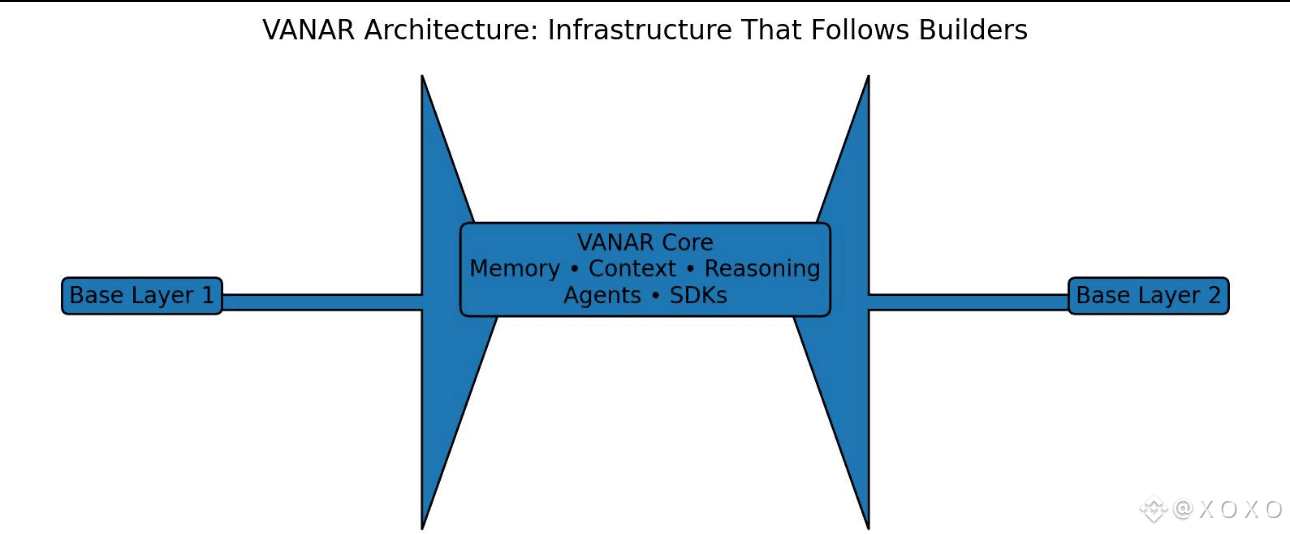
This is why VANAR’s design treats base layers not as destinations, but as connection points. The idea of “Base 1” and “Base 2” is not about competition between chains. It reflects a reality where builders deploy, test, and scale across multiple environments simultaneously. VANAR positions itself between these bases, not above them, acting as connective tissue rather than a replacement.
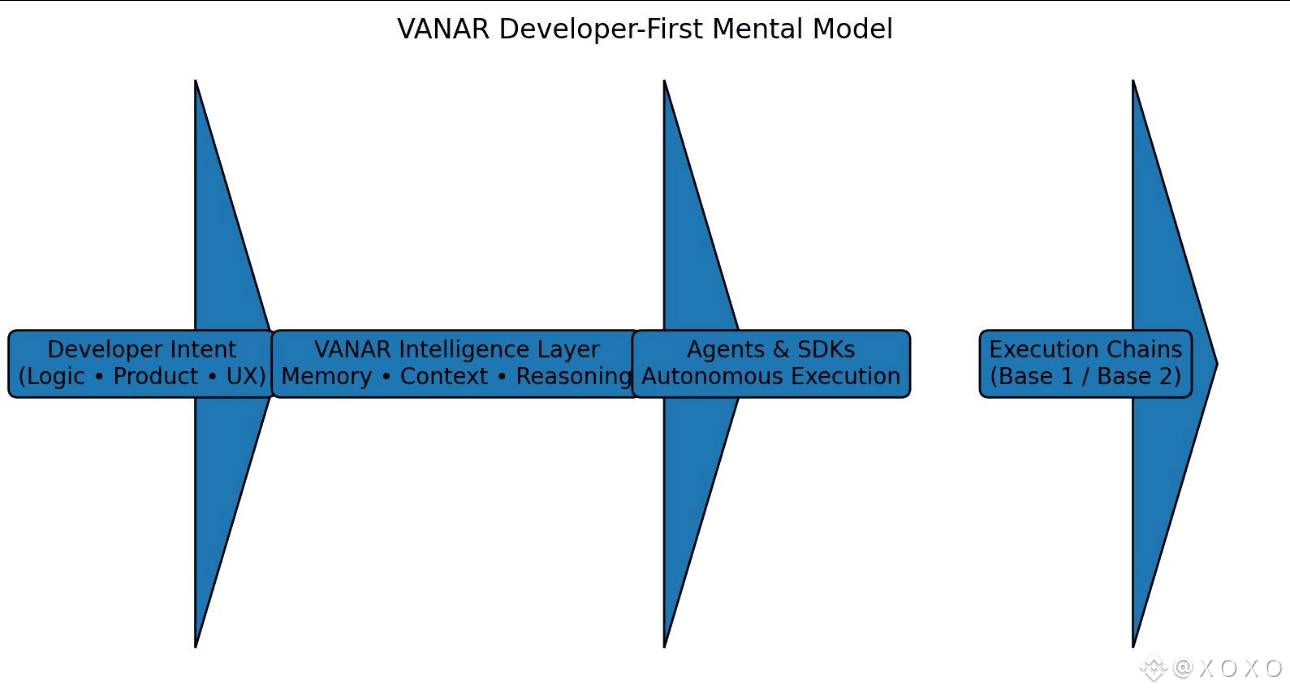
The presence of developers at the center of the system is not symbolic. It is structural. Developers are not endpoints; they are active participants who shape flows in both directions. Code moves from idea to execution, feedback loops back into refinement, and infrastructure must support that motion continuously. When systems force builders to think about plumbing instead of product, innovation slows.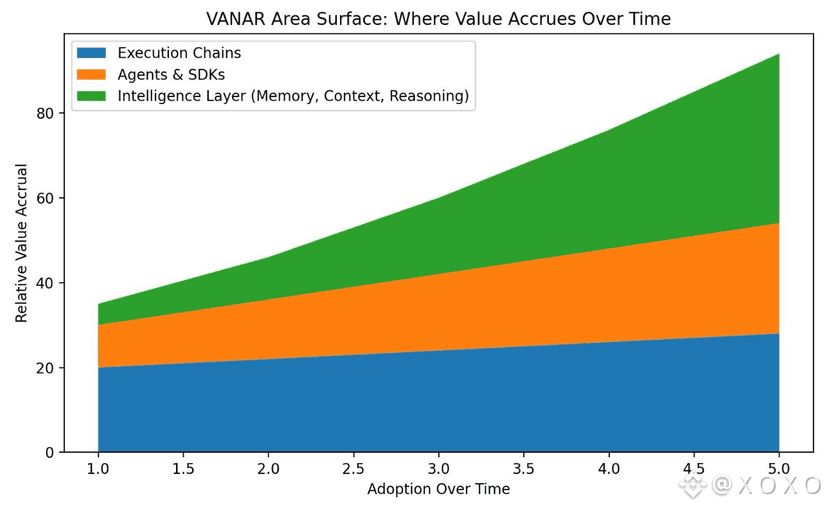
What distinguishes VANAR is its focus on internal primitives that mirror how builders actually think. Memory, state, context, reasoning, agents, and SDKs are not abstract concepts. They are the components builders already manage mentally when designing systems. By externalizing these components into infrastructure, VANAR removes cognitive overhead and replaces it with composability.
Memory, in this sense, is not storage alone. It is persistence of intent. Builders want systems that remember decisions, preferences, and histories so that applications evolve instead of resetting. State ensures continuity across interactions, while context gives meaning to actions. Without context, execution is mechanical. With context, systems become adaptive.
Reasoning and agents introduce a deeper shift. Builders are no longer designing static applications. They are designing systems that act. Agents operate within constraints, make decisions, and interact with users and other systems autonomously. Infrastructure that cannot support reasoning at the system level forces builders to recreate intelligence repeatedly at the application layer.
By offering these primitives natively, VANAR does not dictate what builders should create. It simply ensures that whatever they build does not fight the underlying system. This is what it means to go where builders are. It is not about attracting them with incentives, but about removing the reasons they leave.
The $VANRY token sits within this flow not as an abstract utility, but as a coordinating mechanism. It aligns incentives across bases, developers, and execution layers without demanding ideological commitment. Builders do not need to believe in a narrative to use infrastructure. They need it to work. VANAR’s design respects that truth.
The most telling sign of maturity is that VANAR does not try to be everything. It does not claim to replace base layers, developer tools, or execution environments. It accepts fragmentation as a reality and builds coherence on top of it. This is how durable systems emerge not by enforcing uniformity, but by enabling interoperability without friction.
In that sense, VANAR is less a platform and more a pathway. It allows builders to move freely without losing memory, context, or trust. That freedom is what keeps ecosystems alive long after incentives fade.