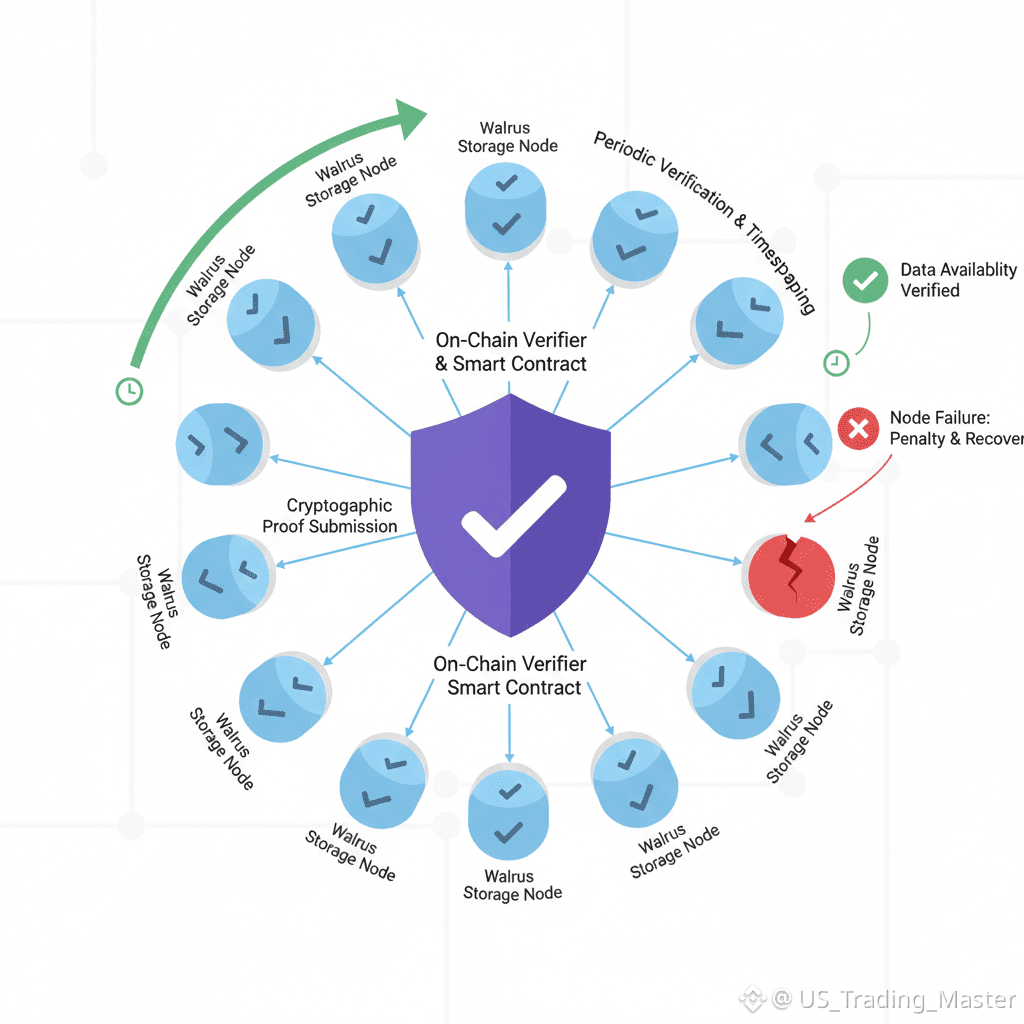
Failures are inevitable in distributed systems. Hardware breaks, networks partition, operators go offline, and incentives misalign. The real question is not whether failures happen, but whether the system assumes they will. What stood out to me while studying Walrus is that failure is treated as a baseline condition, not an exception.
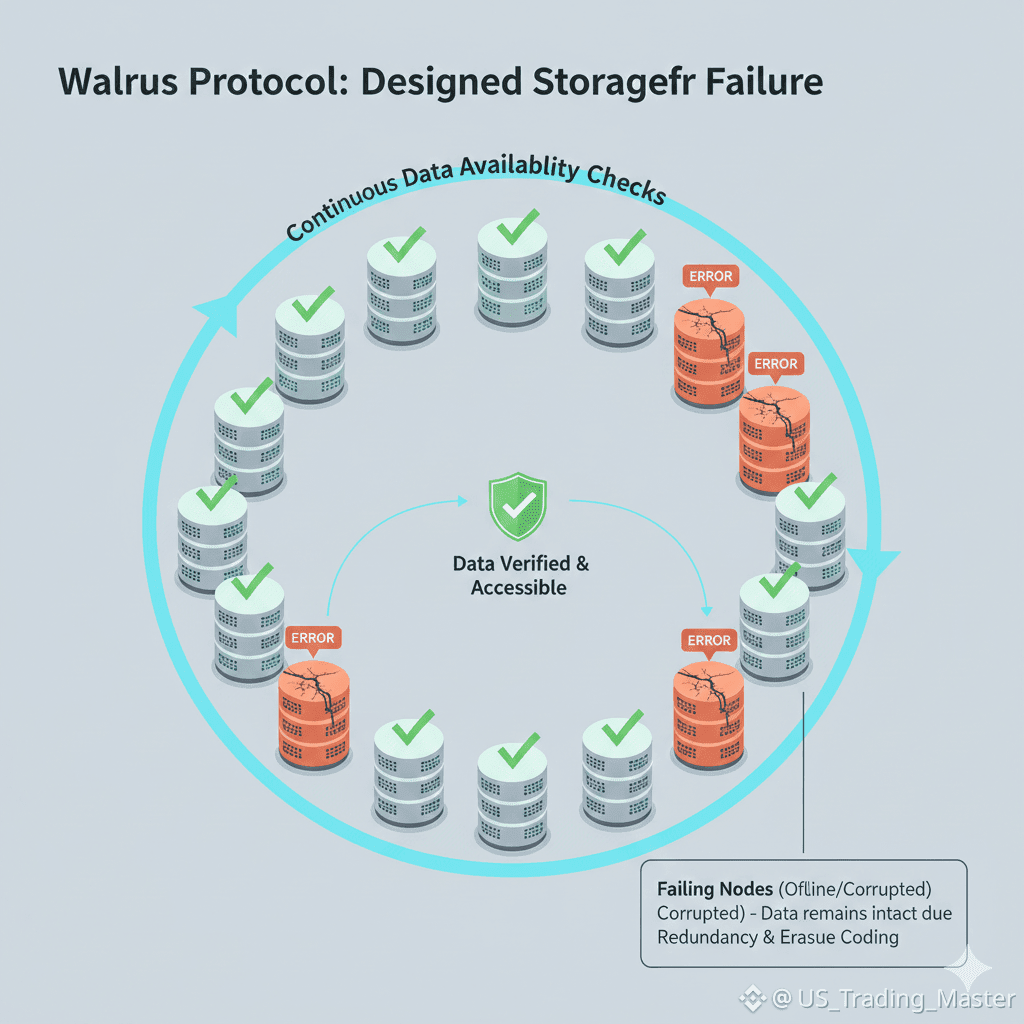
Most storage architectures rely on uptime assumptions. If enough nodes behave correctly, the system works. Walrus flips this logic by continuously verifying that data remains available, even as participants come and go. This is achieved through its Proof of Availability mechanism, which plays a central role in maintaining data integrity.
Instead of trusting storage providers to behave honestly, Walrus requires them to prove they are actually holding the data. These proofs are generated regularly and can be verified independently. If a provider fails to produce valid proofs, the system detects it early, long before data becomes irretrievable.
What I think is crucial here is timing. Integrity failures are dangerous when they are discovered too late. Walrus’ approach surfaces issues proactively, allowing the network to reassign responsibilities and repair gaps before users are affected.
Node failure, in this model, does not translate into data loss. Because data is encoded and distributed, the loss of individual nodes only reduces redundancy, not availability. As long as a threshold of fragments remains accessible, the original data can be reconstructed with certainty.
This has important implications for long-term data use cases. AI datasets, legal records, and financial archives require guarantees that extend beyond short-term uptime. Walrus offers a model where integrity is continuously enforced, not assumed.
From a market standpoint, this reduces trust premiums. Users do not need to overpay for “reliable brands” or centralized assurances. Integrity becomes a property of the protocol itself. That shift opens the door to more competitive, permissionless data markets.
In my view, Walrus demonstrates that decentralization only works when paired with constant verification. Without proofs, decentralization is just distribution. With proofs, it becomes trust minimization.