
We live in a world obsessed with digital transparency.People often think that exposing everything online means stronger security and real accountability.Dusk doesn’t buy into that.Instead,it pushes the idea of selective visibilitya smarter,more deliberate way to handle what we share and with whom.Trust,in this view,doesn’t come from dumping all your data into the open.It comes from showing just enough,to the right people,for the right reasons.
Selective visibility is about controlling who sees what,based on context,need,and permission.Dusk rejects the old black and white choice:everything secret or everything public.It goes for layers.Different people get different slices of information,depending on who they are and what they need to know. This isn’t just a technical trick it’s a recognition that privacy and transparency don’t cancel each other out They work together.
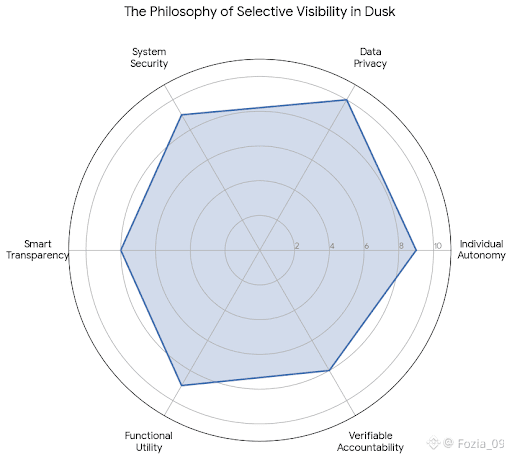
At its core,Dusk’s model puts function over curiosity.Traditional systems often chase openness for its own sake,but that just opens the door to surveillance,leaks,and abuse. Selective visibility flips the script.Only what’s necessary for a task like proving a claim or meeting a requirement gets revealed.The rest stays hidden.This isn’t just practical;it fits with ethical ideas about minimal disclosure and treating people with dignity online.
On the technical side,Dusk makes this possible using cryptographic proofs and permissioned access.Users can prove facts compliance,legitimacy,whatever without laying bare all the underlying data.Visibility becomes flexible.It’s not a switch you flip on or off.It’s something you tune for every interaction.
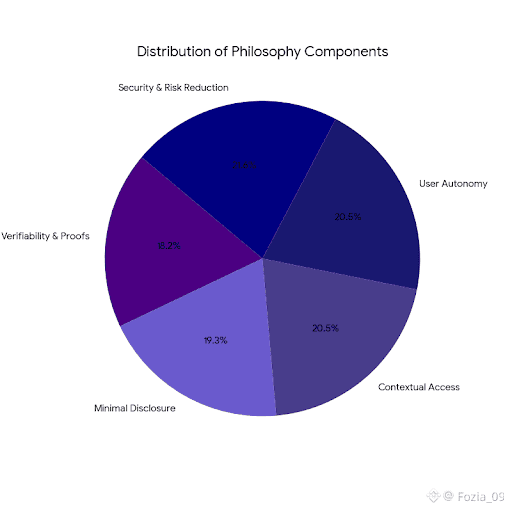
This approach also shakes up power dynamics.In the old model,big platforms or authorities call the shots about who sees what.With selective visibility,that control spreads out.People and decentralized systems get a say in how their own data shows up,and who gets to use it.The result? More individual autonomy,less dependence on black box intermediaries.
Selective visibility isn’t just about safety;it actually makes complex systems sturdier.By limiting exposure,it cuts down the risks of data breaches and manipulation.At the same time,it keeps enough transparency to guarantee accountability.Privacy and verifiability don’t need to be enemies they can reinforce each other.
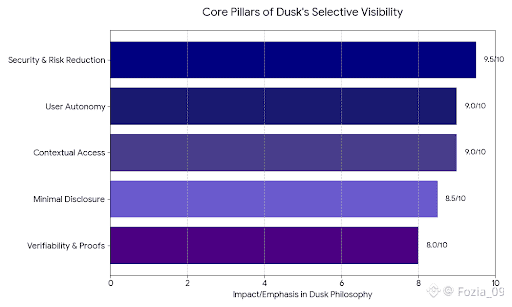
But the idea goes even further.It signals a bigger cultural change.Societies are starting to realize that full transparency can hurt just as much as secrecy.The real challenge is knowing what to show,who should see it, and under what circumstances.Dusk’s philosophy isn’t just a tech fix.It’s a statement about knowledge,trust,and how we negotiate those in the digital age.
In short,Dusk’s selective visibility offers a more thoughtful way to handle digital interactions.Here,transparency gets smart, not reckless.Privacy becomes a tool,not a fortress.By rethinking how we structure visibility,Dusk sketches a future where digital systems stay secure and ethical fit for the messy realities of modern information.
