

Walrus Protocol: Introducing Lease-Verified Data Availability as an Execution-Adjoining Primitive for Sui Applications
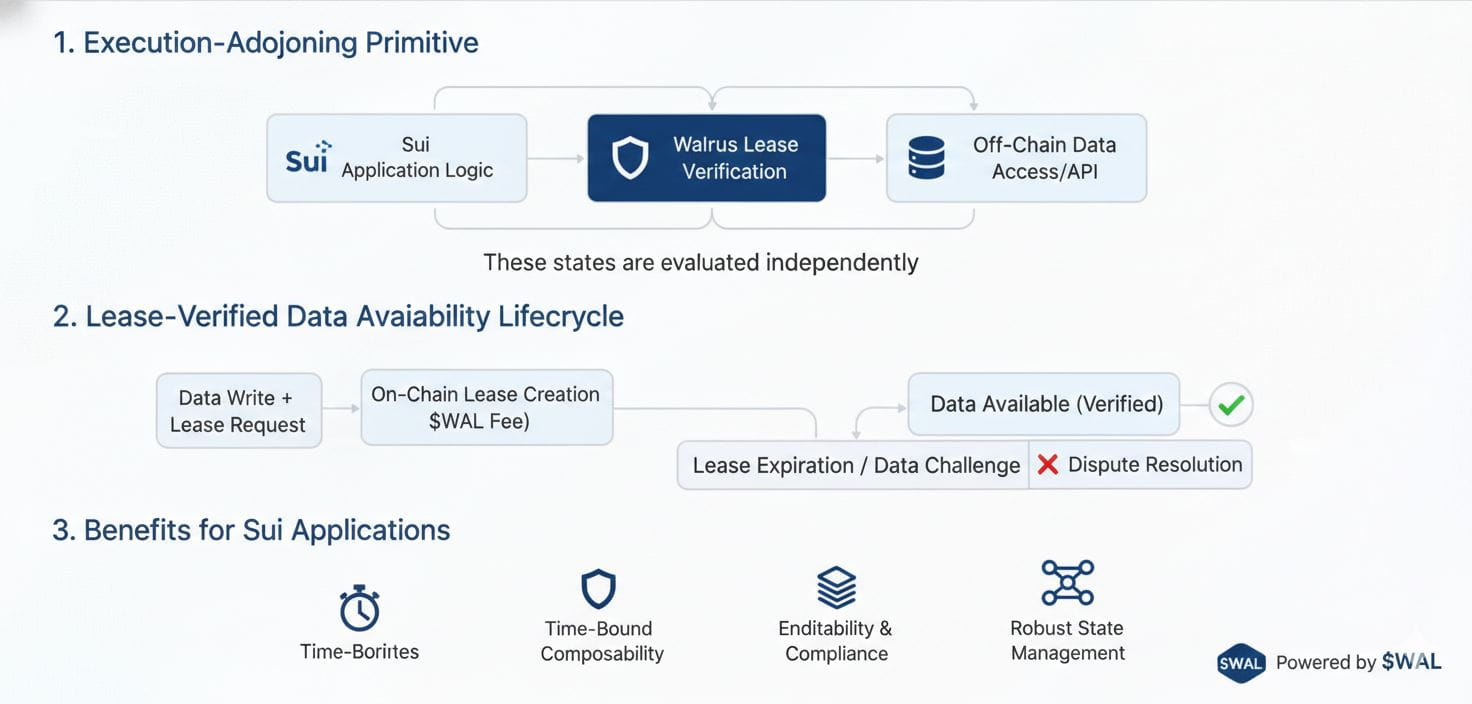 The most important shift happening inside Sui’s ecosystem right now is not higher TPS or cheaper transactions it is the realization that execution without verifiable data persistence breaks the life cycle of applications. Programs can execute, objects can mutate, state can finalize, but if the data that those programs depend on cannot persist beyond the execution window, the application becomes a short-lived demo rather than a long-lived system. Walrus Protocol introduces a new primitive to correct this gap: lease-verified data availability that sits adjacent to execution rather than outside it.
Historically, decentralized applications treated storage as an external service. The blockchain would handle execution, then developers would push heavy data into IPFS clusters, centralized clouds, or ad-hoc pinning providers. This solved short-term storage, but left long-term state in an undefined trust boundary. There was no concept of who was responsible for data persistence, how long it should persist, or how availability could be verified. Walrus flips this model by introducing time-bounded leases that tie availability to verifiable, economically enforced commitments.
Under Walrus, data availability isn’t an assumption it’s a contract. When a blob is stored, users don’t purchase “permanence” as a philosophical promise. They initialize a renewable lease denominated in WAL tokens. Storage operators earn continuously as long as the blob remains accessible, and they must prove availability through repeated retrieval proofs anchored in Sui’s Move-based execution environment. This transforms storage from a write-once operation to an ongoing economic service tied to application lifespan.
The execution-adjoining part is critical. Sui’s parallel execution model resolves transactions deterministically through causal object dependencies. Walrus extends this by introducing lease objects and certificate objects that can be referenced directly by applications. Programs don’t merely assume that data is somewhere they can query its lease horizon, verify its certificates, renew its persistence, or adjust availability windows based on application logic. This is similar to how operating systems treat memory allocation not as a one-time grant, but as a resource that can be scheduled, extended, or reclaimed.
This also changes how Sui-native applications can be designed. AI systems can attach retention guarantees to datasets so that compute never outruns availability. NFT projects can evolve metadata without relying on centralized gateways. Social applications can track how long posts must remain retrievable. Enterprise workflows can encode compliance requirements directly into leases. In each case, execution no longer ends when data leaves the transaction boundary execution continues as data persists.
Lease verification further introduces a risk-adjusted pricing layer that previous decentralized storage systems lacked. Storage that has to survive for three months does not carry the same risk profile as storage that must survive for five years. With Walrus, cost scales with the temporal and survivability constraints of the data object, not with a flat replication multiplier. This gives Sui applications a resource model closer to cloud computing but without sacrificing decentralization or cryptographic auditability.
WAL isn’t your typical currency it works more like a way to track resources in the system. Apps use WAL when they want to open or renew leases. Operators have to stake WAL to lock in capacity, and they risk losing some if they can’t deliver on retrieval proofs. Governance uses WAL too, tweaking things like how long a lease has to last, what penalties look like, how much redundancy to require, and how pricing adjusts. So, instead of encouraging speculation, the whole setup pushes people to care about actual, long-term data persistence. The more data you need to keep around, the more WAL moves through leases, renewals, and staking rewards.
This design is not about making storage cheaper; it’s about making persistence measurable, billable, and enforceable. Blockchains have historically downgraded data into an externality because they lacked a primitive to express long-lived state beyond ledger entries. Walrus introduces that expression. Lease-verified data availability becomes a first-class execution-adjoining resource, allowing Sui to support state-heavy, AI-native, and long-lived applications without collapsing into centralized infrastructure.
In many ways, this is how durable infrastructure always emerges: not through hype, but through the normalization of responsibilities that were previously handled informally. When storage stops being “best effort” and becomes economically accountable, the stack gets stronger. Walrus did not create new narratives around data it created new mechanics. And in decentralized systems, mechanics outlive narratives every time.


