
Trust in digital systems doesn’t come from a single authority anymore.It’s something that shifts and adapts,shaped by the technology itself, the rules we set,and the way we use these systems.Dusk takes trust and flips the script no longer just assumed or handed down from a central power,but built into the system so you can measure it,program it, and check that it actually exists.
At the core of Dusk’s design is a simple idea: trust works better when it’s flexible,not locked into one place.Traditional models lean on a single gatekeeper a bank,a tech giant, some institution to check the facts and enforce the rules.It works,but it piles up risk, hides what’s going on,and puts too much power in too few hands.Dusk breaks this by layering trust throughout the system.Here, trust comes from proofs you can verify, cryptography that holds up under scrutiny, and information flows that aren’t wide open but carefully controlled.
Conditional trust sits right at the center of how Dusk works.You don’t just get trust by default.The system turns it on only under the right conditions.Want to prove you have a right,or meet a requirement?You don’t just rely on your reputation.You show cryptographic evidence something others can test,not just believe.Every transaction, every claim about who you are or what you’re allowed to do,gets checked by explicit rules.Trust isn’t a vague feeling;it’s a concrete result.
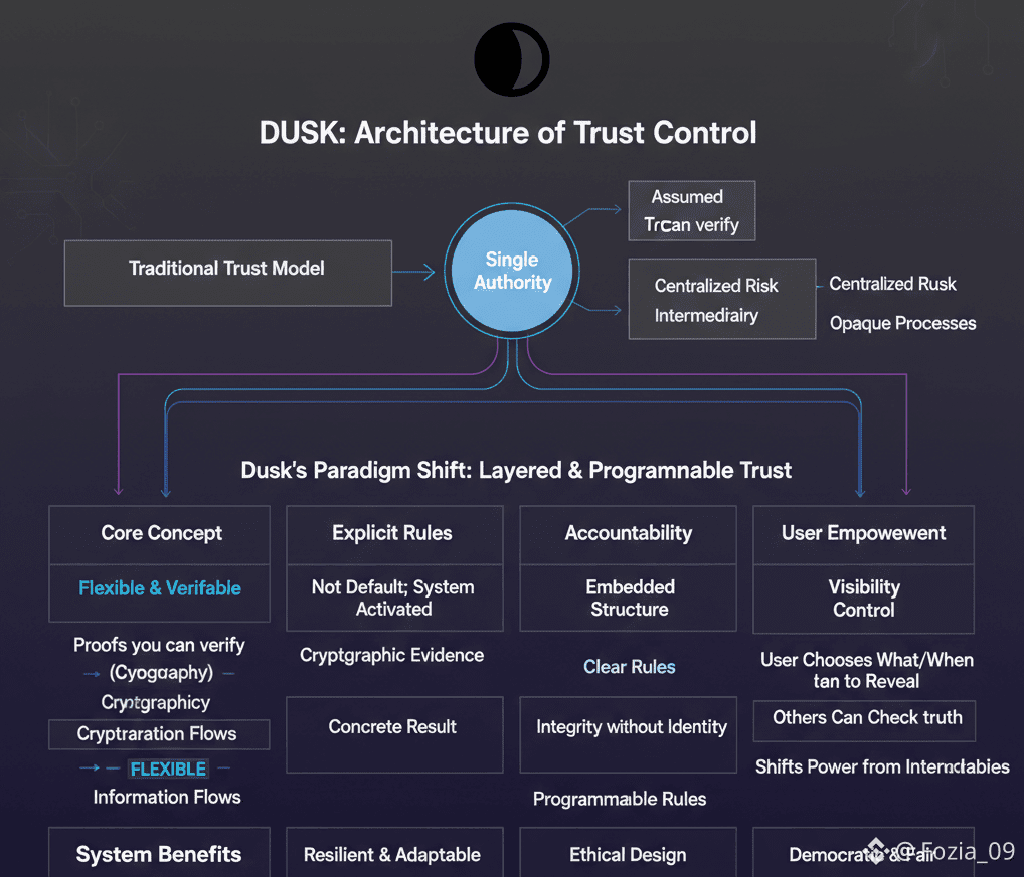
Decentralization gets a lot of praise for breaking up control,but it often stumbles on the question of accountability.Who’s responsible when things go wrong?Dusk tackles this head on.It embeds accountability into the trust structure itself.You don’t have to give up privacy,but the system’s logic leaves a trail actions are provable,and the rules are clear.Integrity stands without needing to tie every move to a real world identity.
Dusk also flips the old script on who holds power through visibility.In most systems, whoever decides what you can see ends up holding the keys to trust.Dusk gives that power back to users.You choose what to reveal and when,but the system still lets others check that your claims are true.This change shifts control away from big intermediaries and puts it into the hands of the people using the network.
Zooming out,Dusk’s approach makes systems tougher and more adaptable.Trust doesn’t get bottlenecked in one spot. Instead,it spreads across layers of verification,so the whole thing doesn’t fall apart if one piece fails or gets corrupted. Programmable trust means the rules can change as new challenges show up,but the core remains solid.Trust isn’t just a resource to guard it’s a structure that can grow and respond.
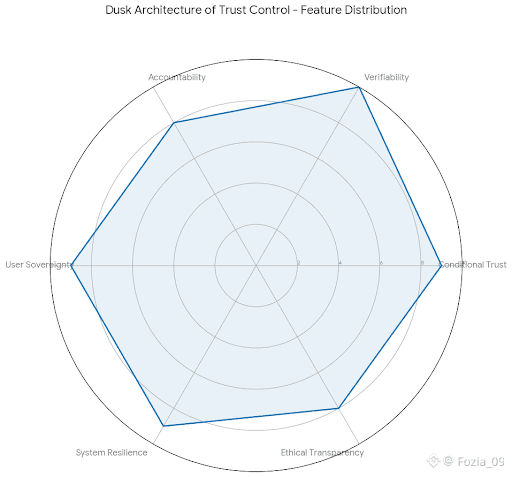
There’s a deeper idea here,too.Dusk signals that trust in the digital era shouldn’t be blind, or handed down from on high.It should be transparent,built on logic,and shaped by ethical design that puts users in charge.By treating trust as something to architect,not just assume,Dusk links technology with values that matter like democracy and fairness.
Dusk’s architecture of trust control isn’t just an upgrade to how we build systems;it’s a shift in what we expect from digital life.By making trust something you can check, improve,and govern,Dusk pushes past old ideas of authority and opens new ground for secure,fair,and smart digital interactions.As our digital world grows more complicated and powerful,the way we design trust might end up as the real foundation everything else stands on.