

Walrus + Sui: Introducing a Cold-Memory Layer That Lets Applications Persist State Beyond Execution Windows
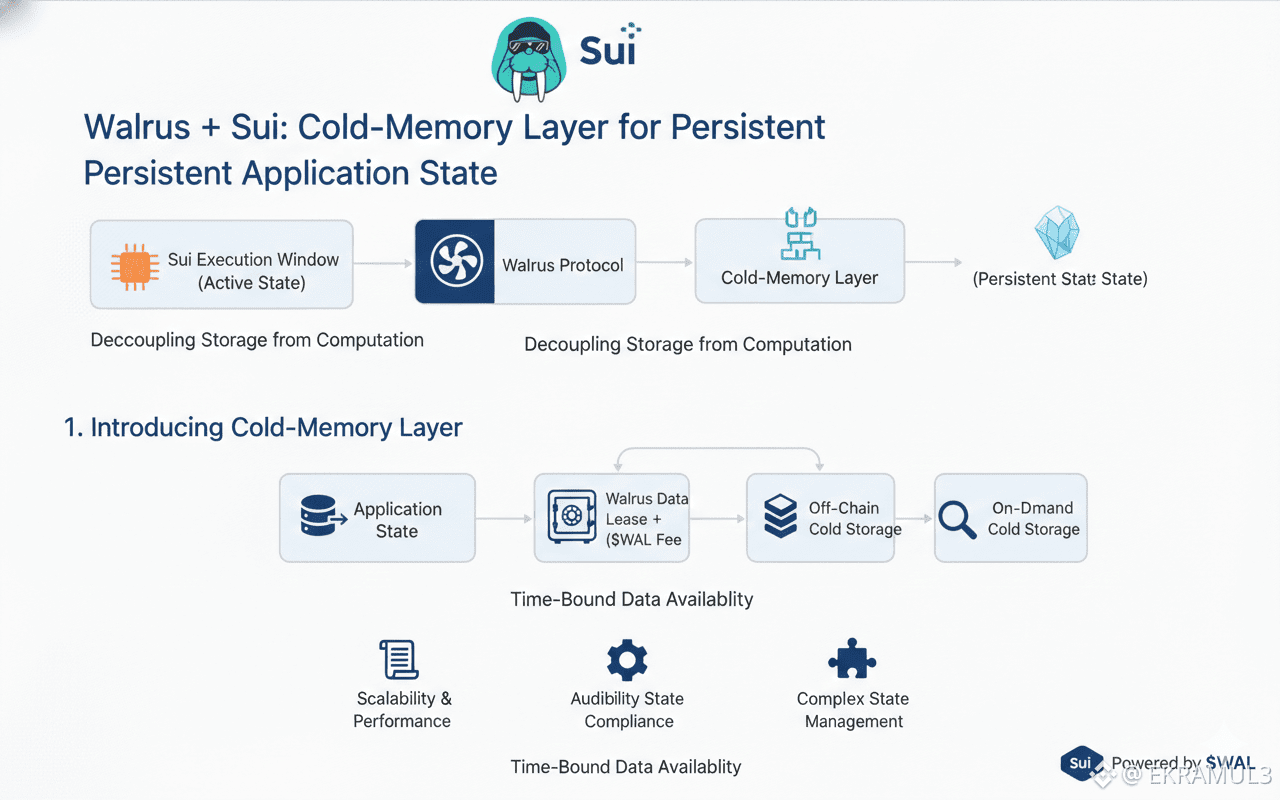
One of the quiet limitations of Web3 has always been that blockchains only recognize the world during execution, not after it. Once a transaction finalizes, its influence becomes static state on-chain and everything else session history, off-chain context, media artifacts, model outputs, user-generated data disappears into unstructured storage that the chain does not reason about. Sui pushed execution forward with parallelism and object-centric state transitions, but long-lived application state still needed a home. Walrus emerges as the missing cold-memory layer that bridges this gap by allowing Sui applications to persist large data objects beyond execution windows while keeping them verifiable, schedulable, and economically anchored.
From a systems viewpoint, this changes the architecture of Sui-based applications. Instead of treating data persistence as an external side-car service that developers “bolt on” through cloud buckets or IPFS gateways, Walrus introduces a persistence substrate that the execution layer can reference directly. Data is encrypted, fragmented through erasure coding, distributed across independent storage nodes, and tied to Sui objects via certificates that enforce renewal, availability, and retrieval guarantees. The chain is not storing the data it is supervising its lifecycle. That supervision is the critical evolution.
This cold-memory framing matters because real applications do not operate exclusively in hot execution state. Social platforms maintain message archives, AI agents maintain training logs, NFTs maintain evolving media traits, and enterprise systems maintain audit histories that persist far beyond single transactions. Blockchains historically treated this type of state as “somebody else’s problem.” Walrus formalizes it as an infrastructure responsibility. Persistence becomes an extension of execution rather than a workaround outside it.
Importantly, Walrus does not attempt to make all data immortal. Instead, it exposes time as a native dimension of persistence. Data objects can carry lease durations, renewal logic, and availability obligations that reflect their real-world value. High-value state can persist for years. Low-value artifacts can expire gracefully when they no longer justify cost. This is the opposite of permanent-storage ideology, which treats all bytes as equally important forever. Sui + Walrus instead treat durability as an economic primitive, not a philosophical commitment.
Once persistence becomes programmable, new design space opens. Smart contracts can schedule storage renewals, enforce retrieval proofs, tie blob references to governance, or track state evolution across time. Applications gain the ability to integrate cold-memory into logic rather than waiting for external servers to fill the gap. This looks more like operating system memory tiers hot memory for active execution, cold memory for long-lived resources coordinated under a single trust domain rather than fragmented across multiple vendors.
The WAL token plays an accounting role in this model. It prices persistence rather than compute. Applications pay WAL to lease storage capacity, operators stake WAL to guarantee availability, and penalties reclaim WAL when obligations are not met. The result resembles resource metering in distributed systems rather than speculative tokenomics. Persistence stops being an assumed convenience and becomes a measurable resource with incentives aligned to continuity, not hype cycles.
The significance of this shift goes beyond storage. For Sui to host AI-driven systems, media-rich platforms, identity infrastructures, or compliance-grade enterprise workflows, it needs a way to retain data reliably without bloating state or offloading responsibility to private clouds. Walrus supplies the cold-memory tier necessary for those workloads to exist without betraying decentralization. When execution, settlement, verification, and persistence align under one economic model, blockchains start to behave less like ledgers and more like full computing environments.
The most interesting part is that Walrus does not ask developers to care about its internal mechanics. Like all good infrastructure, the payoff is abstraction. Developers stop worrying about storage hacks and start focusing on product. Users stop noticing where data lives and start noticing that it is always there when needed. Markets stop pricing narratives and start pricing utility. In the long run, that is how platforms move from experimental to inevitable.


