

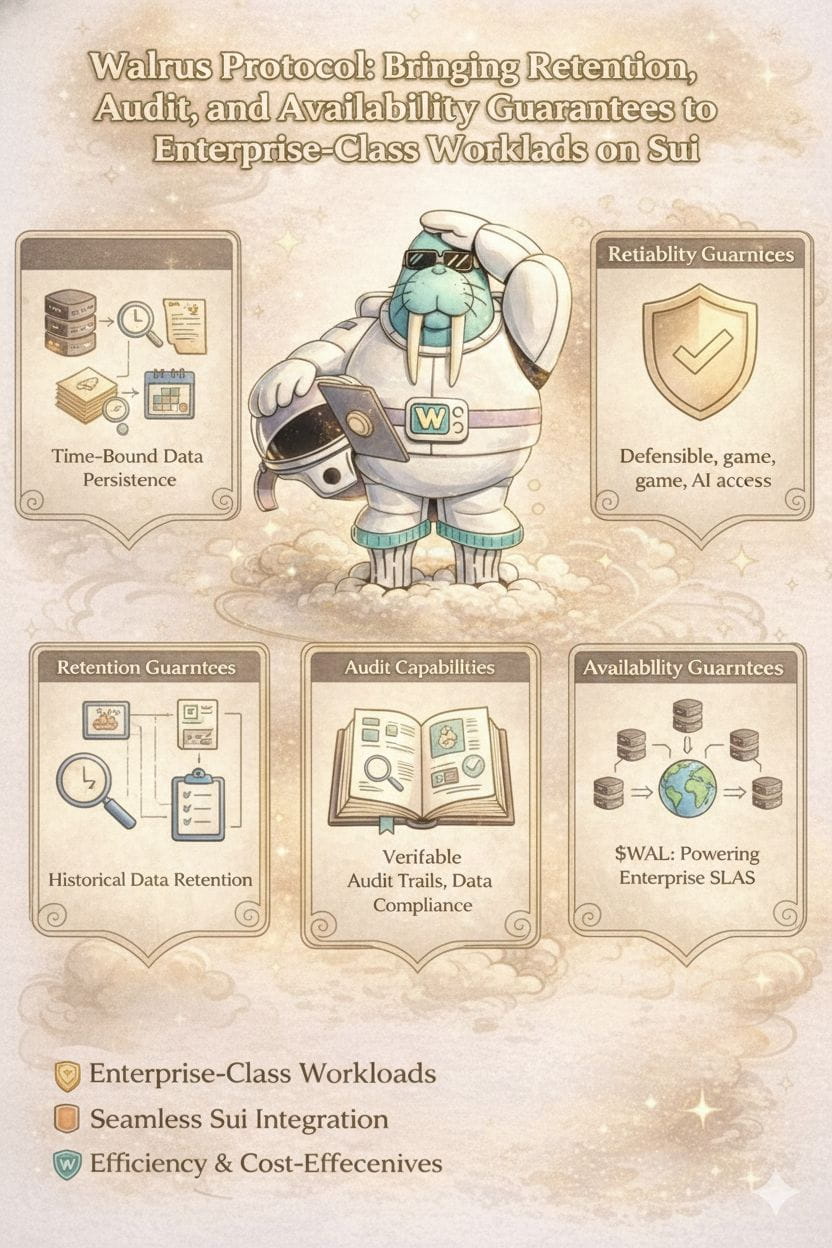
 Enterprises do not adopt new platforms because they are decentralized. They adopt them when guarantees become measurable, enforceable, and auditable. For most of Web3’s history, those guarantees only existed for computation and settlement. Data persistence remained a weak link handled with off-chain buckets, proprietary storage vendors, or opaque gateway systems that broke the trust model as soon as sensitive or long-lived data was involved. Walrus Protocol introduces a missing layer for Sui: retention, auditability, and availability as native infrastructure properties instead of hope-based operational assumptions.
Where decentralized storage networks typically position themselves as file hosts, Walrus positions itself as a compliance-aligned data substrate. The protocol encrypts large blob data, fragments it using erasure coding, distributes fragments across independent operators, and then anchors proofs, renewal logic, and retrieval commitments to Sui. The effect is subtle but powerful: data does not just “exist somewhere,” it exists under a verifiable lifecycle that applications and auditors can rely on.
For enterprise workflows, retention is not optional. Whether it is financial statements, healthcare records, research datasets, or identity artifacts, information must persist for defined periods set by regulation, internal policy, or contractual obligations. Walrus allows this through renewable lease terms that make time a first-class dimension of data management. Instead of declaring data “permanent” or “ephemeral,” applications can choose retention windows and have them economically enforced rather than manually maintained.
Second, auditability has historically been missing from decentralized storage. Enterprises need to answer basic operational questions: Who stored the data? For how long? Was it available? Who accessed it? Under what authorization? Walrus introduces certificate objects that represent storage state, renewal events, and retrieval proofs on Sui. These certificates form a verifiable audit trail without exposing the underlying data, which is critical for industries where privacy and compliance intersect.
Third, just adding redundancy isn’t enough to guarantee availability. If nobody’s actually responsible, all you get are pricey backups that don’t mean much. Walrus does things differently. It keeps operators on their toes by making them regularly prove they’ve still got the data, and it backs this up with real economic collateral. If someone drops the ball, they get penalized. This way, you don’t have to just hope everything’s fine availability gets checked, again and again. It helps protect big, long-term assets from slipping through the cracks when operators leave or stop caring.
Sui’s architecture makes this model more compelling. Its object-based execution system allows data leases, certificates, proofs, and ownership metadata to behave as stateful objects that contracts can reference directly. This is not how typical chains handle storage, where data sits outside the execution domain and can only be accessed through external APIs or trusted services. Walrus brings storage back into the same trust boundary as computation without forcing the chain to store large payloads itself.
The WAL token functions as an accounting primitive rather than a speculative instrument. Retention consumes WAL. Operators stake WAL to provide availability guarantees. Renewals circulate WAL over time rather than concentrating it at upload. The entire system mirrors how enterprises already think about cloud infrastructure: pay for what you store, verify what you get, and settle responsibility transparently.
This design unlocks categories of workloads that previously did not fit on-chain ecosystems:
— regulated document storage with time-based audit windows
— enterprise identity and credential systems
— research and healthcare datasets requiring controlled access
— AI corpora with structured retrieval patterns
— financial archives with compliance retention needs
— decentralized SaaS products with multi-tenant data models
These use cases do not care about narratives or token incentives. They care about three questions:
1. Will the data persist?
2. Who is accountable?
3. Can I prove it?
Walrus answers those questions inside the same trust domain that controls computation and settlement, which is the dividing line between decentralized experiments and production-grade systems.
The broader implication for Sui is that it begins to resemble a full-stack infrastructure platform rather than a high-performance execution engine attached to off-chain services. As persistence becomes programmable and auditable, the ecosystem becomes viable for applications that outlive hype cycles and require guarantees that cloud vendors currently monopolize.
The story here is not about “storage.” It is about converting retention, audit, and availability into protocol-level guarantees that enterprises can model, price, verify, and depend on. That shift is what marks the entry point from speculative Web3 into durable digital infrastructure.