

@Walrus 🦭/acc appeared in my mind during a subdued discussion the kind that happens after everyone has already nodded through the standard conclusions. Someone posed a question that sounded almost understated what if many of our assumptions about security in decentralized storage aren’t wrong, just focused on the wrong layer? That idea lingered longer than expected, because once you take it seriously, a lot of familiar design decisions begin to feel less solid.
After watching enough on-chain systems fail in ways no whitepaper ever anticipated, a pattern becomes clear. Breakdowns rarely come from weak cryptography. They come from incentive drift, operators optimizing for survival, and recovery costs quietly rising until only the largest players can afford to behave correctly. Walrus doesn’t attempt to correct those failures after the fact. It sidesteps them by redefining where trust is allowed to exist.
In Walrus, encoding isn’t a convenience feature it’s the security boundary itself. Many systems still rely on a familiar recipe pick the right nodes, punish bad actors, replicate data widely, and assume correctness will emerge. That approach works right up until it doesn’t. Walrus eliminates the need to care about individual node behavior at all. If a sufficient number of encoded fragments are present, the data is recoverable. If they aren’t, no amount of goodwill can change the outcome. The rule is stark, but it’s transparent.
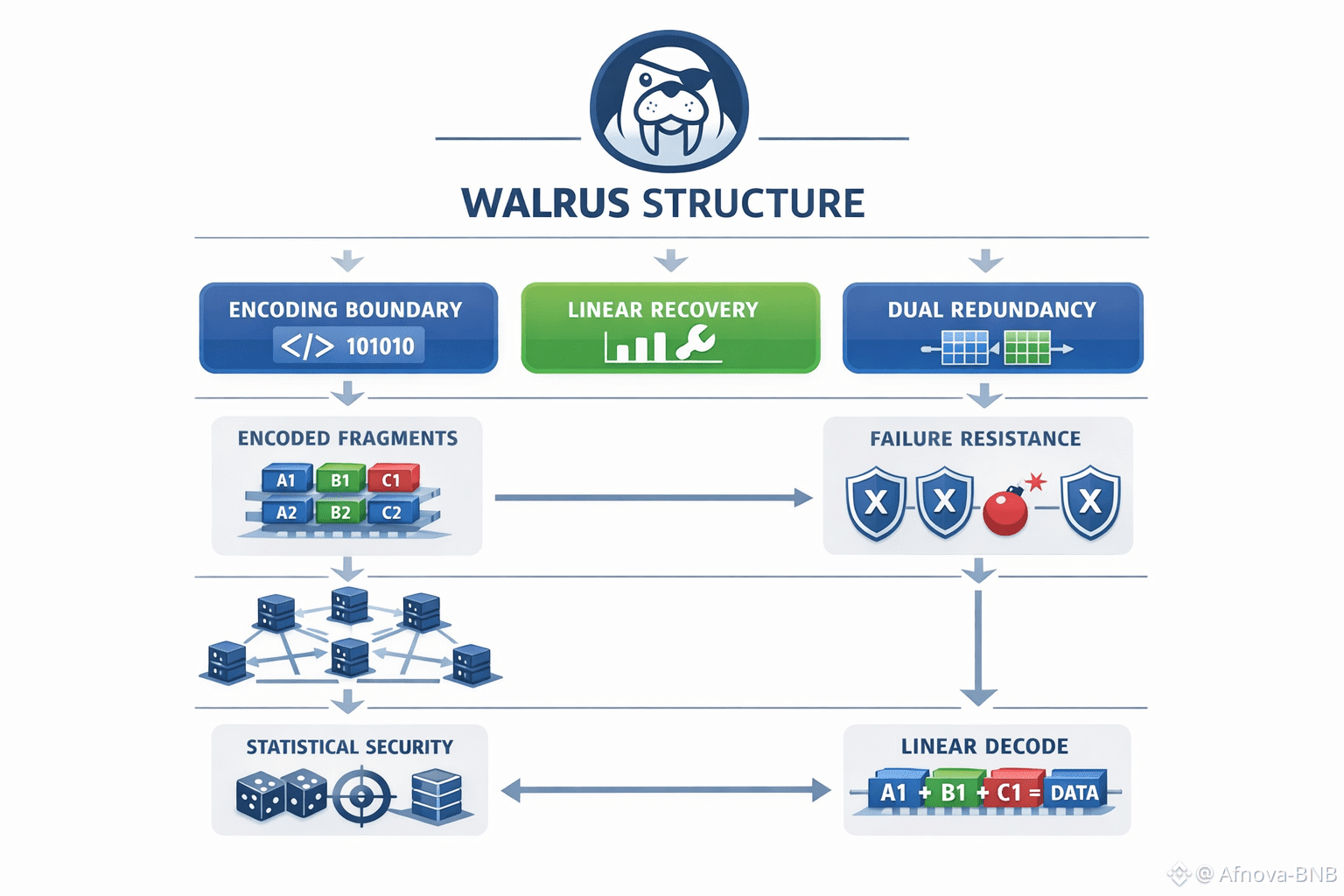
That shift reframes the threat model entirely. Instead of worrying about which node might misbehave or which operator might cut corners during a downturn, the only remaining risk is statistical. An attacker must disrupt a large share of the network simultaneously, not exploit a handful of weak points. Misbehavior doesn’t corrupt the system it simply loses relevance. This isn’t optimism it’s math replacing incentives that often fail under pressure.
Recovery cost is another dimension that’s easy to underestimate. Not theoretical storage cost, but the real expense of restoring a system after partial failure. Heavy decoding schemes look manageable when networks are young. Over time, they become quiet engines of centralization. Only the most well-capitalized operators can absorb repeated, large-scale recomputation. Everyone else either exits or becomes dependent.
Walrus avoids that trap by enforcing linear decodability. Recovery effort scales with what’s actually missing, not with the total volume ever stored. It sounds like a technical nuance, but it’s one of those choices that determines who can still participate years down the line. When failure occurs as it inevitably does the system degrades gradually instead of catastrophically.
That characteristic matters more than it gets credit for. DeFi is already full of mechanisms that appear neutral while subtly encouraging short-term thinking. Systems that impose sudden, massive recovery costs push operators to over-replicate, over-insure, or abandon ship at the first sign of trouble. Linear recovery removes that pressure. You repair the damaged parts, not the entire structure. Sustainability becomes a built-in property rather than a marketing claim.
Redundancy is handled with the same restraint. Most networks oscillate between two flawed extremes: full replication that wastes resources, or thin fragmentation that collapses under correlated failures. Walrus rejects that binary. By spreading redundancy across two independent dimensions, it ensures that no fragment stands alone. Each piece participates in multiple recovery paths without being blindly copied.
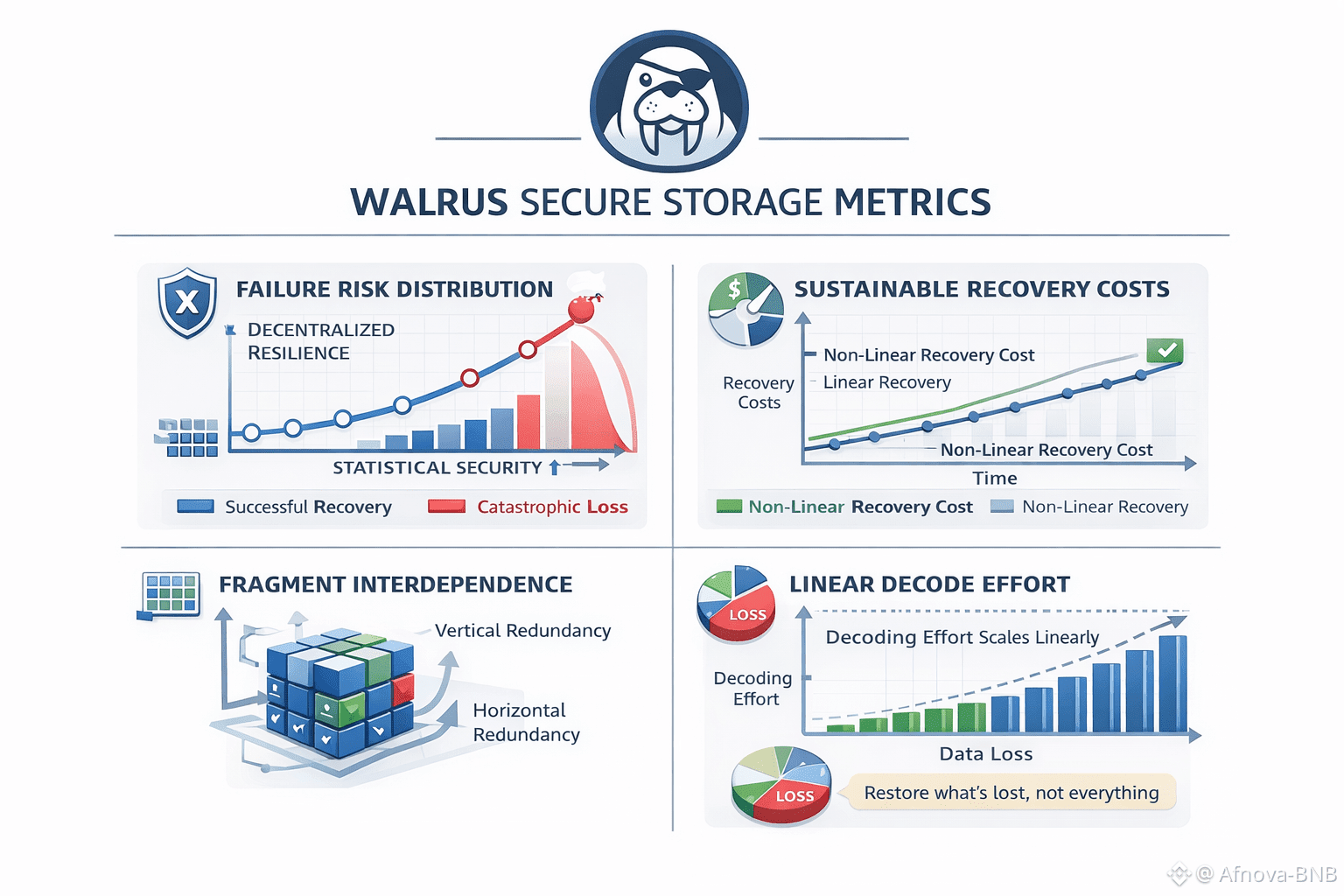
At that point, the design starts to feel almost philosophical. Resilience doesn’t come from stockpiling duplicates; it comes from structured interdependence. Loss along one axis is offset by strength along another. Efficiency emerges not from storing less, but from storing more intelligently. Capital isn’t burned on brute-force safety it’s embedded in the relationships between fragments.
Anyone who has watched enough systems age learns to distrust designs that only look robust when conditions are perfect. Real stress shows up as slow erosion creeping correlations, rising operational overhead, governance fatigue. Walrus doesn’t claim to fix human behavior. It limits how much harm that behavior can cause. Governance can stagnate. Nodes can disappear. Operators can leave. The data remains calm.
What’s notable isn’t cleverness plenty of clever systems fail once they meet reality. What stands out is restraint. Walrus doesn’t chase narratives or growth curves. It assumes networks will age, incentives will blur, and participants will change. Its answers are structural rather than motivational.
Over the long run, the protocols that endure are rarely the ones making the most noise. They’re the ones that quietly remove fragility. Walrus exists because too much on-chain value depends on storage assumptions that few people want to scrutinize. By shifting security from behavior to mathematics, from promises to reconstruction, it tackles a problem most only recognize after something goes wrong.
That’s why Walrus matters not because it will transform everything overnight, but because it’s built to keep working once the noise dies down, doing exactly what it was designed to do without asking for attention.

