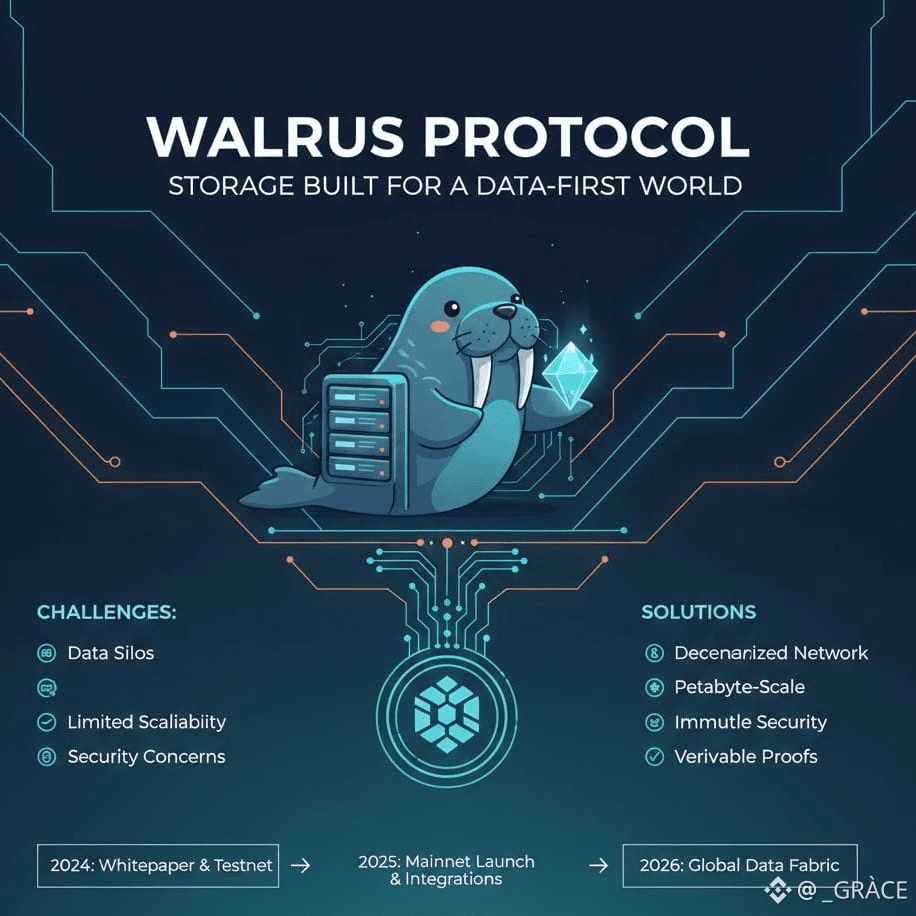
The way digital systems treat data is undergoing a quiet but profound shift. For decades, storage was something users rarely thought about. Files were uploaded, backups were assumed, and reliability was taken on trust. That model worked when data volumes were manageable and applications were relatively simple. Today, that assumption no longer holds. Data has become the primary fuel of modern technology. Artificial intelligence systems depend on massive datasets. Games operate as persistent environments rather than downloadable products. Enterprises generate continuous streams of information that must remain available, verifiable, and secure. In this new reality, storage is no longer a background service. It is infrastructure. This is where Walrus Protocol enters the picture.
Walrus does not present itself as a revolutionary idea built on hype. Instead, it approaches storage as a problem that must be solved properly if decentralized systems are to scale. The protocol is built around the idea that data durability, availability, and performance should not be tradeoffs. Many decentralized storage networks promise resilience but struggle with speed or cost. Others optimize for low prices while compromising reliability. Walrus attempts to resolve these tensions through careful architecture rather than shortcuts.
At a fundamental level, Walrus treats large data blobs as a normal part of blockchain-enabled applications. This may sound obvious, but it is a significant departure from how most blockchain systems were designed. Early blockchains focused on transactions and state changes, not multimedia files or large datasets. As a result, developers have often relied on external storage systems that feel disconnected from on chain logic. Walrus bridges this gap by creating a storage layer that is decentralized yet deeply integrated into the application stack.
One of the defining characteristics of Walrus is its use of erasure coding instead of simple replication. Traditional replication stores multiple complete copies of the same file across different nodes. While this increases redundancy, it also multiplies storage costs and limits scalability. Walrus takes a different approach. Files are split into fragments, encoded, and distributed across many independent storage providers. Only a subset of these fragments is required to reconstruct the original data. This design dramatically improves efficiency without sacrificing resilience.
This technical choice has practical consequences. Storage providers are not burdened with holding full copies of large files. Network capacity is used more effectively. At the same time, data remains accessible even if multiple nodes fail or go offline. The system is built to expect imperfections and handle them gracefully. Instead of relying on ideal conditions, Walrus assumes a dynamic network and designs around it.
Performance is another area where Walrus distinguishes itself. Many decentralized storage solutions struggle with retrieval times, especially as file sizes increase. This creates friction for developers and frustration for users. Walrus is optimized for large data transfers from the ground up. Blob storage is treated as a core function rather than an edge case. As a result, retrieval remains predictable even under load. This predictability is essential for real world applications that cannot tolerate delays or uncertainty.
The decision to build on the Sui blockchain reinforces these strengths. Sui was engineered with high throughput and parallel execution in mind. Its object based model allows data to be referenced and manipulated efficiently. Walrus integrates naturally into this environment, allowing developers to store data, reference it on chain, and build logic around it without complex workarounds. Storage becomes part of the application’s logic rather than an external dependency that must be managed separately.
This tight integration has important implications for developers. Instead of stitching together multiple systems, builders can rely on a unified stack where execution and storage work together. This reduces complexity, shortens development cycles, and lowers the risk of errors. Over time, it also encourages more ambitious applications, because developers are not constrained by fragile infrastructure choices.
Reliability is often the deciding factor when organizations evaluate storage solutions. It is not enough for data to be stored somewhere. It must be retrievable when needed, under predictable conditions. Walrus addresses this through structured retrieval mechanisms that emphasize defined expectations rather than best effort delivery. By designing for predictable access, the protocol moves closer to the standards required by enterprises and large scale platforms.
Economics play a critical role in whether a storage network can survive long term. Many projects rely on aggressive incentives to attract early participants, only to struggle when subsidies decline. Walrus takes a different approach by focusing on cost efficiency at the architectural level. By reducing unnecessary redundancy and optimizing data distribution, the network lowers its baseline operating costs. This allows pricing to remain competitive without relying on unsustainable incentive structures.
As the network scales, these efficiencies compound. More data increases distribution and resilience. Greater resilience attracts more users who need dependable storage. This creates a reinforcing cycle driven by utility rather than speculation. In infrastructure, this type of growth is far more durable than growth driven by short term incentives.
The types of users gravitating toward Walrus provide insight into its role in the ecosystem. Gaming platforms need persistent storage for assets, player states, and user generated content. Content networks require reliable hosting for large media libraries. Research groups depend on datasets that must remain accessible for long periods. These use cases involve valuable data that cannot be easily replaced. Their adoption signals confidence in the system’s durability.
Artificial intelligence further amplifies the importance of reliable storage. Training models requires access to large, consistent datasets. Centralized providers offer convenience, but they also introduce risks related to access control, outages, and long term availability. A decentralized storage layer like Walrus offers an alternative where data can remain accessible and verifiable without dependence on a single provider. This opens the door to AI systems that are more resilient and more aligned with open innovation.
Enterprise adoption follows similar logic. Organizations increasingly recognize the risks of relying entirely on centralized cloud infrastructure. Service disruptions, policy changes, and regional outages can have significant consequences. Decentralized storage does not eliminate all risk, but it distributes it in a way that centralized systems cannot. Data is no longer tied to a single vendor or location. Instead, it exists across a network designed to withstand localized failures.
Another important aspect of Walrus is how it reframes data permanence. In traditional cloud environments, persistence is ultimately a matter of policy. Accounts can be suspended. Services can be discontinued. Access can be revoked. Walrus replaces policy based guarantees with architectural ones. Data persists because the network is designed to preserve it. No single actor has the authority to remove or censor information unilaterally.
This has meaningful implications for ownership and control. When data is stored in a decentralized system, users are not dependent on centralized intermediaries to safeguard their information. Access is governed by cryptographic rules rather than contractual terms. For individuals and organizations that value autonomy, this represents a fundamental shift in how digital assets are managed.
The broader vision behind Walrus becomes clearer when viewed through the lens of the evolving data economy. Applications are no longer isolated. They are interconnected systems that rely on shared data layers. Games interact with marketplaces. Social platforms integrate financial features. AI services consume data from multiple sources. In this environment, storage must be interoperable, verifiable, and reliable. Walrus positions itself as the layer that enables this convergence.
Rather than chasing short lived narratives, the protocol focuses on fundamentals that will remain relevant regardless of market cycles. Data volumes will continue to grow. Demand for availability will increase. Cost efficiency will remain essential. Systems that cannot adapt to these realities will struggle. Walrus appears designed with these constraints in mind, favoring solutions that scale naturally rather than those that require constant adjustment.
Community sentiment around Walrus often highlights its understated approach. It is not defined by aggressive marketing or exaggerated claims. Its reputation grows through usage and developer adoption. This organic growth pattern suggests that the protocol is solving real problems rather than manufacturing demand. In infrastructure, this is often a sign of long term viability.
The relationship between Walrus and builders is especially important. By offering clear primitives for storage and retrieval, the protocol reduces friction for developers. Teams can focus on building products instead of managing complex storage systems. Over time, this can accelerate innovation across the ecosystem as more applications are able to incorporate rich data features without compromising reliability.
Security remains a central concern in decentralized environments. Walrus addresses this through cryptographic verification and distributed data integrity checks. Users do not need to trust individual storage providers. They can verify that data remains intact and available through the protocol’s design. This trust minimization is essential for systems that operate without centralized oversight.
As decentralized finance, gaming, AI, and enterprise applications continue to converge, the importance of robust storage infrastructure will only increase. Blockchains excel at coordination and execution, but they require complementary systems to handle data at scale. Walrus fills this role by providing a storage layer that is deeply integrated yet independently scalable.
Looking forward, it is easy to imagine Walrus supporting applications that are only beginning to emerge. Persistent virtual worlds with vast asset libraries. Scientific collaborations sharing enormous research datasets. Media platforms hosting decentralized archives. AI models trained on open data that remains accessible for decades. Each of these scenarios depends on storage that can grow without collapsing under its own complexity.
The true test of Walrus will not be short term attention or market cycles. It will be whether the network continues to operate reliably as usage increases and demands evolve. Early signals suggest that its architectural choices are aligned with this goal. By prioritizing efficiency, resilience, and integration, Walrus positions itself as infrastructure rather than experiment.
Decentralized storage is no longer about proving that data can exist outside centralized servers. That question has already been answered. The real challenge is building systems that can support the scale, performance, and reliability modern applications require. Walrus addresses this challenge directly with an approach that treats storage as foundational rather than optional.
As the data economy continues to expand, the value of dependable storage infrastructure will become increasingly clear. Protocols that focus on fundamentals will shape the next generation of digital systems. Walrus stands as a strong example of how thoughtful design and long term thinking can turn decentralized storage into something truly practical for the world ahead.