
The blockchain world is at an inflection point. For over a decade, networks were designed for human users: wallets, manual approvals, and interfaces that required attention. Those paradigms worked for early DeFi, NFTs, and consumer apps. But AI is changing everything. Autonomous agents — systems that learn, reason, and act independently — cannot rely on manual interfaces. They require infrastructure that assumes intelligence at the base layer, not as an add-on.
This is where @Vanarchain distinguishes itself. The Vanar ecosystem, anchored by $VANRY, is not simply “AI-ready” in marketing terms. It is AI-native, purpose-built to serve agents as first-class participants in the economy. #Vanar
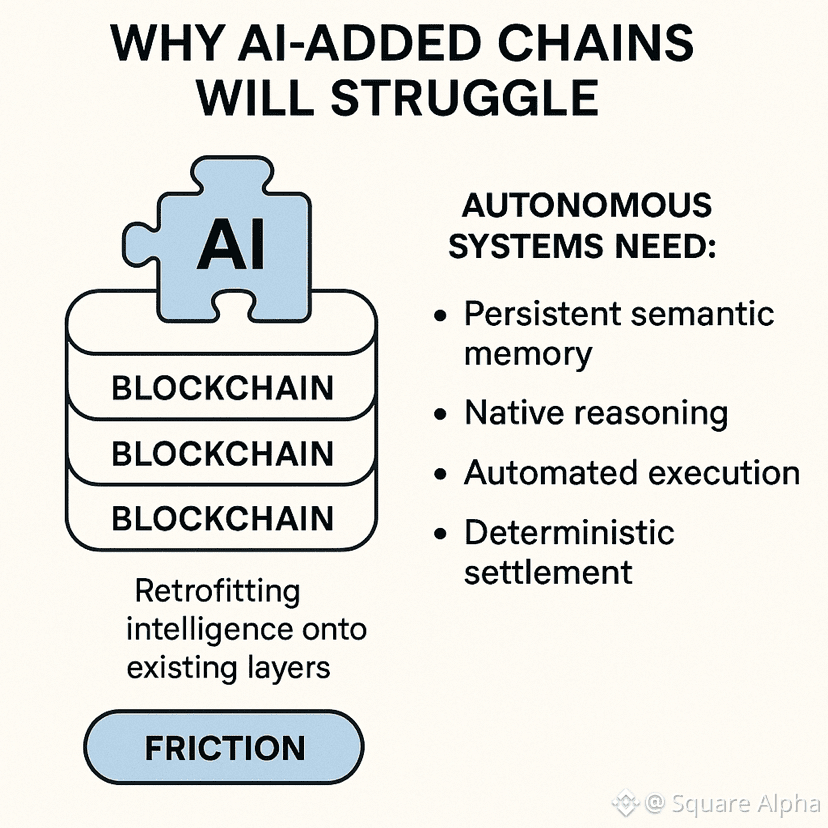
Why AI-Added Chains Will Struggle
Most blockchains today are retrofitting intelligence onto existing layers. They were designed for users, then patched with SDKs or APIs to support AI applications. This approach introduces friction: memory is ephemeral, reasoning is off-chain, and automation requires human intervention.
Autonomous systems need primitives that are structural, not cosmetic:
Persistent semantic memory, so context is preserved across sessions
Native reasoning, allowing decisions to be explained and audited
Automated execution, enabling action without manual triggers
Deterministic settlement, ensuring value transfers are reliable
Chains built for users cannot meet these requirements at scale. Vanar flips the script by embedding these capabilities directly into its architecture, making $VANRY a natural medium for agent-driven activity.
From Human Users to AI Agents
Transitioning from user-centric to agent-centric economies is more than semantics. It changes how value is captured, routed, and settled. Autonomous agents do not wait for interfaces, they interact continuously. They require real-time context, persistent knowledge, and settlement rails that operate programmatically.
Vanar addresses these needs natively. $VANRY is not just a gas token; it is the coordination and settlement layer for the AI-first stack, facilitating payments, staking, and cross-agent interactions without human intervention. This is why VANRY aligns with real usage and long-term value accrual rather than speculative hype.
Proving AI Readiness With Live Infrastructure
Vanar isn’t theorizing AI readiness — it is demonstrating it through operational products:
myNeutron
Enables persistent semantic memory at the infrastructure level. Agents retain context, accumulate experience, and act consistently across sessions. For any intelligent system, memory is the foundation — and VANRY underpins the economic layer of these interactions.
Kayon
Provides native reasoning and explainability. AI decisions must be verifiable; Kayon embeds reasoning on-chain so that agents’ actions can be audited, ensuring trust and reliability.
Flows
Transforms intelligence into safe, automated execution. Actions can occur autonomously, securely, and value-settled with VANRY. Flows closes the loop between intelligence and economic activity, proving that Vanar’s infrastructure is ready for agents, not just human users.
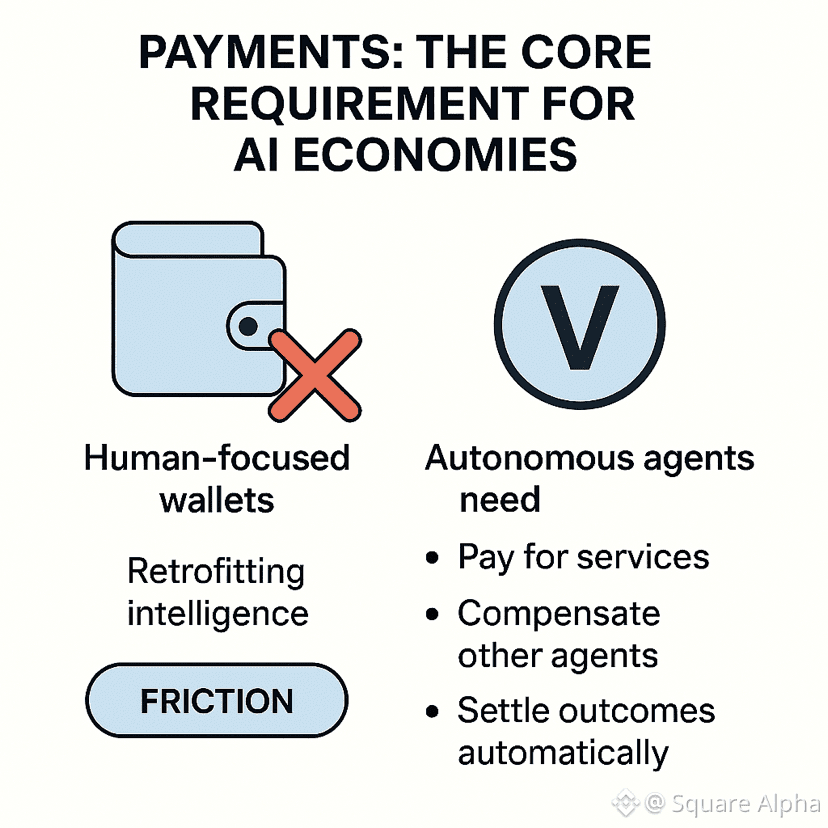
Payments: The Core Requirement for AI Economies
Human-focused wallets are insufficient for AI-native operations. Autonomous agents need programmatic, global settlement rails to transact efficiently:
Pay for services
Compensate other agents
Settle outcomes automatically
Vanry is built precisely for this role, enabling real economic activity across intelligent systems. Unlike traditional tokens that incentivize hype or superficial usage, VANRY facilitates transactions that are necessary for AI-driven economies to function and scale.
Cross-Chain Accessibility Expands Reach
AI agents do not respect chain boundaries. If infrastructure is isolated, adoption and utility are constrained. @vanar’s cross-chain strategy, starting with Base, ensures that Vanar’s AI-native infrastructure can interact with multiple ecosystems. This expands the potential user base for VANRY, increases on-chain activity, and strengthens long-term value accrual.
Why VANRY Reflects Readiness, Not Narrative
New L1 launches often compete on hype or marketing narratives. Vanar competes on readiness. By embedding memory, reasoning, and automation natively into the infrastructure, Vanar ensures that VANRY exposure correlates with real usage: agents interacting with intelligent systems, executing tasks, and settling value programmatically.
This is where #vanar differentiates itself from chains attempting to retrofit AI later. Infrastructure designed for AI from day one compounds utility over time — and tokens like VANRY are the economic manifestation of that readiness.
Conclusion: Agents Are the New Users
The future of blockchain is not wallets, dashboards, or TPS charts. It is autonomous economic actors operating on intelligent infrastructure. $VANRY is positioned to capture this shift, providing settlement, coordination, and incentives for systems that learn, reason, and act independently.
For creators, developers, and early adopters, @Vanarchain represents not speculation, but participation in an AI-first economy. Those who understand this transition will see that readiness beats narratives, and infrastructure built for agents will dominate the next wave of blockchain adoption.
