
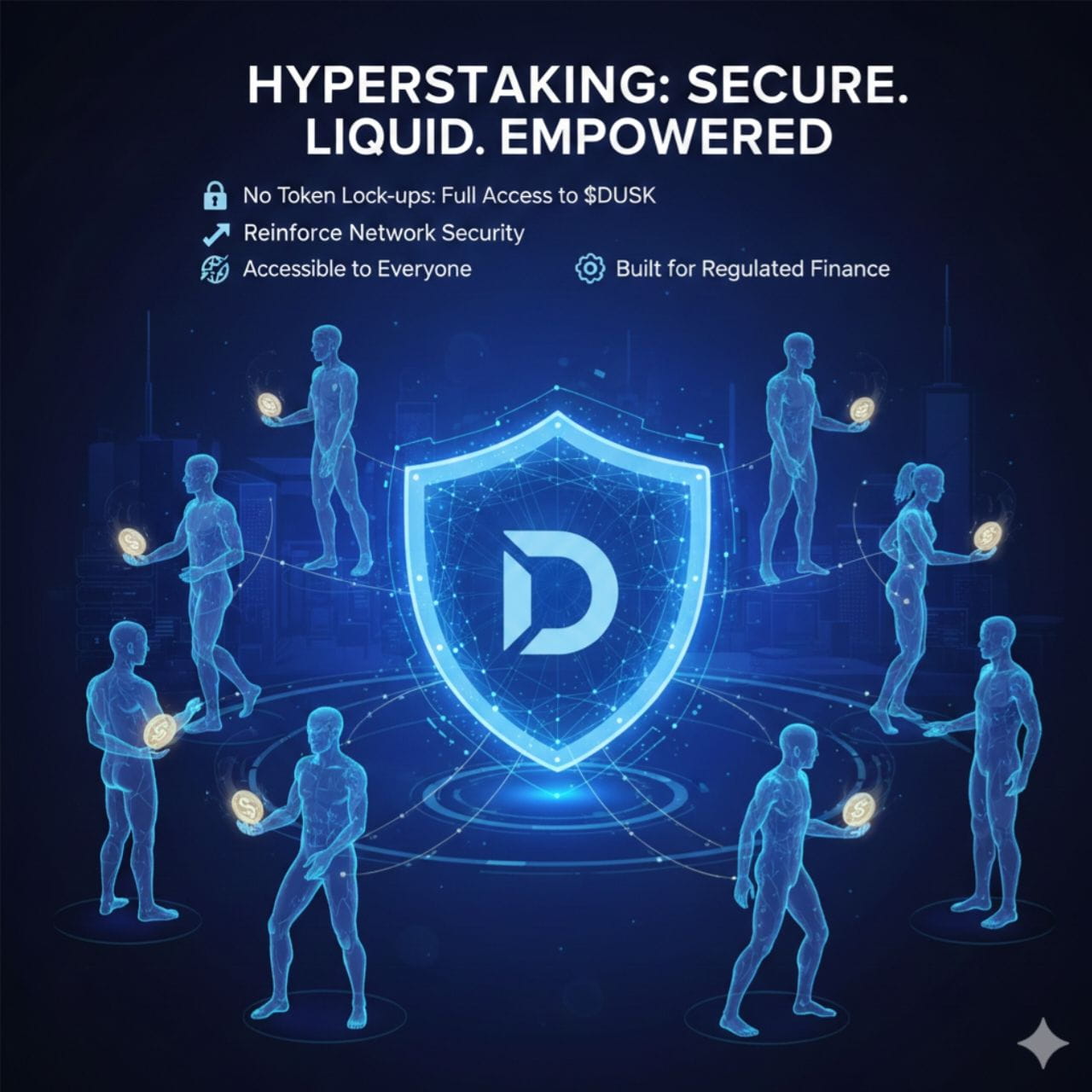
 Let’s dive deeper into Hyperstaking on Dusk Network — what it really stands for, the vital role $DUSK holders like you play in maintaining security, and why this feature is crucial for the network’s long-term vision.
When most people hear the term “staking,” their first thought is, “Great, free rewards.” But the reality is that staking is about much more than just collecting extra tokens. On Dusk, staking—referred to as Hyperstaking—goes beyond the simple accumulation of rewards. It’s fundamentally about reinforcing the network’s security, making the entire ecosystem more robust, and preparing it for the rigorous demands of real-world financial applications. The rewards are certainly appealing, but at its core, they’re just an added benefit for those who help keep the system operating smoothly and efficiently.
So, if you’re holding $DUSK, understanding Hyperstaking means you grasp why Dusk remains decentralized and resilient. It’s not just about rewards, but about ensuring the network doesn’t become controlled by a select few, and can truly meet the standards required for regulated finance. This is what sets Dusk apart and makes Hyperstaking so significant for the future of the entire protocol.
Let’s break things down step by step:
What is Hyperstaking, exactly? At its heart, Hyperstaking is Dusk’s innovative way of allowing $DUSK holders to participate in validating the network, but without the traditional inconvenience of locking up your tokens for long periods. You can take part, contribute to blockchain security, and still have full, unrestricted access to your tokens at any time. It’s like joining a neighborhood watch where you help keep the community safe, but never have to hand over your house keys or lose your independence.
Why does this matter for the network and for you? Dusk operates on a privacy-first, advanced consensus protocol where validators and stakers play a critical role in maintaining honesty and integrity across the system. The more people who participate, the stronger the network becomes—making it significantly harder for any single entity to compromise or manipulate the system. With broader participation, single points of failure are minimized, and the network becomes much more secure and resilient against attacks or attempts at centralization.
There’s also an important economic aspect. When you stake, you’re not just a bystander—you have real skin in the game. If the network remains secure and valuable, everyone—including you—benefits. This alignment of incentives is what keeps participants motivated, engaged, and honest.
So, what are the key benefits for $DUSK holders?
First and foremost: No token lock-ups. You’re not forced to immobilize your assets for months at a time. You maintain flexibility, your capital remains liquid, and you can manage your exposure to risk on your own terms. This level of freedom is especially important if you prefer not to have your assets tied down.
Second: It’s incredibly accessible. You don’t need to be a technical expert or have specialized hardware to join in. Participation is open to everyone, whether you’re new to crypto or an experienced user. As more people get involved, the network becomes even stronger and more decentralized—precisely what’s needed for a healthy, resilient blockchain.
Third: Real security, without the usual complexity. Many staking systems can feel overwhelming, as if you need a degree in computer science just to get started. Hyperstaking is designed to be straightforward, allowing you to make a tangible impact on network security without unnecessary headaches. This is especially crucial given that Dusk is meant to power real financial products, not just theoretical crypto projects.
Fourth: The rewards system is built for sustainability. Dusk’s incentive structure discourages quick, opportunistic in-and-outs. Instead, it encourages long-term participation, reducing the chances of sudden exits and wild fluctuations. This stability is a cornerstone for building trust and reliability in a network aimed at real-world financial integration.
How does all this align with Dusk’s vision for regulated finance? It’s simple: trust, stability, and compliance are far more important than chasing high, short-term rewards or risky setups. Hyperstaking provides a way for participants to strengthen the network without sacrificing control or liquidity. This approach is far more suitable for institutions and anyone who needs to keep compliance and accessibility in mind.
Here’s an example to make it even clearer. Imagine two different networks: one requires you to lock up your funds for months, leaving you unable to access them in case you need them urgently. The other allows you to actively participate in securing the network while keeping your tokens accessible at all times. For anyone who needs to think about regulatory requirements or who might actually need to use their funds, the second option is the obvious choice. Hyperstaking is designed precisely with this need in mind.
Let’s address a few frequently asked questions:
Will I lose access to my DUSK if I Hyperstake? No, your tokens remain fully liquid. You can access and use them whenever you wish.
Is Hyperstaking only for experienced crypto users? Absolutely not. It’s been designed to be beginner-friendly, while still offering meaningful participation for more experienced users.
Are rewards guaranteed? Staking rewards vary depending on network conditions and the number of participants. They are not guaranteed, so it’s important not to rely on them as a sure source of income.
How is Hyperstaking different from traditional staking? Traditional staking typically requires you to lock up your tokens. Hyperstaking eliminates this requirement, offering substantially more flexibility.
To sum it up: Hyperstaking on Dusk empowers you to help secure the network, maintain immediate access to your tokens, and participate in a system built for real-world financial applications. It combines robust security, genuine flexibility, and a long-term, sustainable approach—all in one innovative package.

Disclaimer: Not Financial Advice