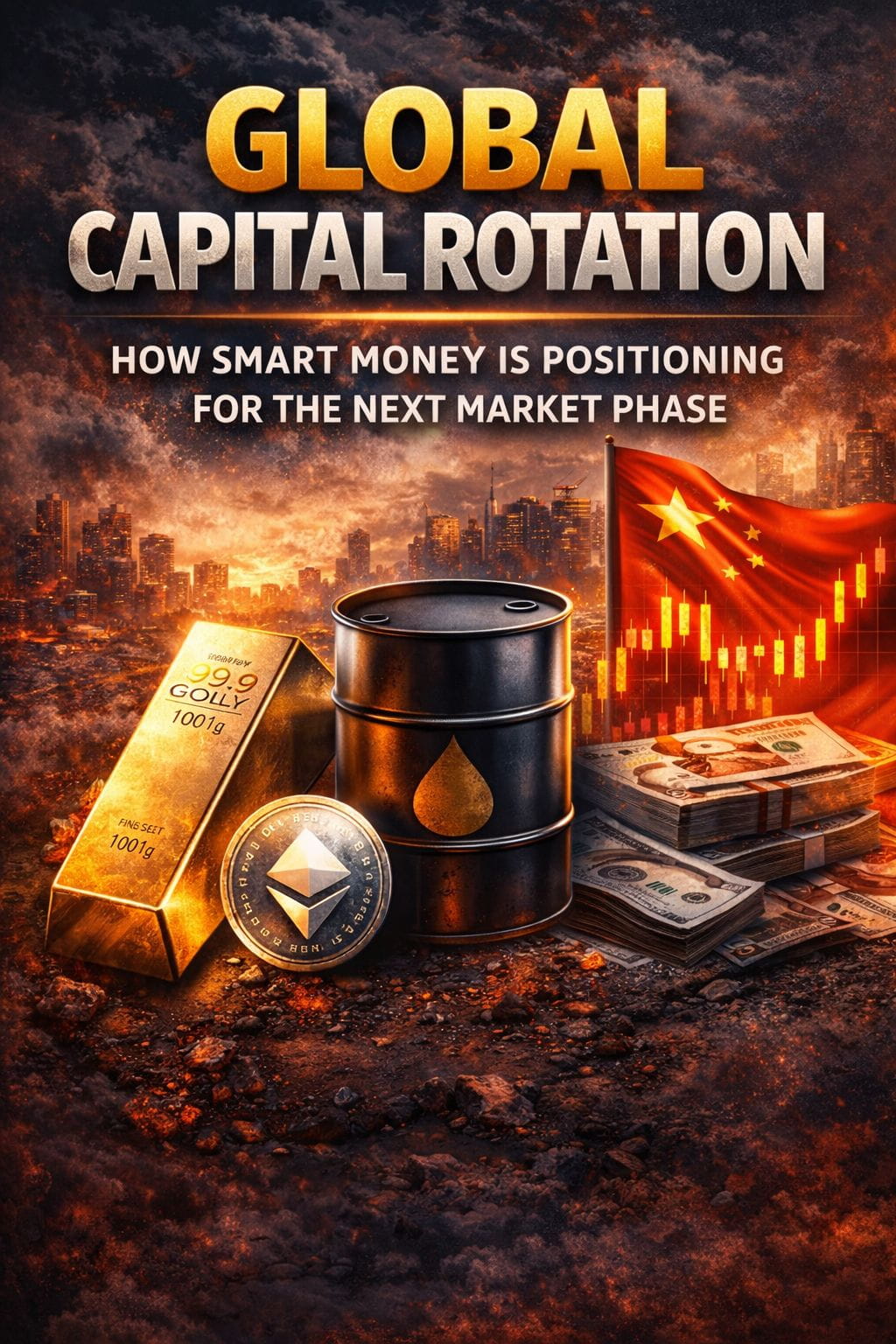
Financial markets are entering a critical transitional period defined not by short-term volatility, but by structural changes in liquidity, risk tolerance, and global capital flows.
Historically, such phases separate speculative participants from disciplined capital allocators.
At this stage of the cycle, risk assets are showing late-cycle characteristics. Valuations across multiple markets are increasingly supported by sentiment and leverage rather than sustainable fundamentals. When this dynamic dominates, capital preservation becomes more important than aggressive growth.
The Changing Risk Landscape
Cryptocurrencies, once viewed as high-growth asymmetric opportunities, are now exhibiting elevated downside risk. Market structure has shifted toward dependency on retail liquidity, leverage, and narrative-driven momentum.
For large investors, the risk-to-reward profile in crypto has deteriorated. This does not imply the end of digital assets as a concept, but it does signal that the current phase favors distribution over accumulation.
Crucially, even the oldest and most established cryptocurrencies are not immune. During systemic market stress, correlations rise sharply, and diversification within the same asset class becomes ineffective. In such moments, liquidity exits first — narratives follow later.
Gold: The Monetary Anchor in Uncertain Times
Gold continues to play its historical role as a store of value and hedge against systemic risk.
Central bank accumulation, geopolitical fragmentation, sovereign debt expansion, and declining confidence in fiat stability are reinforcing gold’s long-term structural strength.
Unlike speculative assets, gold is not driven by hype cycles. Its value proposition lies in trust, liquidity, and durability. Current macro conditions support a continuation toward new all-time highs, reflecting not excess optimism, but a repricing of monetary confidence.
For institutional capital, gold is not an aggressive bet — it is a strategic necessity.
Silver: Asymmetric Upside with Real Demand
Silver presents a different, yet complementary, opportunity.
Historically, silver underperforms gold in early stages and outperforms significantly during later expansions.
Its dual role as both a monetary metal and an industrial input creates asymmetric upside potential, particularly during periods of economic transition and infrastructure demand. From a valuation perspective, silver remains structurally undervalued relative to gold, offering attractive convexity for investors seeking measured exposure with tangible backing.
Energy Markets: Volatility as Opportunity
Oil and energy markets remain among the most macro-sensitive asset classes.
Geopolitical instability, supply constraints, and uncertain demand trajectories ensure continued volatility.
Rather than passive long-term holdings, energy assets should be approached as strategic trading instruments. For disciplined investors, this volatility is not a risk — it is a source of repeatable opportunity. Energy pricing remains a geopolitical tool, not a declining legacy asset.
Foreign Exchange: The Shift Beyond the US Dollar
The global currency system is undergoing a gradual but meaningful realignment.
De-dollarization initiatives, regional trade settlements, and Asian economic resilience are reshaping capital flows within the FX market.
Chinese-linked and broader Asian currency pairs are increasingly viewed as strategic alternatives to exclusive USD exposure. This trend reflects long-term capital repositioning rather than short-term speculation, driven by structural changes in global trade and monetary policy.
For investors with a multi-year horizon, FX exposure is becoming a core strategic consideration, not a secondary allocation.
Investment Discipline in Transitional Markets
Periods of transition reward discipline over prediction. Successful capital allocation in this environment requires:
- Reduced exposure to speculative narratives.
- Increased allocation to assets with real demand and liquidity.
- Macro alignment over short-term excitement.
- Strategic patience and risk control.
Wealth is rarely built at market peaks. It is protected during transitions and compounded during expansions.
Conclusion
Markets rarely collapse without warning. Instead, they rotate quietly, while attention remains focused on noise rather than structure.
This phase belongs to investors who understand that:
- Capital preservation precedes capital growth.
- Positioning matters more than prediction.
- Liquidity is opportunity.
$BTC $ETH $BNB #Binance #crypto #Write2Earn #BinanceSquareFamily #Write2Earn!