

It comes to a point with every technological transformation when everything shifts to noise and the builders remain. Vanar Chain lives at the moment. As most of the blockchain industry has been tirelessly pursuing the cycle of hype, Vanar has been relentlessly building infrastructure that does not treat scalability, ownership and user experience as slogans, but rather as design values. It is not a chain which is attempting to be loudest. It is one that appears to be determined to be protracted.
Vanar Chain does not start with a postulated token chart or a meme going viral. It starts with an issue that virtually all the users do not express but experience on a daily basis: blockchain systems are too splintered, too slow, and too disconnected to the realities of the contemporary digital life. Latency is an issue in gaming studios. NFT tools are cumbersome to brands. Trade of developers is among decentralization and usability. Vanar DE briefly came about answers to these frictions, but not as an abstract test article, as a scaleably used chain without the compromise to integrity.
In its fundamental form, Vanar Chain is an entertainment, AI-based, and immersive digital installation layer 1 platform. However, this description is still incomplete without its more elaborate story. Vanar is not merely a Web3-target, but an attempt to bring Web3 to the existing online interactions. The design of the chain is based on the insight that users should not worry about gas fees, bridge risks, and network congestion. They desire experiences that are immediate, that are intuitive and persistent. The approach of Vanar is that whatever new blockchains may offer in the future will not come as an ideology, but in the form of a product that appears smooth.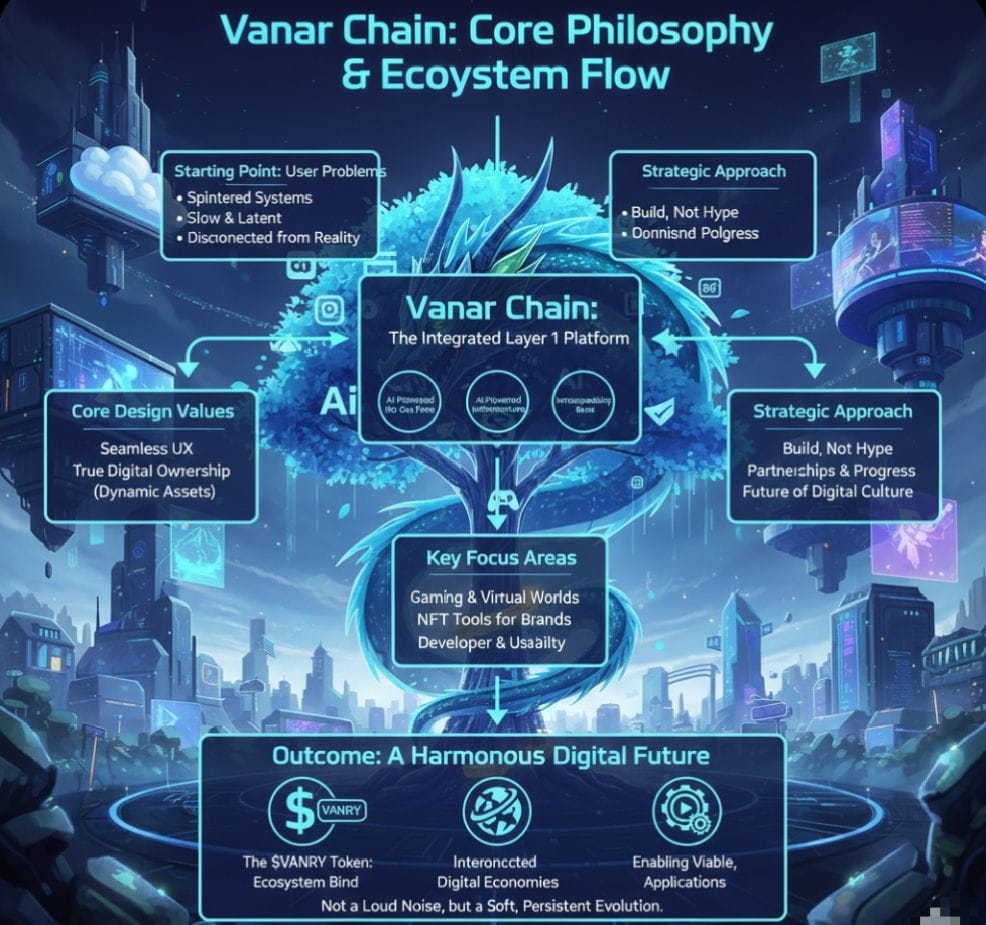
The most interesting fact about Vanar Chain is that the company considers ownership of the digital world to be lived and not documented. The only thing that counts in gaming and virtual worlds is that ownerships should be able to be transferred, develop, and have some value in other situations. The infrastructure of Vanar is constructed in this philosophy and allows the assets to exist not as fixed objects lying in pockets but as dynamic elements of more general ecosystems. And that is where $VANRY can be more than a utility token; it will be a bind between an ever-growing array of applications, creators, and start users.
Vanar ecosystem is no longer a single chain but more of an interoperability base of digital economies. Vanar builders do not have to make use of fixed structures but rather are inspired to test out AI-enhanced assets, real-time engagement, and scaling on-chain logic. Such flexibility is all the more relevant when it comes to the fact that the border between blockchain, gaming, and AI is becoming blurred. Vanar appears to understand that these intersections are the next wave of innovation and not the standalone verticals.
Another thing worth noting is the maturity of the positioning of Vanar in the existing market. In a time when all projects make overstated promises of roadmaps that are full of buzzwords Vanar talks in terms of progress and partnerships. The increase in its involvement in entertainment and immersive technology does not completely represent a short-term story but a more long-term tactic. By making an emphasis on infrastructural elements capable of dealing with complex and data intensive applications, Vanar Chain is setting itself up towards the future of digital culture and not where it already is.
There is a given trust in the manner in which the project by the name Vanar interacts with its community. Vanar does not position itself as a disruptor trying to challenge the established systems but rather as an enabler. This tone matters. It appeals to those builders who are serious about shipping products and to those kinds of users who are interested in functionality rather than speculation. Vanar in a sense is vulnerable to feel like a chain constructed by individuals who have already gone through several cycles and have chosen to maximize on resilience as opposed to attention.
In a bigger point of view, Vanar Chain also indicates a change in the assessment of blockchains. Cost and speed are no longer differentiators per se. The actual question now is whether a chain is able to sustain complex ecosystems by not fracturing in the process of its growth. The fact that Vanar focuses on performance, supporting interoperability, and developer experience implies that the company knows this evolution. It is not making the attempt to win yesterday, it is preparing to meet the needs of tomorrow.
With the digital world shifting towards constant virtual spaces, AIs created content, and economies based on the users, infrastructure such as Vanar Chain is all the more applicable. Several applications of these environments need chains capable of processing huge volumes of interactions without compromising security and decentralization. The design used by Vanar shows that it is being constructed taking into consideration these future pressures. The chain is not interested in hosting the applications, it wants to be the layer that enables them to be viable on the scale.
Ultimately, the narrative of Vanar Chain is not so much of unison as that of harmony. Harmony between technology and user behaviour. Correlation of the developers with long-term incentives. Correspondence between online innovation and actual property. The point is that the most effective blockchain projects might be those that are not making the loudest noises, but those that subtly prepare the systems people would find comfortable to work with.
With the ecosystem beginning to grow and an increasing number of applications to the problems of $VANRY starting to experience its application in the ecosystem, the case of Vanar Chain presents an excellent representation of the ability of thoughtful design to influence the future phase of decentralized tech. To the observant, this is not any other chain joining the discussion. It is an indication that even the discussion itself is growing up.
