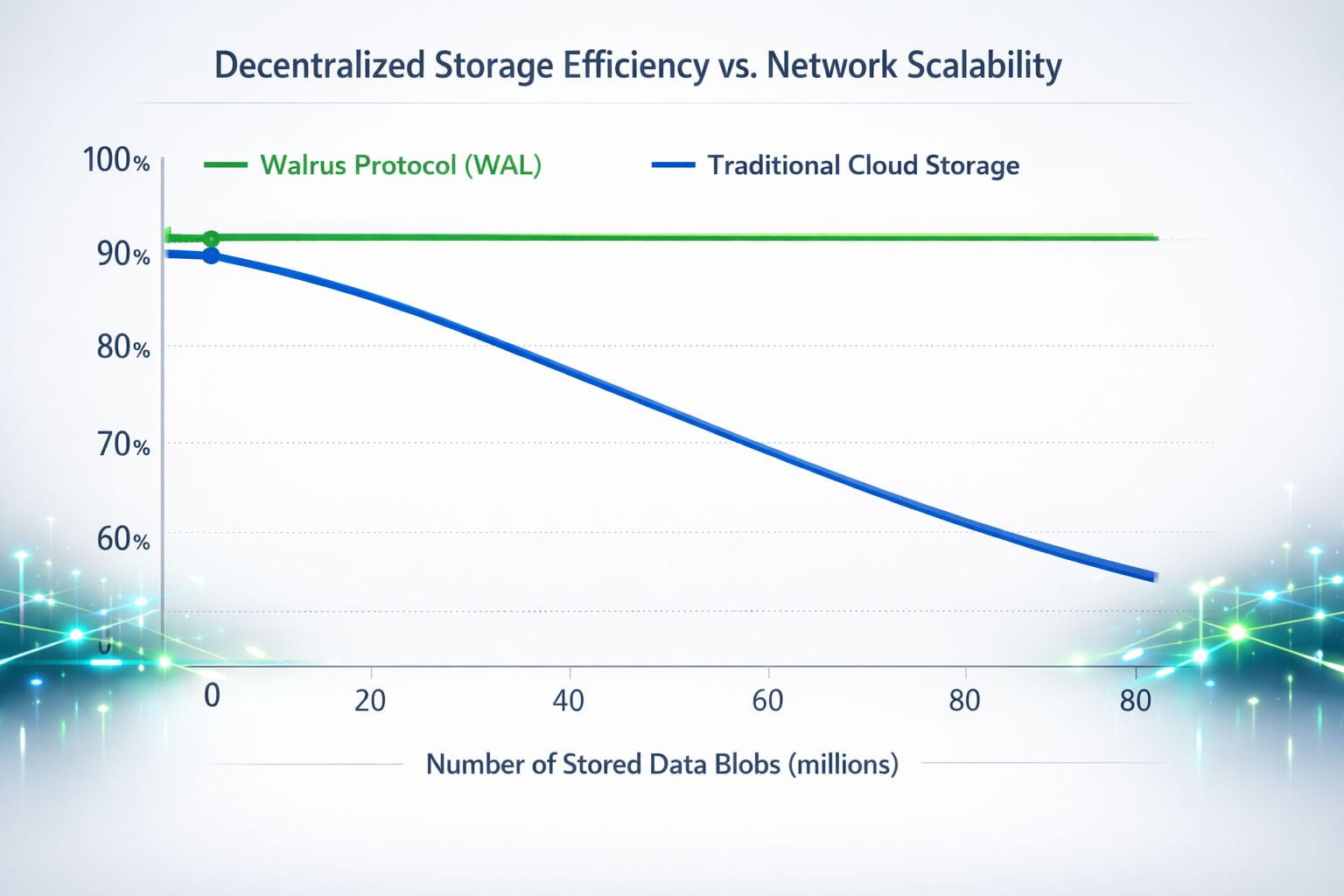
In the rapidly evolving world of Web3, decentralized applications, and blockchain infrastructure, reliable and secure storage has become one of the most critical bottlenecks for developers and enterprises alike. Traditional cloud storage solutions, though convenient, remain centralized, expensive, and vulnerable to censorship or breaches. The Walrus (WAL) protocol, built on the high-performance Sui blockchain, is addressing these challenges head-on, offering a decentralized, privacy-focused, and cost-efficient storage solution that is redefining how data can be stored, accessed, and utilized in the digital age.
Walrus is designed to provide a fully decentralized storage infrastructure that is scalable, secure, and verifiable. By leveraging advanced technologies like erasure coding and blob storage, the protocol enables files—whether datasets, multimedia assets, or AI models—to be split into fragments distributed across multiple nodes. These fragments can be reassembled even if some nodes are offline or malicious, ensuring reliability and availability at scale. This method not only strengthens data resilience but also significantly reduces storage overhead, making it a practical and efficient alternative to traditional replication-based systems.
One of Walrus’s key differentiators is its seamless integration with the Sui blockchain. Every piece of data stored within the Walrus network is represented on-chain, allowing developers and users to interact with storage assets in a programmable and verifiable way. This opens the door for developers to create sophisticated decentralized applications that can access, manipulate, and secure large datasets directly on-chain. From gaming platforms requiring real-time asset storage to AI projects needing verifiable training datasets, Walrus enables a level of flexibility and functionality that centralized cloud providers cannot match.
The WAL token is at the heart of the ecosystem, powering network payments, staking, governance, and incentive mechanisms. By staking WAL, users contribute to network security and reliability, earning rewards while participating in the protocol’s decision-making processes. This token-driven model aligns the interests of all stakeholders, ensuring that the network remains decentralized, robust, and resilient. Governance mechanisms allow WAL holders to propose and vote on protocol updates, giving the community direct influence over the development and evolution of the network.
Privacy is another cornerstone of the Walrus protocol. Sensitive data can be encrypted and stored securely, while still enabling verification on-chain without revealing the underlying content. This capability is particularly valuable for sectors like finance, healthcare, and enterprise AI, where data confidentiality is non-negotiable. Walrus empowers users to retain control over their data while benefiting from decentralized storage, effectively bridging the gap between privacy, security, and transparency.
The potential applications of Walrus extend across multiple industries. Developers can leverage it to build dApps with scalable and cost-efficient storage. Enterprises can integrate Walrus into their infrastructure to reduce dependency on centralized cloud providers while maintaining compliance with privacy regulations. AI developers can securely host large training datasets, ensuring data provenance and integrity, which is crucial for reproducible and auditable AI workflows. Additionally, blockchain projects can use Walrus to manage data availability for Layer 2 solutions, archival storage, or distributed applications, all with verifiable on-chain proof.
Economically, Walrus stands out as a cost-effective solution in the decentralized storage landscape. While many networks rely on full replication, Walrus’s erasure coding technique dramatically lowers storage costs without sacrificing reliability. This makes it an appealing choice for startups, enterprises, and content creators who require decentralized storage but are wary of high costs. By combining efficiency with the speed and programmability of the Sui blockchain, Walrus offers a uniquely practical and versatile solution for the next generation of Web3 applications.
The growing demand for decentralized storage solutions, coupled with privacy and data integrity concerns, positions Walrus as a strategic infrastructure layer for the Web3 ecosystem. As AI adoption expands and blockchain applications scale, protocols like Walrus will become increasingly central to maintaining secure, reliable, and auditable data. For developers, it offers a platform to innovate without the limitations of centralized storage. For enterprises, it provides a path toward more resilient and privacy-focused digital infrastructure. For investors and crypto enthusiasts, WAL represents a stake in a project that is foundational to the future of decentralized data management.
In conclusion, Walrus is not just a storage protocol; it is a comprehensive ecosystem that addresses critical challenges in data security, scalability, and privacy while enabling new opportunities across Web3 and AI sectors. By offering programmable, decentralized, and verifiable storage, Walrus empowers developers, enterprises, and users to fully realize the potential of decentralized applications. As the digital landscape continues to evolve, protocols like Walrus will play a pivotal role in shaping the future of how we store, manage, and utilize data. Investing time, resources, or participation in this ecosystem today positions stakeholders at the forefront of the decentralized data revolution