

Walrus Protocol is quietly building one of the most important layers of the onchain world: the layer that makes data real. In crypto we often talk about decentralization in terms of consensus and execution, but real decentralization is incomplete without decentralized availability. If a chain can process transactions but the underlying files, media, datasets, and app resources still live in fragile centralized storage, then the ecosystem remains dependent on single points of failure. Walrus exists to solve that exact gap by treating data availability as a first-class primitive, not an afterthought.
At the heart of Walrus Protocol is a very practical truth: storage is not just about saving data, it’s about proving it remains accessible over time. Anyone can claim “I stored your file.” The hard part is proving, continuously and verifiably, that the file is still there and can be retrieved when needed. This is where Walrus introduces a powerful idea that separates it from typical storage narratives: incentivized proofs of availability. Instead of relying on blind trust, Walrus builds a system where storage providers are economically motivated to keep data available, and where that availability can be verified without repeatedly downloading entire files.
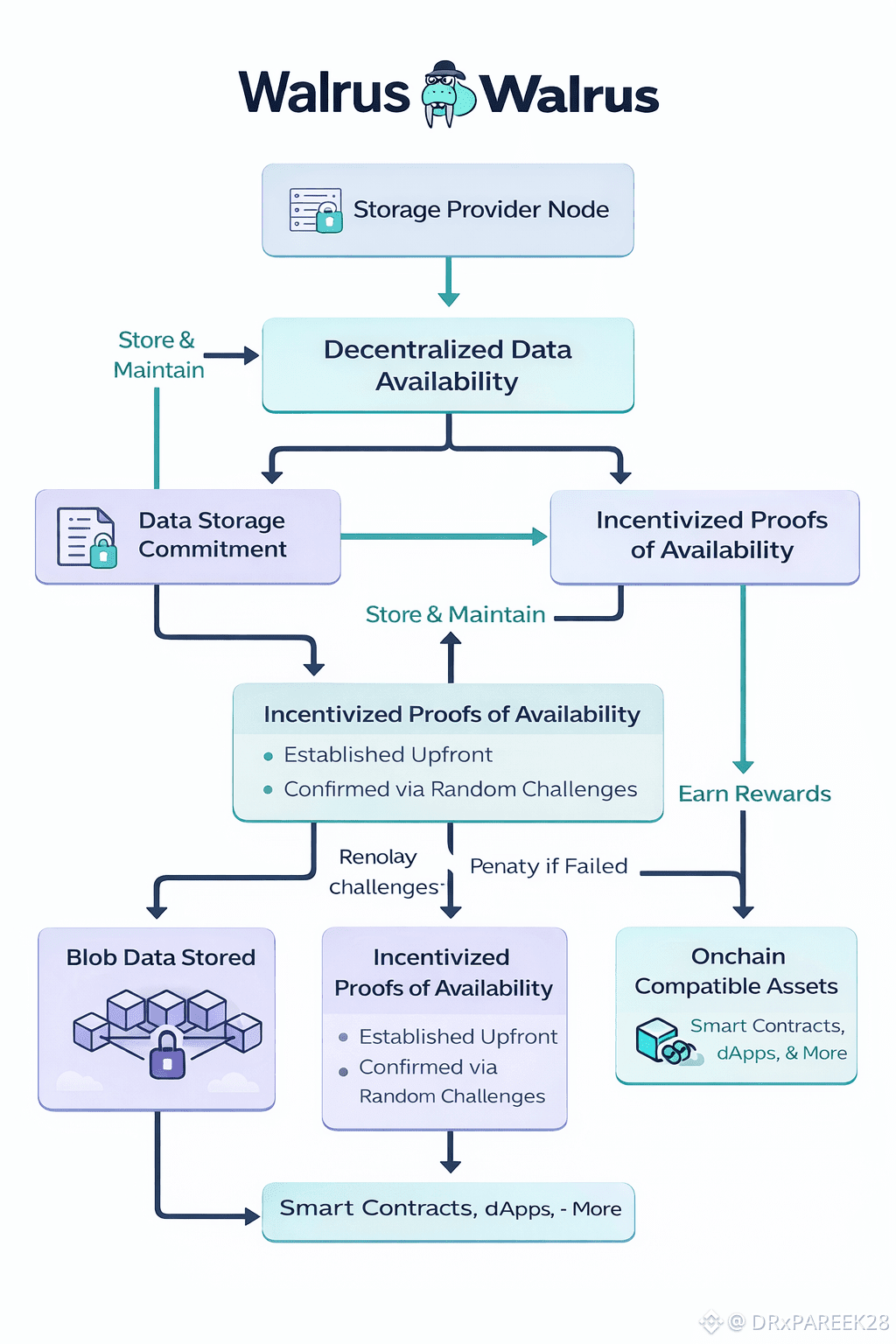
The core concept is simple but deep. Proofs of availability are established upfront, meaning when data is first stored, the protocol ensures the storage commitment is created in a verifiable way. After that, the network confirms continued availability using random challenges. This approach matters because it dramatically reduces the cost of verification. Imagine needing to check whether a large video archive, a dataset, or content library is still hosted correctly. Downloading the full data regularly would be expensive, slow, and impractical. Walrus replaces that with lightweight cryptographic checks that can still provide strong confidence. A node is challenged at random and must respond correctly to demonstrate it still maintains the data “blobs” it promised to keep. If it fails, the protocol can penalize it. If it succeeds, it continues earning rewards. In other words, availability becomes measurable, enforceable, and economically secured.
These “blobs” are a key design choice. Walrus isn’t limited to narrow file types or small payloads. It is designed for large-scale content and real-world usage where datasets, media, application assets, and user-generated content need to exist beyond the life cycle of any single server, platform, or company. The blob abstraction allows Walrus to handle storage at scale and make it compatible with onchain systems. This is crucial because the future of Web3 is not just transactions—it’s content, identity, AI data pipelines, game assets, social media archives, and institutional records. All of it needs an infrastructure that can match blockchain reliability.
What makes the incentivized availability model so impactful is that it aligns the network’s health with honest behavior. Traditional systems often fail because verification is optional or too costly. Walrus flips the incentive structure so that verification is cheap, random, and unavoidable. Since challenges are unpredictable, a storage provider cannot “fake” availability by only keeping partial data or temporarily hosting content during audits. The rational strategy becomes the honest strategy: keep the blobs stored and accessible at all times. This is exactly the kind of mechanism that transforms decentralized storage from a marketing claim into a dependable public utility.
This system also unlocks something even bigger: Walrus makes stored content onchain-compatible. That doesn’t mean every byte is placed directly on a base layer chain, which would be inefficient. It means the data can be referenced, verified, and used within decentralized applications in a way that preserves integrity. A creator’s content can become more than a file—it becomes a programmable asset. A dataset used in AI training can be verifiably the same dataset, unchanged, and available. Game studios can store world assets without fearing broken links. Communities can archive media and culture without relying on centralized gatekeepers. When data availability becomes decentralized and provable, entire categories of applications become possible without compromising security or long-term access.
This is why Walrus is increasingly gaining attention from serious builders and brands. When a large organization migrates major datasets into Walrus infrastructure, it signals real confidence in the protocol’s core promise: not only is the content accessible and secure, but it becomes usable as an asset inside the next wave of onchain products. That is a major shift from how we currently treat content online. The internet today is full of “dead links” and lost archives because the underlying hosting layer is temporary and fragile. Walrus is designed to be the opposite: persistent, verifiable, and economically enforced.
In the bigger picture, Walrus is not simply “decentralized Google Drive.” It’s a decentralized availability engine built for a world where files are no longer separate from finance, identity, and application logic. By establishing proofs of availability upfront and confirming them through random challenge mechanisms, Walrus creates a system where data lives with the same seriousness as value. And that’s exactly what Web3 has been missing for years.
The most exciting part is that this is not just theory. Incentivized availability is one of the few approaches that can scale decentralized storage to real demand while keeping verification affordable. It reduces waste, reduces trust assumptions, and increases resilience. And when you connect that with blob-based storage and onchain-compatible integrity, Walrus becomes a foundational layer for the next generation of decentralized apps. In an ecosystem where reliability decides everything, Walrus is positioning itself as the infrastructure that makes decentralization actually practical—because if your data can disappear, your future can too.

