@Walrus 🦭/acc is emerging at a very specific moment in Sui’s lifecycle — when the chain is no longer proving speed, but trying to support real, data-heavy applications. That timing matters. Walrus is not abstract storage. It is infrastructure Sui increasingly needs.
Most discussions around Web3 infrastructure focus on execution: faster chains, parallelism, better VM design. Sui already solved much of that. What it hasn’t solved — and what Walrus directly addresses — is where large, critical data actually lives once apps scale.
Why Sui Needs Walrus Now (Not Later)
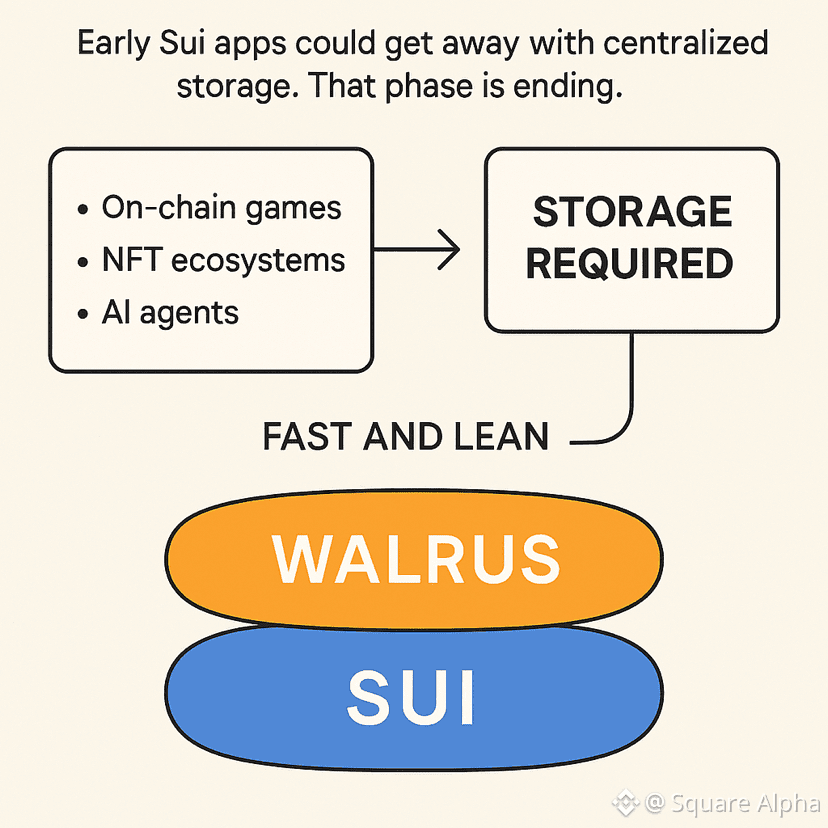
Early Sui apps could get away with centralized storage. That phase is ending.
As Sui moves into:
on-chain games with persistent assets
NFT ecosystems with long-lived media
AI agents and data-driven apps
RWAs requiring audit trails and historical proofs
the storage layer stops being optional. If data disappears, apps don’t degrade — they fail.
Walrus fills this gap by acting as Sui’s native data availability and blob storage layer, without forcing Sui to bloat its base chain.
That design choice is critical:
Sui remains fast and lean, while Walrus absorbs data weight.
Walrus Is Not “Decentralized Dropbox”
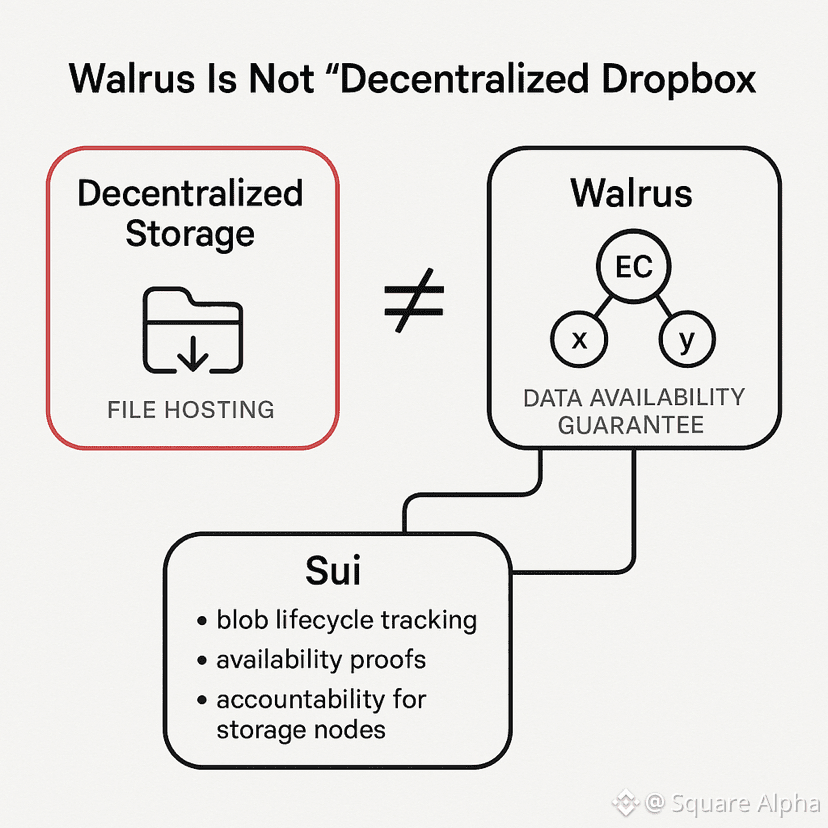
A common mistake is comparing Walrus to generic decentralized storage. That framing kills relevance.
Walrus is built around data availability guarantees, not file hosting. Using erasure coding and distributed blob fragments, it ensures data can be reconstructed even when nodes churn — which is the normal state of decentralized networks, not an edge case.
The key distinction:
Walrus does not assume reliability. It enforces it.
That enforcement is coordinated via Sui:
blob lifecycle tracking
availability proofs
accountability for storage nodes
Data lives off-chain, but truth lives on-chain.
That’s infrastructure, not tooling.
Where WAL Fits (And Why It’s Misunderstood)
$WAL is often treated like a speculative asset, which hides its real role.
Walrus uses WAL to:
incentivize long-term data persistence
compensate storage providers under churn
price availability guarantees over time
This means demand for WAL is usage-linked, not hype-driven. When applications rely on Walrus for critical data, they don’t churn casually. Storage becomes sticky. That’s fundamentally different from DeFi liquidity or NFT volume.
As of now, Walrus sits in an early infra valuation zone — not microcap, but far from fully priced as a default storage layer. That’s exactly where infra either compounds quietly or gets ignored until usage forces repricing.
Real Adoption Signals to Watch (Not Price)
If you want to track Walrus relevance correctly, ignore short-term charts and watch:
Sui-native apps integrating Walrus by default
AI or gaming projects storing live datasets on Walrus
Tooling that abstracts Walrus away for developers
Storage usage growth relative to Sui activity
When developers stop mentioning Walrus because it’s “just there,” adoption has already happened.
The Strategic Reality
Walrus is not trying to win narratives. It is trying to become boring infrastructure — the kind projects quietly depend on because replacing it is painful.
Sui’s execution layer without a native data layer is incomplete. Walrus completes that stack.
That is the relevance.
Not philosophy. Not promises.
Dependency.
If Sui succeeds in attracting real applications, Walrus becomes unavoidable. If it doesn’t, no storage narrative matters anyway.
That asymmetry is exactly why Walrus is worth watching.