

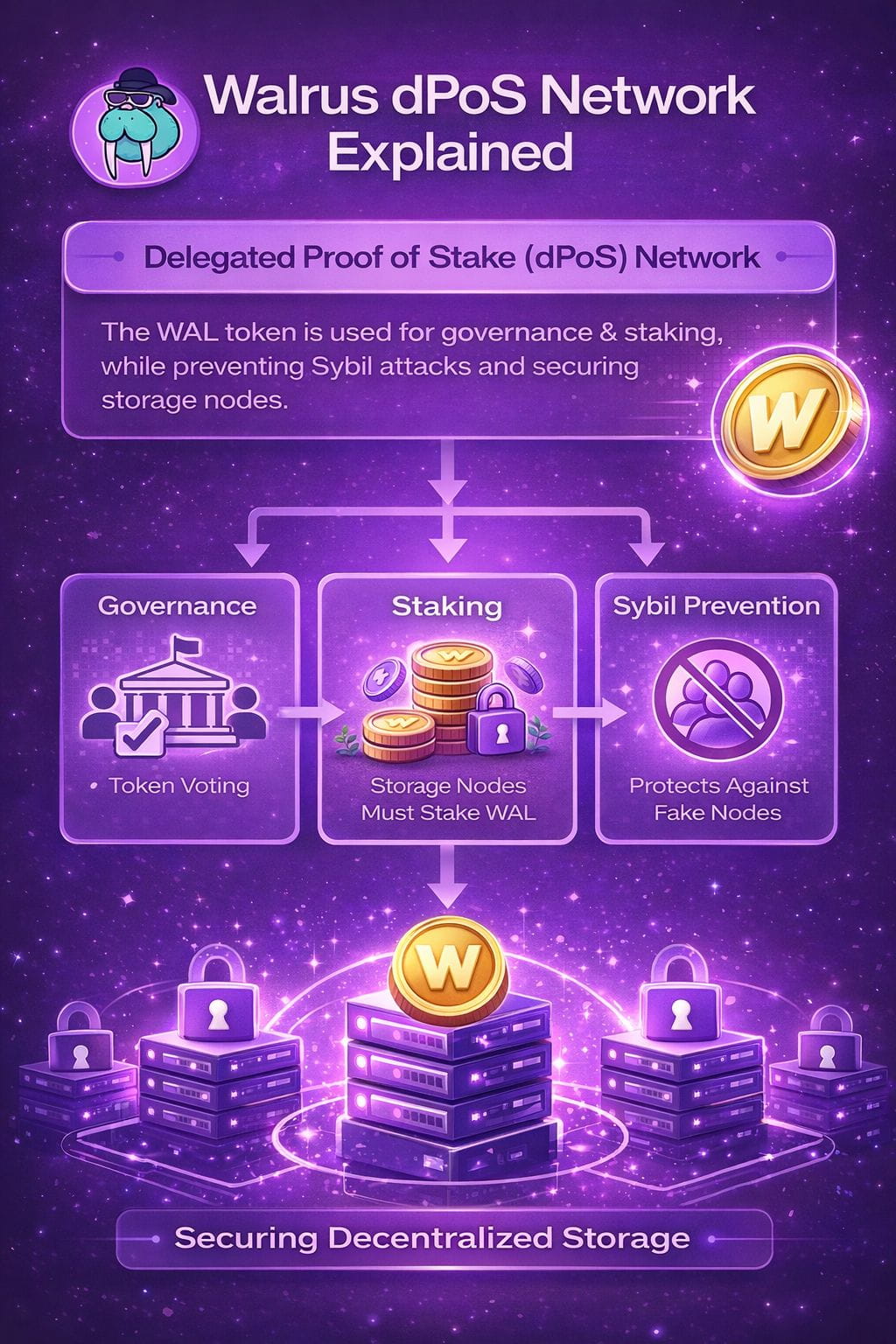
Walrus Protocol is not just another decentralized storage narrative — it is a full network design where storage reliability, governance, and economic security are tied together into a single system. And the key engine powering this system is its Delegated Proof of Stake (dPoS) network. When you understand how Walrus uses dPoS, the WAL token, and staking requirements for storage nodes, you realize Walrus is building something much deeper than “store files on-chain.” It’s building a storage infrastructure that can defend itself, coordinate itself, and scale with real incentives.
In most storage networks, the weakest point is not the technology — it’s coordination. Who decides network parameters? How does the system prevent spam nodes from taking over? What stops low-quality storage providers from joining, earning rewards, and failing when the network needs them most? This is exactly where Walrus makes a strong design choice by using a dPoS-based structure. Delegated Proof of Stake is a governance and security model where the network operation is shaped by token-backed participation. Instead of allowing anonymous participation with zero cost, Walrus introduces a strong accountability layer: if you want to participate seriously, you must have skin in the game.
The first major benefit of Walrus using dPoS is protection against Sybil behavior. In decentralized networks, a Sybil attack happens when one entity creates a large number of fake identities or nodes to influence the system. In storage ecosystems, this is extremely dangerous. Imagine a network where a single attacker spins up hundreds or thousands of nodes, pretends to offer large storage capacity, collects rewards, and then disappears or fails at the moment data retrieval is needed. This can destroy trust in the protocol overnight. Walrus prevents this by requiring staking and governance participation through the WAL token. The cost of attacking the system increases because creating multiple identities is no longer free — each meaningful identity needs stake, and stake is valuable.
This is where WAL becomes more than a token. In Walrus Protocol, WAL is not designed to exist only for trading or speculation. Its purpose is tightly connected to the network itself. WAL powers governance, which means WAL holders influence the direction of the protocol, parameter updates, and network-level decisions. But more importantly, WAL is also used for staking, making it the backbone of network security and operational quality. A storage network only survives long-term when participants have aligned incentives, and Walrus aligns incentives with WAL in a direct, enforceable way.
The staking requirement for storage nodes is one of the most important parts of Walrus’s design. Storage nodes must stake WAL to participate in the network. This single rule upgrades the entire quality standard of the ecosystem. It creates an economic filter that discourages spam participants and forces node operators to act responsibly. If a node wants to earn from the protocol, it must first commit value to the system. That commitment changes behavior. Operators become long-term focused, because their stake represents a locked interest in the protocol’s success. And it also ensures that when nodes fail, behave dishonestly, or attempt manipulation, the protocol has the ability to penalize them through slashing or stake-based punishment mechanisms (depending on network rules). The result is a system where reliability is not requested politely — it is demanded economically.
This matters massively because decentralized storage is not like most blockchain use cases. In typical transaction networks, failure might cause delays or lost opportunities. But in storage, failure can mean permanent loss of important datasets, community archives, creator media libraries, institutional content, application resources, or AI training material. If storage becomes unreliable, everything built on top collapses. Walrus’s dPoS architecture treats storage as a critical infrastructure service, and it ensures the network is protected by the same type of economic security that protects high-value blockchains.
Another reason dPoS fits Walrus is efficiency. Delegated Proof of Stake systems generally scale better than permissionless models where every participant competes equally for validation. Walrus needs to support high throughput operations, proofs, retrieval requests, and large-scale storage management. A dPoS framework can make coordination faster and more structured. It can support stable operation while still being decentralized, because the power is distributed via delegation rather than held by a single authority. WAL holders effectively become part of the steering wheel of the network by deciding which participants should have operational responsibilities.
This creates a powerful loop: WAL holders push for network health because their token represents governance influence and economic exposure. Storage nodes act honestly because their stake is at risk. The protocol remains resilient because Sybil attacks become expensive and difficult. And network evolution becomes transparent because governance decisions are tied to the token, not hidden behind private teams.
The deeper insight here is that Walrus Protocol is designing decentralized storage as a real economy. The token is not decoration. The staking requirement is not a barrier. It’s a quality control system. It ensures that when Walrus claims it can store and serve important content, it is backed by a network of operators who are financially motivated to do the job correctly. Decentralization without accountability is chaos. Walrus avoids that by making participation meaningful.
So when you read that Walrus Protocol uses a dPoS network, that it prevents Sybil behavior, and that WAL is used for governance and staking, you are not looking at simple technical details — you’re looking at the foundation of trust for the entire storage layer. This is how Walrus moves from an idea into infrastructure. It creates a network where storage nodes must earn their place, where decisions are community-driven through governance, and where the system defends itself against manipulation through economic security. That is what makes Walrus one of the most serious decentralized storage protocols being built today.

