

If you’ve been around crypto long enough, you start to see patterns. New blockchains pop up, promise the world, chase the latest trend DeFi, NFTs, gaming, whatever’s hot and then scramble to retrofit their tech when the narrative shifts again. Now it’s AI’s turn, and, honestly, a lot of these old networks are showing their age. By the end of 2023, when people started putting real AI tools on-chain, it was obvious: traditional infrastructure just doesn’t cut it for what AI needs.
AI-first infrastructure might sound like just another buzzword, but the idea’s pretty simple. AI doesn’t behave like your average app. It needs memory, constant back-and-forth, automation, and everything has to run smoothly, all the time. There’s no submit and forget it. These systems are always on. Try to force all that onto old-school chains and, well, you get headaches. Fees shoot up, things get glitchy, and storage turns into a nightmare. That’s not some academic problem developers ran headfirst into these issues all through 2024, trying to launch real, working AI agents on-chain.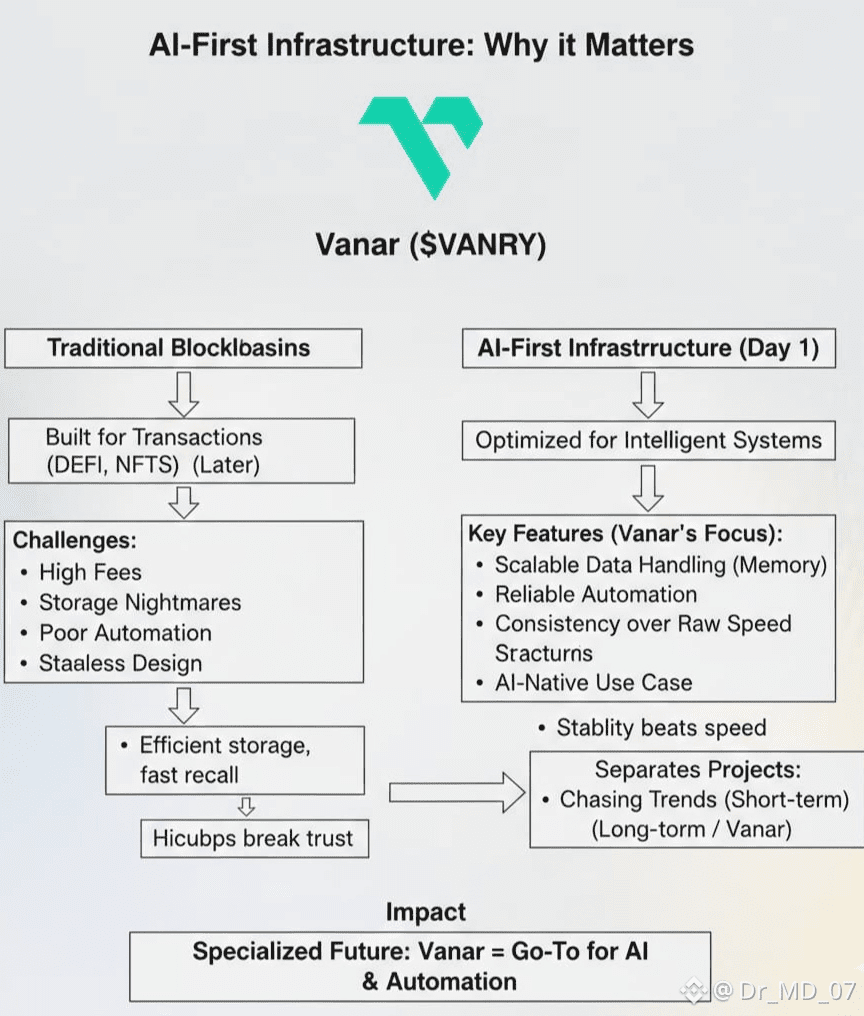
The AI-first way flips things around. You don’t build a blockchain and then bolt on AI later. You assume AI is a core user from day one, and that changes everything. Suddenly, questions like “How do we handle data?” and “Can we guarantee reliable execution?” matter a whole lot more than whatever shiny feature everyone’s hyping. If you’re trading or building, this difference is huge. It separates projects chasing short-term trends from those actually built to last.
That’s why Vanar and $VANRY stand out. It’s not about splashy marketing. What’s different here is the architecture it’s built for automation and intelligent systems from the ground up. Vanar isn’t slapping AI on as an afterthought. It’s treating AI as a native use case. And sure, maybe that sounds a little boring, but in infrastructure, boring usually means it’ll actually hold up when things get busy.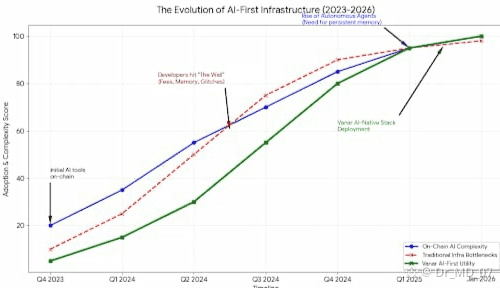
One of the toughest nuts to crack for on-chain AI is memory. AI needs to remember stuff, store it efficiently, and pull it up fast, without burning through cash. Regular blockchains just aren’t built for that they’re all about stateless transactions and pricey storage. Vanar’s all-in on scalable data handling, and that makes a difference. It’s one of those choices you only really appreciate when you try to build something ambitious and discover… hey, this actually works.
Then there’s automation. AI agents don’t just sit around and wait for the network to clear up if there’s congestion. If they’re managing assets, handling identities, or running games, any hiccup breaks trust. Developers learned this the hard way last year. Vanar puts consistency over raw speed, which shows they get it. When people actually start using these systems, stability beats flashy benchmarks every time.
Why’s everyone suddenly talking about AI-first infrastructure? It’s not just because crypto needs a new story. AI itself is moving fast. In 2024 and early 2025, we went from theory to real, working autonomous agents and live decision-making models. Teams want platforms where these systems can run openly, without some central authority pulling the strings. Blockchain’s great for that, but only if the plumbing can handle nonstop action.
Vanar hasn’t jumped at every shiny new use case. Instead, it’s doubled down on building the basics for AI-native apps. As someone who’s seen plenty of overhyped projects fall apart the minute real demand hits, I notice that kind of discipline.
AI-first doesn’t mean people get left behind. Actually, it’s the opposite. AI agents just help users optimizing, automating, making life easier but people still call the shots. Infrastructure that bakes in this balance from the start usually ages better than stuff built just for direct clicks and taps.
Honestly, don’t expect AI-first chains to kill off general-purpose blockchains overnight. What’s more likely is things get specialized. Some networks will become the go-to for automation and AI, others for finance, gaming, or social stuff. Vanar picking its lane early gives it an edge.
From a market angle, real infrastructure stories take time. They don’t always pump right away, and they’re rarely flashy. But when people actually start using them, they stick around. AI-first design isn’t about chasing hype it’s about cutting down on compromise. And in this game, that’s what separates the projects that last from the ones that fade.
