

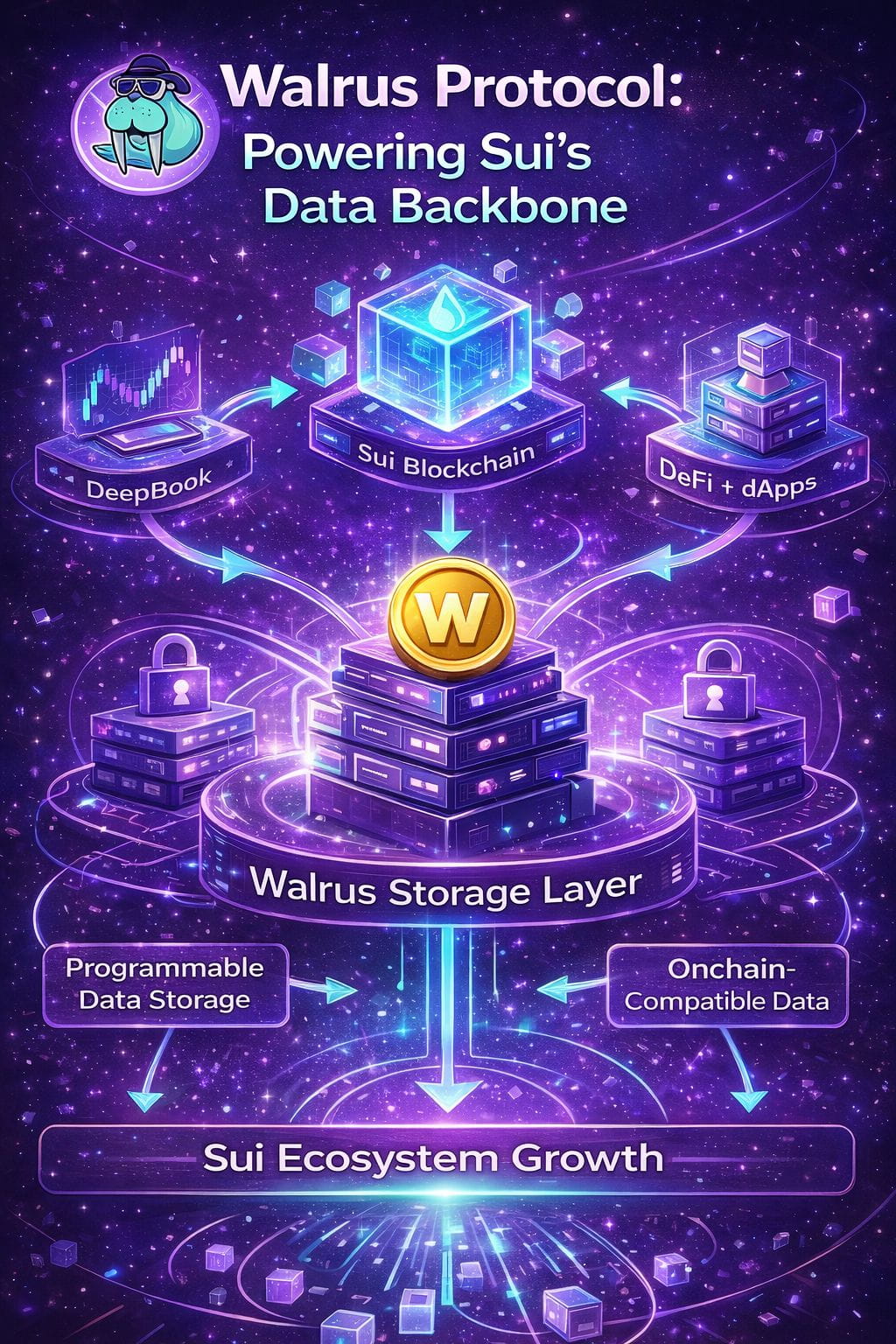
Walrus Protocol is no longer a “future narrative” inside the Sui ecosystem — it is increasingly becoming one of the most important infrastructure layers shaping what developers can actually build. While most people still define blockchain growth through token price action or short-term hype cycles, the real expansion of an ecosystem happens when core rails mature. On Sui, those rails are now becoming clearer: execution at scale, liquidity infrastructure, and a reliable data layer. Walrus sits directly in that third category, and the market is finally starting to treat it with the seriousness it deserves.
To understand why Walrus matters, we need to zoom out and see how modern Web3 is evolving. Early crypto applications could survive with simple smart contract logic and lightweight frontends. But today the standard has changed. Builders want to create fast consumer apps, games, social platforms, AI-driven tools, and large-scale DeFi products. These applications don’t run on transactions alone. They run on data: media, user content, game assets, datasets, proofs, histories, and app resources. If that data is hosted on centralized infrastructure, then the app is decentralized only in name. The weakest link becomes a server, a cloud provider, or a private database. One shutdown, one ban, one outage, or one policy change can break the entire product experience.
This is the exact problem Walrus Protocol is designed to solve. Walrus provides programmable data storage and active data management built for a decentralized environment. That phrase sounds technical, but its meaning is simple: Walrus turns data into a usable infrastructure layer for builders. It’s not only a place to “store files.” It is a system where data can be securely maintained, verified, and integrated into Web3 applications as a dependable component. In a world where content is the product, having a native storage backbone is not optional — it’s survival.
What’s making Walrus even more interesting right now is that attention is shifting from retail noise to institutional focus on ecosystem fundamentals. The launch of new investment vehicles linked to key Sui ecosystem protocols highlights a powerful trend: traditional capital is not just watching chains; it’s watching the infrastructure that makes chains useful. When institutions start creating exposure products around protocols like Walrus, it sends a message that the market is beginning to value building blocks over trends. It’s not simply about “buying a token.” It’s about recognizing which protocols act like backbone infrastructure that will be used regardless of what narratives are popular next month.
This perspective is backed by a very important framing that has been shared publicly: that Walrus, alongside the trading and liquidity layer of the ecosystem, represents a core backbone enabling fast, secure, and decentralized applications. That statement is highly revealing because it positions Walrus exactly where it should be positioned: not as an accessory, but as essential infrastructure. In every major tech cycle, the biggest long-term winners are the ones building foundational layers. In Web2, it wasn’t only social apps that won — it was the platforms that powered hosting, data, cloud distribution, and developer tooling. In Web3, the same rule applies. A protocol that becomes the default storage and data layer can quietly become one of the most valuable pillars in the ecosystem.
At the same time, Sui itself has been expanding rapidly in activity. The network was designed for high throughput and low latency, supported by parallel transaction processing. This makes Sui particularly suited for consumer-grade experiences where users expect speed and smooth UX. But as usage increases, the ecosystem’s needs also increase. When more apps launch and more users interact, the ecosystem doesn’t just need scalable execution — it needs scalable data infrastructure. That’s where Walrus becomes strategically perfect for Sui. High-performance blockchains create demand for high-performance storage. Developers building at speed need data systems that can keep up. They want to create products where content loads instantly, history is retrievable, datasets can be verified, and application resources remain accessible without relying on centralized servers. Walrus is the piece that connects the onchain execution world with the offchain content world, without breaking decentralization.
Walrus also becomes even more relevant as DeFi grows. Rising activity in decentralized finance often leads to an explosion of analytics, dashboards, trading histories, strategy data, and application integrations. As the ecosystem becomes more active, the “data surface area” grows massively. Every protocol generates metrics and user data flows. Every application needs reliable storage for important resources. In that environment, a storage protocol that offers programmable data becomes a major advantage because it can serve as a standardized layer for content and data management across many apps.
Another key point is how Walrus changes the nature of stored content. Storage in Web3 cannot be treated like simple file hosting. The next generation of applications wants data to be verifiable, reusable, and compatible with onchain logic. Walrus supports this shift by enabling stored content to become part of the decentralized application stack. When data becomes usable as a component of the onchain experience, it unlocks new product design possibilities. Creators can store content with higher permanence. Games can host assets in a decentralized way. Communities can archive media without depending on a company. AI builders can store datasets and reference them transparently. This is not just “better storage.” It’s an entirely new way of building.
In many ways, Walrus represents the quiet evolution of what decentralized systems are supposed to be. Web3 has always promised ownership, permanence, and censorship resistance, but those promises don’t hold if key application data remains centralized. Walrus makes decentralization more complete by bringing storage and active data management into the same trust-minimized environment as smart contract execution. And when bigger market participants begin to recognize that value, it’s a strong indicator that we’re entering a phase where infrastructure projects get rewarded for real utility.
Walrus Protocol is not winning attention by being the loudest. It’s winning by being necessary. As Sui grows into a high-performance application chain, its infrastructure stack must mature around it. Liquidity infrastructure matters. Execution performance matters. But the data layer is what turns decentralized apps into real apps. Walrus is positioning itself as that layer. If this trajectory continues, Walrus won’t just be “a protocol in the ecosystem.” It will become part of the ecosystem’s identity — the storage backbone that helps developers build faster, safer, and more decentralized products for the next wave of users.

