

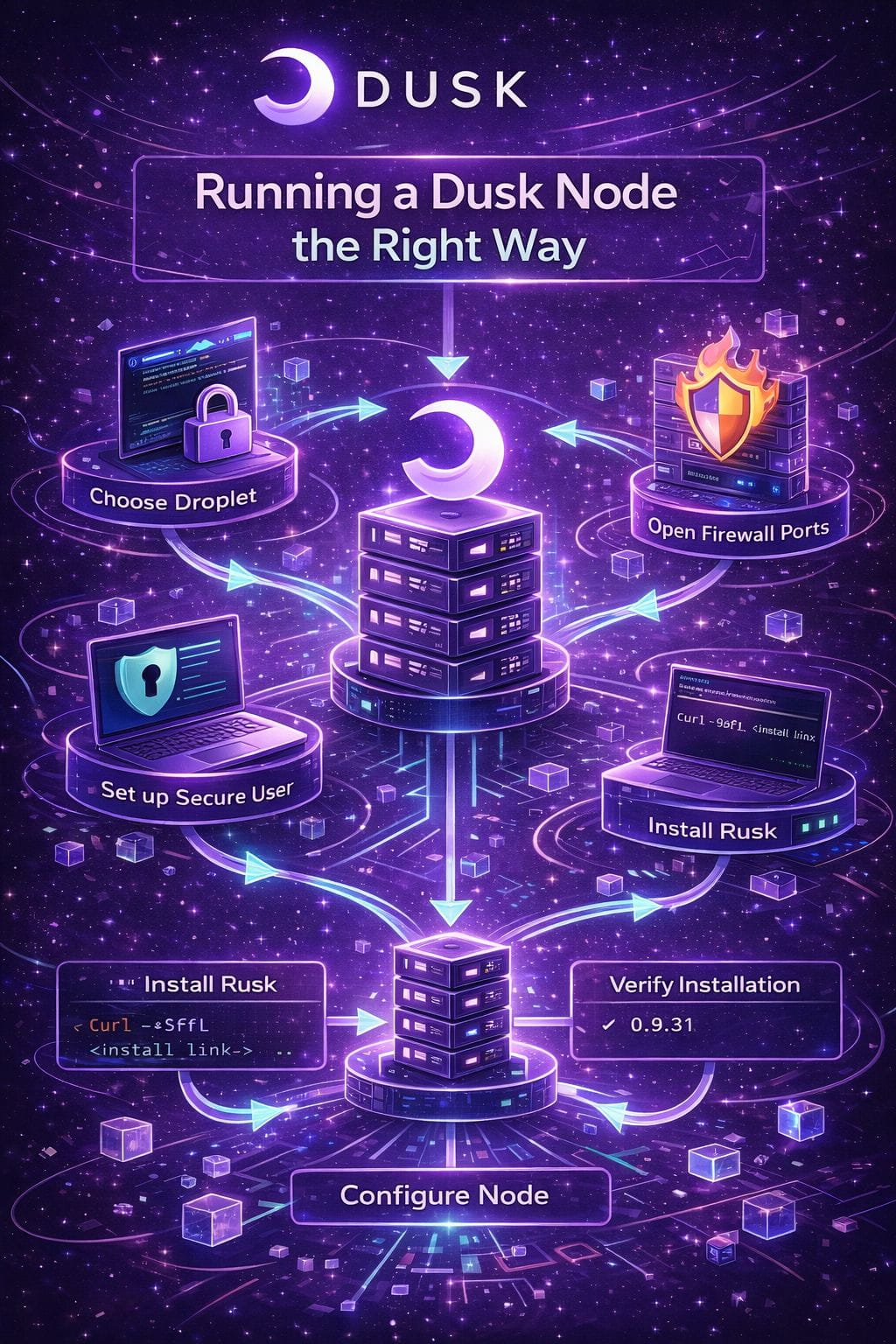
Dusk is building more than a blockchain — it’s building a full privacy-first infrastructure where real utility meets real decentralization. But what makes Dusk truly powerful is not only the technology it ships, it’s the way the network is designed to be operated by the community through node participation. When you look at how a Dusk node is deployed in a real environment, you realize this is not a “click and stake” chain. This is a serious network that expects serious infrastructure, and that is exactly why its ecosystem is maturing in a strong direction.
The first step in entering that world starts with understanding the environment where nodes actually run. For most operators, that means using a cloud virtual machine with stable uptime, predictable network performance, and enough compute to keep the node responsive. A properly sized server is important because consensus networks don’t forgive lag. If your node is too weak, it might sync slowly, miss messages, or fail under load. Dusk node requirements are designed to be realistic, so you don’t need a supercomputer, but you do need a setup that can run consistently 24/7. Choosing the right CPU and memory profile matters because it becomes the foundation of your network reliability. This is also where many people learn their first lesson: node operation is infrastructure work. Reliability is the product.
Once the server is created, secure access becomes the next priority. A lot of new node runners make the mistake of treating access like a simple password login, but in real infrastructure security, SSH keys are the gold standard. They reduce the risk of brute force attacks, password leaks, and unauthorized login attempts. Even if a platform allows password-based access, using SSH keys gives you a stronger long-term posture. Dusk node operation is not only about getting the node running today; it’s about making sure the node remains safe and controlled for months.
That security mindset continues with one of the most overlooked best practices: using a non-root user. Running everything as root may feel easier, but it increases risk massively. A dedicated user account helps isolate privileges, making it harder for mistakes or malicious commands to damage the whole server. The smart setup is to create a proper group and user, assign permissions carefully, and then enable secure login for that account. After that, the user is granted sudo access so you can manage the system without operating in the most dangerous mode by default. This may sound like extra steps, but these steps separate casual setups from professional-grade node operations.
After access control, the next most critical layer is the firewall. A blockchain node is not just software running silently — it’s a network participant that communicates constantly with other nodes. That communication requires specific ports. If you leave ports open randomly, you expose yourself to unnecessary risk. If you close the wrong ports, your node becomes isolated and useless. A strong firewall setup is not about blocking everything; it’s about allowing exactly what the protocol needs and nothing more. Remote access should be limited and protected, while consensus messaging requires the correct UDP rules. In some cases, optional services might require additional TCP ports, especially if you plan to support extra network functions. This is where Dusk node operation becomes very real: security and connectivity are always a balance, and you need to configure it correctly.
This is also why the idea of layered security matters. Even when your cloud provider supports firewall rules, relying on only one layer is not ideal. Configuring system-level firewall rules adds a second lock to the door. With basic rule sets, you can rate-limit remote login attempts, allow only required protocol traffic, and reduce the attack surface of the server dramatically. Dusk node runners who take this seriously don’t just run nodes — they operate infrastructure that looks like what you’d expect in real production systems.
Once the server is secured and communication is prepared, installation becomes the main milestone. Dusk makes this easier through a guided installer approach that sets up the node software as a proper service, including preconfiguration and helper scripts. That matters a lot because the difference between “a node running in a terminal window” and “a node running as a managed service” is the difference between hobby and reliability. A managed service can auto-restart, can be monitored more easily, and fits into proper operational workflows. This is how modern node networks maintain stability.
After installation, the verification step is key. Many people skip verification and assume everything is fine because “it installed.” But Dusk node installation should always be confirmed by checking the installed version and ensuring the expected tools respond correctly. This step avoids silent failures, mismatched versions, and half-complete setups that later cause problems during updates or consensus participation. The habit of verifying is what turns a node runner into a node operator.
Then comes configuration, the stage where you shift from setup mode to participation mode. At this point, the focus moves to wallet preparation and network readiness, because the node is not just a server; it’s part of consensus. That means the system you built is now stepping into a live environment where uptime, performance, and communication decide whether it contributes value or becomes dead weight. A clean setup is not enough if the node is not properly configured to operate in the network context.
What’s important here is the bigger message: Dusk is not building a network for shortcuts. It’s building an ecosystem where infrastructure and privacy-first tech require strong operators. Every step — choosing correct server resources, using secure authentication, creating dedicated users, configuring firewalls, installing as a managed service, verifying versions, and preparing configuration — is part of a serious operational pipeline. And this pipeline is exactly what creates decentralization that actually lasts.
This is why Dusk stands out. Many chains focus only on user hype, but Dusk focuses on building a real network with real infrastructure standards. When community members run nodes properly, the network becomes stronger, more distributed, and more resilient. And when that happens, Dusk’s privacy-first mission becomes achievable at scale because the foundation is not centralized providers or fragile servers — it’s a network of reliable operators who understand that infrastructure is the true backbone of decentralization.
In the end, running a Dusk node is more than an installation guide. It’s a mindset shift. You’re not just “joining a project.” You’re powering a living system. And for anyone serious about being part of the future of privacy-first blockchain infrastructure, this is exactly the kind of network worth building with.
